Is the Turing Test a Fair Test of Machine Intelligence?
If you ask someone outside of AI to name one test for artificial intelligence, chances are they’ll mention the Turing test.
That says a lot.
Most people have never heard of model architectures, benchmark datasets, or evaluation frameworks—but they’ve heard of the Turing Test.
For more than 70 years, it has shaped how people think about machine intelligence.
But there’s a problem.
The more capable AI becomes, the more people start asking a different question:
Is the Turing test a fair test of machine intelligence?
That question matters because the Turing Test is often treated as a finish line for artificial intelligence when it was never designed to be one.
Today, researchers still debate whether passing the Turing Test demonstrates intelligence—or simply demonstrates the ability to appear intelligent.
Let’s unpack why.
What Is the Turing Test?
The Turing test was introduced in 1950 by mathematician and computer scientist Alan Turing in his paper Computing Machinery and Intelligence.
Turing avoided asking:
“Can machines think?”
Instead, he proposed a practical experiment.
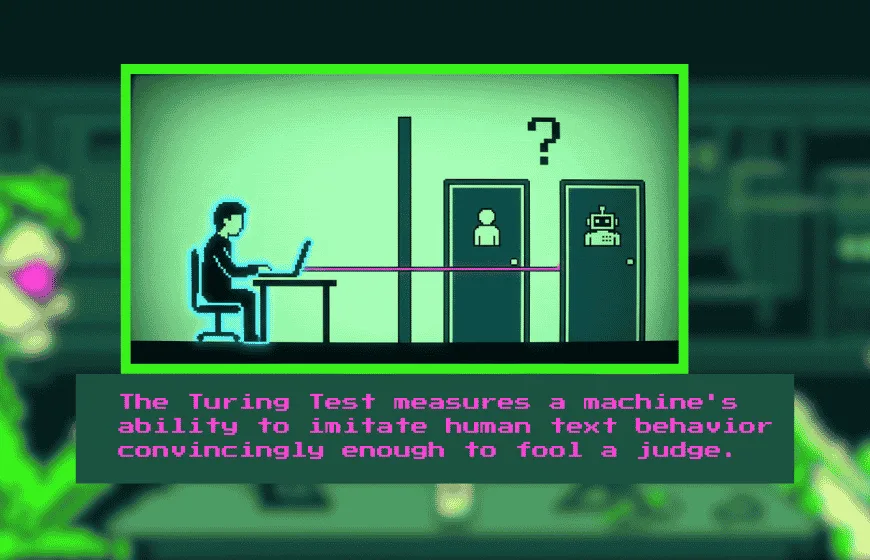
A human evaluator communicates through text with two hidden participants:
- one human
- one machine
If the evaluator cannot reliably identify which participant is the machine, the machine passes.
That setup became known as the Turing Test.
Notice what the test measures.
It does not evaluate:
- consciousness
- understanding
- emotion
- reasoning processes
It evaluates whether human behavior can be imitated convincingly.
That difference sits at the center of almost every criticism.
The Historical Context: Why the Turing Test Was Created
To understand whether the Turing Test is fair, you first need to understand why Turing proposed it.
In the 1950s, computers were still new.
Many people believed machines could never become intelligent.
Arguments sounded familiar:
- Machines only follow rules
- Machines cannot create
- Machines cannot think
Turing’s response was clever.
Instead of trying to define thinking, he shifted attention to observable outcomes.
If a machine behaves intelligently, maybe debating invisible mental processes is unnecessary.
This was less of a scientific measurement and more of a philosophical challenge.
That historical context often gets lost.
Turing was exploring ideas—not creating the final authority on intelligence.
Why the Turing Test Feels Fair at First
There is a reason the Turing Test became famous.
At first glance, it seems reasonable.
How do humans judge intelligence in other people?
Mostly through interaction.
You cannot directly observe someone else’s thoughts.
You assume intelligence based on:
- conversation
- decisions
- explanations
- emotional responses
The Turing Test simply extends that logic.
If we already judge people through behavior, why not machines?
This argument gives the Turing Test lasting appeal.
But it also creates problems.
The Biggest Limitation of the Turing Test: It Measures Performance, Not Understanding
One of the major limitations of the Turing test is that appearing intelligent is not necessarily the same thing as being intelligent.
Imagine someone memorizes thousands of conversation patterns.
They answer naturally.
They sound informed.
But internally, they do not understand anything they are saying.
Would you call that intelligence?
That question appears constantly in debates about human vs. machine intelligence.
Machines may produce outputs that look intelligent while operating through prediction and statistical relationships.
The Turing Test cannot distinguish between:
- genuine understanding
- convincing simulation
That gap becomes more visible as AI improves.
Human vs. Machine Intelligence: Are We Comparing the Right Things?
Another criticism is that the test assumes machine intelligence should resemble human intelligence.
But should it?
Human intelligence includes:
- memory
- emotion
- sensory experience
- intuition
- physical interaction
Machines may develop strengths humans do not have.
For example:
- calculating millions of possibilities instantly
- processing enormous datasets
- recognizing patterns at scale
If AI develops differently from humans, measuring success through human imitation may become unfair.
This raises a bigger question.
Should artificial intelligence be judged by how human it appears—or by what it can accomplish?
Real-World Examples: Have Machines Passed the Turing Test?
Several systems have claimed partial success.
Most relied heavily on conversation design rather than broad intelligence.
Some strategies included:
- pretending to be non-native speakers
- acting younger
- using humor
- redirecting difficult questions
These approaches revealed something interesting.
Human judges often fill in missing understanding.
If a response sounds believable, people sometimes assume deeper intelligence exists.
Modern conversational systems push this even further.
They maintain context better.
They generate more coherent language.
They adapt to user expectations.
But researchers still debate whether this represents understanding or increasingly sophisticated imitation.
The Philosophical Implications of the Turing Test
The philosophical implications of the Turing test may be more important than the test itself.
The debate goes beyond engineering.
It touches questions like:
- What counts as intelligence?
- Is consciousness necessary?
- Can understanding exist without experience?
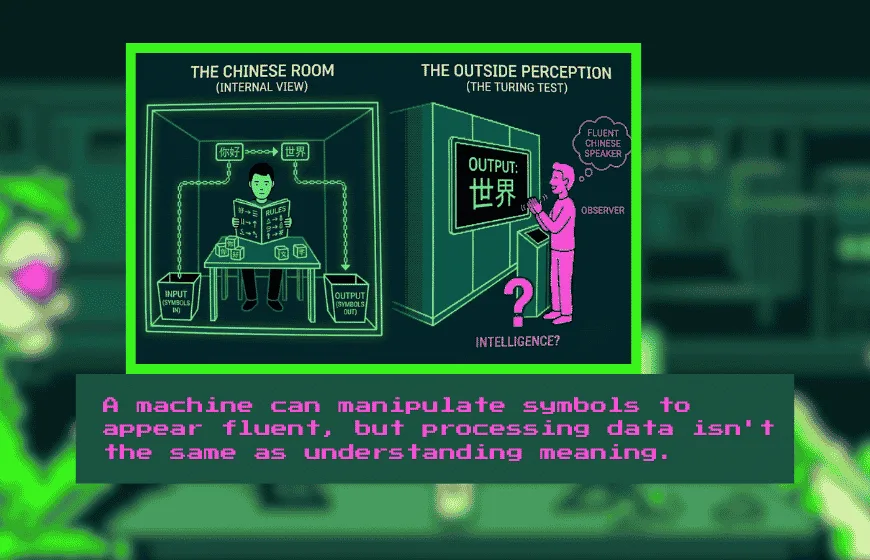
One famous objection comes from the Chinese Room argument.
The idea is simple.
Someone follows instructions to manipulate symbols in a language they do not understand.
From outside the room, they appear fluent.
Internally, there is no understanding.
Critics argue machines may work similarly.
They process symbols but do not necessarily comprehend meaning.
If that argument is correct, passing the Turing Test becomes weaker evidence of machine intelligence.
Evaluation of AI Beyond the Turing Test
Because of these criticisms, AI researchers now use broader approaches for the evaluation of AI.
The Turing Test still matters historically.
But modern systems are measured in more detailed ways.
Examples include:
Benchmark Testing
Measures performance across tasks.
Reasoning Evaluations
Tests logical consistency.
Multimodal Assessment
Combines language, images, and perception.
Real-World Performance
Measures whether systems solve practical problems.
Researchers increasingly treat intelligence as multidimensional.
Conversation is only one part.
Alternative AI Benchmarks and Evaluations
Several alternatives try to improve on the Turing Test.
The Lovelace Test
Focuses on creativity.
Can a machine create something unexpected?
The Total Turing Test
Adds physical interaction and perception.
The Coffee Test
Can a robot enter a home and make coffee successfully?
That requires:
- reasoning
- planning
- adaptability
- environmental understanding
These AI benchmarks and evaluations attempt to measure more than conversation.
Ethical Questions Around Measuring Intelligence
Evaluation methods influence development.
If developers optimize only for passing conversational tests, unintended consequences appear.
Potential concerns include:
- deceptive AI behavior
- emotional manipulation
- unrealistic expectations
- overconfidence in machine capability
This creates an ethical challenge.
A machine that appears human may be trusted more than it deserves.
That risk becomes more relevant as conversational systems improve.
The Future of Machine Intelligence Testing
So where does evaluation go from here?
Most likely toward combinations of:
- language ability
- reasoning
- memory
- perception
- creativity
- real-world adaptability
Future systems may not need to pass as human.
They may simply need to demonstrate competence.
That would represent a major shift away from imitation.
The future of AI evaluation may become less about:
“Can machines act like humans?”
and more about:
“What kinds of intelligence are possible?”
Is the Turing Test a Fair Test of Machine Intelligence?
So, is the Turing test a fair test of machine intelligence?
The answer depends on what you expect it to measure.
If the goal is evaluating whether machines can imitate human conversation, it remains useful.
If the goal is measuring understanding, consciousness, or true intelligence, it becomes much less convincing.
That doesn’t mean the Turing Test failed.
Its biggest achievement may simply be that it forced people to think more carefully about intelligence itself.
And decades later, we’re still arguing about the same question—which may be proof that Turing asked the right one.
FAQ
What is the primary purpose of the Turing Test?
The Turing Test is designed to evaluate a machine's ability to exhibit intelligent behavior equivalent to, or indistinguishable from, that of a human through text-based conversation.
Why do critics say the Turing Test is unfair?
Critics argue it measures performance and imitation rather than actual understanding, consciousness, or genuine intelligence, allowing machines to "trick" judges without knowing what they are saying.
Does passing the Turing Test mean a machine is conscious?
No, passing the test only proves the machine can successfully mimic human conversation patterns; it does not provide evidence of inner experience or consciousness.
What is the Chinese Room argument?
It is a thought experiment showing that a person (or machine) can manipulate symbols to produce correct answers in a language they do not actually understand, proving that syntactic processing is not the same as semantic comprehension.
How do researchers test AI intelligence today?
Researchers now use a combination of methods, including benchmark testing for reasoning, multimodal assessments, and real-world performance tasks, rather than relying solely on conversation.
What is the "Coffee Test" in AI evaluation?
The Coffee Test proposes that a robot must be able to enter an unfamiliar home and successfully make a cup of coffee, which requires complex physical reasoning, planning, and environmental adaptation.
Is the Turing Test still useful?
It remains a valuable historical and philosophical tool that forces us to define what we mean by intelligence, even if it is no longer the definitive standard for assessing modern AI capabilities.