Who Is Alan Turing? The Man Behind the Turing Test
It's hard to imagine a single person shaping so many things we now take for granted. Computers. Artificial intelligence. Codebreaking. Even the way we talk about intelligence itself.
Yet Alan Turing did exactly that—often quietly, often ahead of his time, and often without recognition while he was alive. Asking who is Alan Turing isn't just a history question. It's a way of understanding how modern technology, and modern thinking, came to be.
Who Is Alan Turing, and Why Is He So Important?
At the most basic level, Alan Turing was a British mathematician, logician, and computer scientist. But that description undersells his impact.
Turing helped define what a machine is capable of doing. Before computers existed in any practical sense, he laid out the mathematical rules that made them possible. Much of modern computer science still rests on those ideas.
So if you use a computer today, you're using something built on Turing's thinking.
The Turing Machine: A Simple Idea That Changed Everything
In 1936, Turing published a paper that introduced what's now called the Turing machine. Despite the name, it wasn't a physical machine.
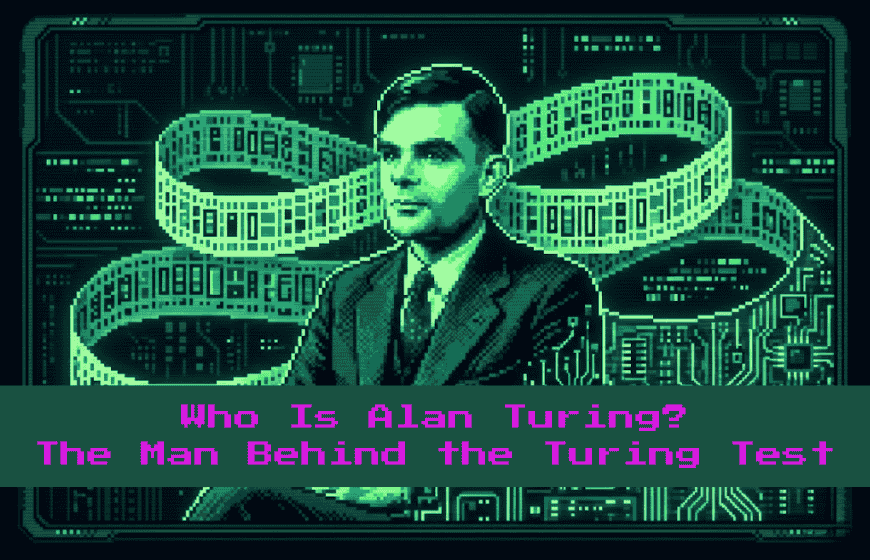
It was a thought experiment: an imaginary device that reads and writes symbols on an endless tape, following a fixed set of rules. Shockingly simple—and incredibly powerful.
This idea showed that any problem that can be solved by a clear procedure (what we now call an algorithm) could be solved by such a machine. That insight became the foundation of modern computers.
Turing didn't build the first computer—he proved what computers could be.
Alan Turing and World War II Codebreaking
When World War II began, Turing's abstract ideas became urgently practical.
At Bletchley Park, he worked on breaking codes produced by German Enigma machines. These machines encrypted military messages that were meant to be unbreakable.
Turing helped design electromechanical machines that dramatically sped up the decoding process. This work is widely credited with shortening the war by years and saving millions of lives.
For decades, this contribution was secret. The public had no idea how much his work mattered.
Turing's ideas didn't just change science—they changed history.
The Turing Test and the Question of Machine Intelligence
After the war, Turing turned to a question that still feels radical today: Can machines think?
Rather than arguing definitions, he proposed a practical test. If a machine could hold a conversation well enough that a human couldn't reliably tell it apart from another human, it should be considered intelligent.
This became known as the Turing test. It remains one of the most famous ideas in artificial intelligence, even as people debate its limits.
Turing reframed intelligence as behavior, not inner experience—and that shift still shapes AI today. Modern language models like GPT-4 are now being tested against this standard.
His Personal Life and Tragic Treatment
Despite his brilliance, Turing's life ended painfully.
In 1952, he was prosecuted for being gay, which was illegal in the UK at the time. He was convicted and subjected to chemical castration as punishment.
Two years later, in June 1954, Alan Turing died at the age of 41. His death is widely believed to have been suicide.
Only decades later did the British government formally apologize and grant him a posthumous pardon.
Society punished Turing for who he was, even as it benefited enormously from what he gave.
Why Alan Turing Still Matters Today
So, who is Alan Turing in the modern world?
He's a foundational figure behind computer science, artificial intelligence, cryptography, and even cognitive science. His ideas still guide how engineers, researchers, and philosophers think about machines and minds.
More quietly, his story has also become a symbol—of lost potential, of injustice, and of how progress can coexist with cruelty.
Turing's legacy is both technological and human.
So, who is Alan Turing?
He was a mathematician who imagined computers before they existed, a codebreaker who helped win a world war, and a thinker who dared to ask what intelligence really means. He was also a man treated unfairly by his own society.
Every time we talk about algorithms, machines, or artificial intelligence, we're still living inside questions Turing asked nearly a century ago. That's not just influence. That's permanence.
Want to test your own ability to tell humans from AI? Try Human or Not—a modern take on Turing's original experiment.
FAQs
Who was Alan Turing best known for?
He's best known for founding computer science, breaking Enigma codes in WWII, and proposing the Turing test.
Did Alan Turing invent the computer?
Not directly. He defined the theoretical model that made modern computers possible.
What is the Turing test?
It's a test of machine intelligence based on whether a machine can convincingly imitate human conversation.
Why was Alan Turing prosecuted?
He was convicted for being gay, which was illegal in the UK at the time.
How did Alan Turing die?
He died in June 1954 at age 41, widely believed to be by suicide.
Why is Alan Turing still important today?
His ideas underpin modern computers, algorithms, and artificial intelligence research.