Is the Turing Test Still Relevant Today in the Age of AI?
Many people still ask: Is the Turing Test still relevant in the age of modern AI? With large language models producing fluent and confident answers, it can seem like the debate ended years ago. If chatbots can hold conversations that feel natural, hasn’t the test already been passed?
Not exactly.
The Turing Test still matters because it highlights a core misunderstanding: fluent language is not the same as genuine understanding. Even today, conversation exposes limits that benchmarks and demos often hide.
Quick Insights
- The Turing Test originated in Alan Turing’s 1950 paper Computing Machinery and Intelligence.
- It evaluates natural conversation, not consciousness or full AGI.
- Modern large language models show fluency but still struggle with long, complex dialogue.
- The Human or Not game mirrors the imitation game in a modern setting.
- The test remains relevant because human-like conversation remains central to real-world AI use.
The Historical Foundation: Alan Turing and the Imitation Game
In 1950, British mathematician Alan Turing published a paper titled Computing Machinery and Intelligence. Instead of debating whether machines could “think,” he proposed a practical experiment known as the Imitation Game.
In this setup, a human judge communicates through text with two unseen participants — one human and one machine. If the judge cannot reliably tell which is which after a reasonable conversation, the machine succeeds.
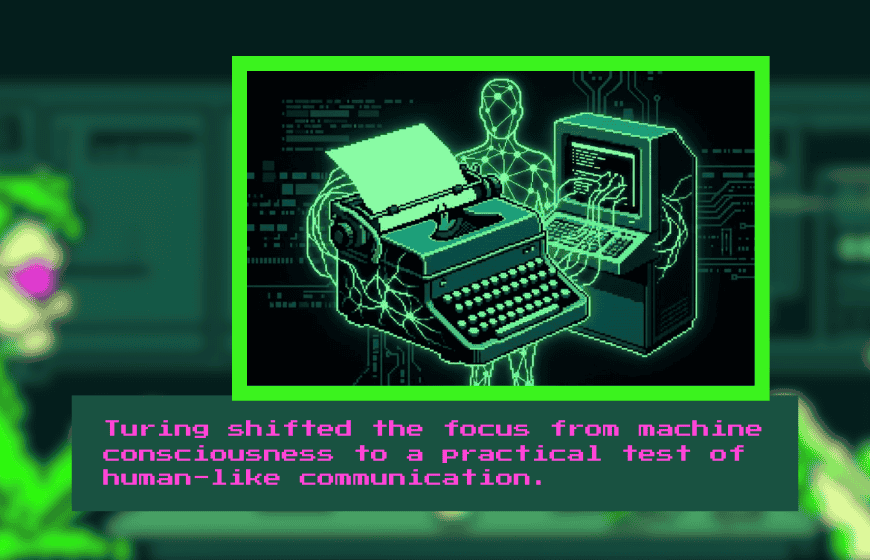
Turing avoided defining consciousness. He avoided abstract philosophy. Instead, he reframed the question: Can a machine communicate in a way that people naturally accept as human-like?
That shift remains powerful today.
The Real Misunderstanding About the Turing Test
Many critics argue that the test was only about “fooling humans.” That interpretation oversimplifies the idea.
The Turing Test was never designed to prove Artificial General Intelligence (AGI). It was meant to evaluate natural language interaction. It explores how well a system handles ambiguity, context, tone shifts, humor, and everyday reasoning.
Modern chatbots often perform well in short exchanges. However, extended dialogue still reveals weaknesses. Memory drifts. Tone becomes inconsistent. Contradictions appear.
This is exactly where the imitation game remains relevant.
Has AI Passed the Turing Test?
You may have seen headlines claiming that AI has passed the Turing Test. These claims usually refer to short, controlled demonstrations.
But passing a brief interaction is not the same as sustaining deep, unpredictable conversation.
Large language models are trained using machine learning techniques to predict likely next words. This produces fluency. However, fluency can mask gaps in reasoning or long-term coherence.
When conversations stretch over time or become emotionally complex, cracks often show. That is why the answer to “Has AI passed the Turing Test?” remains nuanced.
The Human or Not Game: A Modern Version of the Imitation Game
If you have played the Human or Not game, you have experienced a modern version of Turing’s experiment.
In the game, you chat with an unknown participant and decide whether they are human or AI. The challenge revolves around subtle conversational signals — tone, hesitation, emotional shifts, and contextual awareness.
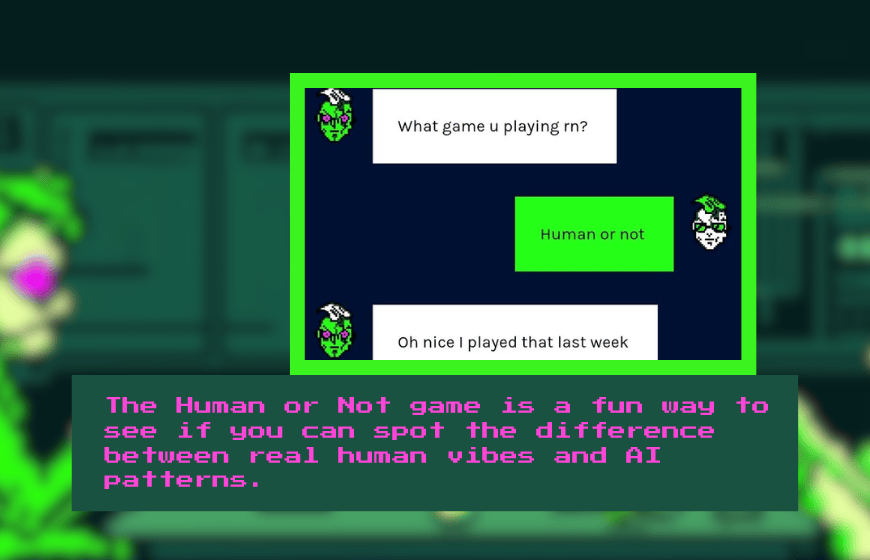
Even advanced conversational AI can appear convincing at first. But small inconsistencies often expose it.
The Human or Not game demonstrates that conversation is not just about correct answers. It is about rhythm, memory, personality, and emotional alignment. These remain difficult for machines to maintain consistently.
Why the Turing Test Is More Relevant in the Age of Large Language Models
Modern AI systems can write essays, generate code, summarize research, and simulate dialogue. Their speed and confidence create the illusion of deep comprehension.
However, the Turing framework reveals a key distinction: human-like output is not the same as human-like understanding.
As conversational AI becomes central to customer support, education, AI companions, and creative tools, consistency becomes critical. Users expect stable identity, empathy, and contextual awareness.
When a system contradicts itself or loses track of earlier context, trust weakens. The Turing Test helps expose those weaknesses.
Rather than being outdated, it has become more relevant because conversational AI now operates at scale.
The Turing Test as a Conversation Stress Test
Think of the Turing Test as a stress test rather than a final exam.
Short exchanges are easy. Real conversations are messy. People change topics. They introduce emotion. They refer back to earlier statements. They use sarcasm and subtle cues.
A conversation-based evaluation exposes whether a system can adapt naturally under pressure. Even today, long-form dialogue often reveals the limits of current AI systems.
New conversational benchmarks and evaluation methods complement this idea. They do not replace it. They extend it.
Why “Is the Turing Test Outdated?” Is the Wrong Question
Some argue that modern AI should be evaluated using reasoning benchmarks, planning tasks, or logic tests. These tools are useful.
But the Turing Test measures something different: natural human interaction.
Conversation remains central to how humans collaborate, teach, negotiate, and build trust. If an AI cannot sustain coherent dialogue, its usefulness declines.
The question is not whether the test measures every dimension of intelligence. It does not.
The real question is whether natural conversation still matters.
It does.
How the Turing Test Helps Beginners Understand AI
For newcomers, complex evaluation frameworks can feel overwhelming. In contrast, the imitation game is intuitive. Anyone can observe a conversation and ask whether the responses feel human.
You do not need to understand neural networks or probability theory. You only need to notice consistency, tone, and context.
This simplicity makes the Turing Test a powerful educational bridge between technical AI research and everyday experience.
The question “Is the Turing Test still relevant?” appears more often as AI becomes more fluent.
But fluency increases the need for evaluation, not the opposite.
Alan Turing’s 1950 proposal remains valuable because it focuses on communication under real conversational conditions. It reminds us that intelligence is not just access to information. It is the ability to use that information naturally, coherently, and consistently over time.
As conversational AI continues to evolve, the imitation game remains one of the clearest ways to see both its progress and its limits.
FAQs
What is the Turing Test in simple terms?
The Turing Test is an experiment where a human judge talks to both a machine and a person and tries to decide which is human based only on conversation.
Is the Turing Test still relevant today?
Yes. It remains useful for evaluating conversational AI and identifying differences between fluent language generation and deeper understanding.
Has modern AI passed the Turing Test?
Some AI systems perform well in short conversations, but extended dialogue often reveals limitations in context, memory, and consistency.
Is the Turing Test the same as the Human or Not game?
They are conceptually similar. The Human or Not game recreates the imitation game format in a modern online setting.
Does passing the Turing Test prove intelligence?
No. Passing it suggests strong conversational performance but does not prove reasoning depth, awareness, or general intelligence.
What are the limits of the Turing Test?
It focuses on dialogue quality and does not directly measure planning, long-term reasoning, or non-linguistic intelligence.