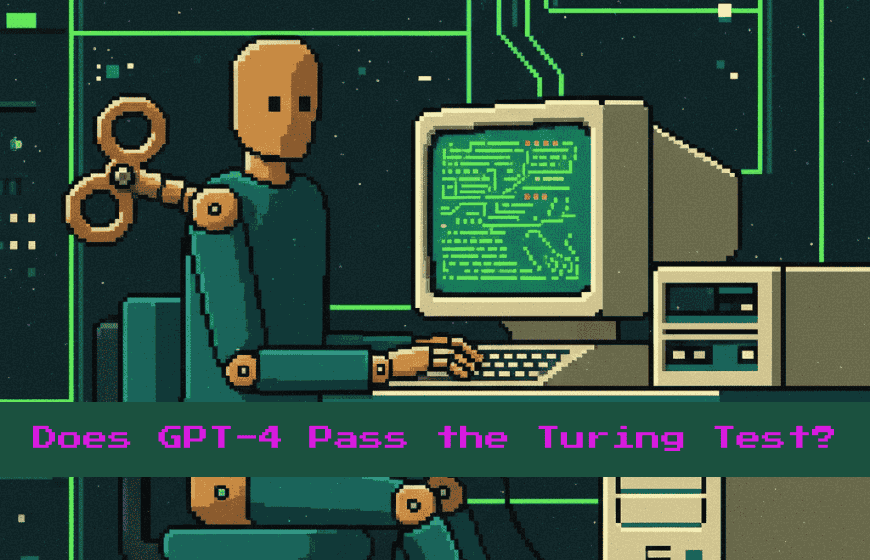
Does GPT-4 Pass the Turing Test?
There's a lot of confidence around this idea: "I'd always know if I was talking to a bot." It feels reassuring, like there's still an invisible line between human and machine that's easy to spot. Text is fast, instincts kick in, and most people assume the difference would be obvious.
But that confidence starts to wobble once the data enters the picture.
The question does GPT-4 pass the Turing test isn't theoretical anymore. It's been tested in real conversations, with real people, under real constraints—and the results suggest that separating human from machine is harder than most expect.
Does GPT-4 pass the Turing test in the way Alan Turing imagined?
To even talk about whether GPT-4 passes the Turing test, we need to rewind to the original idea. Back in 1950, Alan Turing proposed what he called the imitation game. If a computer could convincingly pretend to be human in conversation, often enough, we'd stop arguing about whether machines can "think."
Turing even gave a rough benchmark: if a machine could fool a human interrogator about 30% of the time in a short chat, that would count as shown progress.
By that standard alone, GPT-4 clears the bar. Comfortably.
But that's not the whole story, because we don't live in 1950 anymore—and our expectations of intelligence, language, and deception have changed.
How researchers actually tested GPT-4 against humans
So how do you fairly answer the question does GPT-4 pass the Turing test today? You run the test at scale.
Researchers at the University of San Diego set up a massive online experiment. Thousands of participants acted as interrogators, chatting for five minutes with a single partner. That partner was either a human or an AI system.
No voice. No video. Just text. Pure language.
After the conversation, the interrogator had to decide: Was I talking to a human or a machine?
Simple setup. Brutal outcome.
The result everyone focuses on (and why it's misleading)
Here's the headline number people love to quote: one GPT-4 configuration convinced interrogators it was human 49.7% of the time.
That's where the "GPT-4 passes the Turing test" claim comes from. And yes—by Turing's original 30% prediction, that's a pass.
But context matters.
Real humans in the same experiment were only identified as human about 66% of the time. Which means people misjudge other humans one-third of the time already. Awkward, but important.
So GPT-4 isn't outperforming humans. It's slipping into the same fog of uncertainty that already exists in text-only conversation.
Why GPT-4 fools people: it's not about intelligence
This part surprised me the most. People weren't fooled because GPT-4 showed deep reasoning or rare knowledge. In fact, those traits often made it more suspicious.
What worked was style.
The most successful GPT-4 setup used a casual persona—short replies, slang, lowercase text, occasional grammar mistakes. It felt like texting a distracted, slightly sarcastic person. Which, if we're honest, describes half the people we message daily.
Perfection is a red flag. Awkward humanity is convincing.
That says less about large language models and more about how we subconsciously define "being human" online.
Does GPT-4 pass the Turing test—or just pass as human?
This is where the question shifts. Does GPT-4 pass the Turing test, or does it simply exploit the test's weaknesses?
An old chatbot called ELIZA—built in the 1960s—actually fooled people more often than a weaker modern LLM in some cases. Not because it was smarter, but because it was vague, evasive, and emotionally reflective.
That's the uncomfortable truth: the Turing test often rewards surface-level imitation, not understanding.
GPT-4 is excellent at reading the room linguistically. It mirrors tone, hedges uncertainty, and avoids sounding "too correct." That's not human thinking—but it is human passing.
Why humans are getting worse at spotting AI
Another fascinating finding: interrogators who knew more about LLMs were better at identifying GPT-4. Experience mattered. Practice mattered.
Everyone else? Not so much.
As AI systems blend into everyday tools—customer support, social media, dating apps—we lose the habit of skepticism. Text already strips away facial cues, timing nuances, and body language. Add a model trained on billions of human conversations, and the line gets very thin.
The question stops being "Can AI pretend to be human?" and becomes "Are humans good judges of humanity in text?"
What this means beyond the Turing test
So, does GPT-4 pass the Turing test? Technically, yes—depending on the definition you use. Practically, it passes often enough to matter.
That has consequences.
It affects trust online. It affects misinformation. It affects how we verify identity in digital spaces. And it forces an uncomfortable reflection: maybe the test isn't measuring intelligence anymore—it's measuring our own assumptions.
The imitation game didn't end. It just flipped the mirror toward us.
Conclusion
So let's land this honestly. Does GPT-4 pass the Turing test?
Yes, by Alan Turing's original standard. No, if we demand human-level reliability. And maybe that tension is the point.
GPT-4 isn't thinking like a human—but it's learned how humans sound when they're tired, casual, distracted, or bored. And that turns out to be enough to fool us far more often than we'd like to admit.
The real question might not be whether machines can think—but whether we're ready for how easily thinking can be imitated.
See also: Humans Struggle to Identify GPT-4 in Conversation
Frequently Asked Questions
Does GPT-4 pass the Turing test according to scientists?
Researchers found that GPT-4 meets Alan Turing's original benchmark by fooling people over 30% of the time, with the best setup reaching nearly 50%.
Did GPT-4 outperform humans in the test?
No. Humans were still more likely to be identified as human, at about 66%, compared to GPT-4's best performance.
Why do people think GPT-4 is human during chats?
Because of linguistic style. Casual tone, slang, minor errors, and personality cues matter more than intelligence or knowledge.
Is the Turing test still a good measure of intelligence?
Many researchers argue it isn't. The test rewards imitation and social cues more than reasoning or understanding.
Can most people tell when they're talking to GPT-4?
Not reliably. Accuracy improves with experience and knowledge of LLM behavior, but many people guess wrong.
What does this mean for online communication?
It suggests trust, identity, and authenticity online will become harder to assess as AI systems blend into human spaces.