When Was the First AI Chatbot Released? A Complete History of AI Chatbots From ELIZA to ChatGPT
Most people think chatbot history started with ChatGPT. It didn't.
The first AI chatbot was ELIZA, released in 1966 by MIT computer scientist Joseph Weizenbaum. It could hold text conversations using pattern matching and scripted responses. It didn't actually understand language, but it was convincing enough that many users felt like it did.
That was the beginning of modern chatbot history. Everything from ELIZA to ChatGPT is part of a timeline that spans nearly 60 years.
ELIZA Became the First AI Chatbot in 1966
ELIZA is widely recognized as the first AI chatbot.
Joseph Weizenbaum developed it at MIT and published it in 1966. The system simulated conversation using keyword detection and response templates. When users entered certain words or phrases, ELIZA selected a matching response from a predefined set of rules.
The most famous version acted like a psychotherapist. Instead of providing answers, it often turned statements into questions and encouraged users to keep talking.
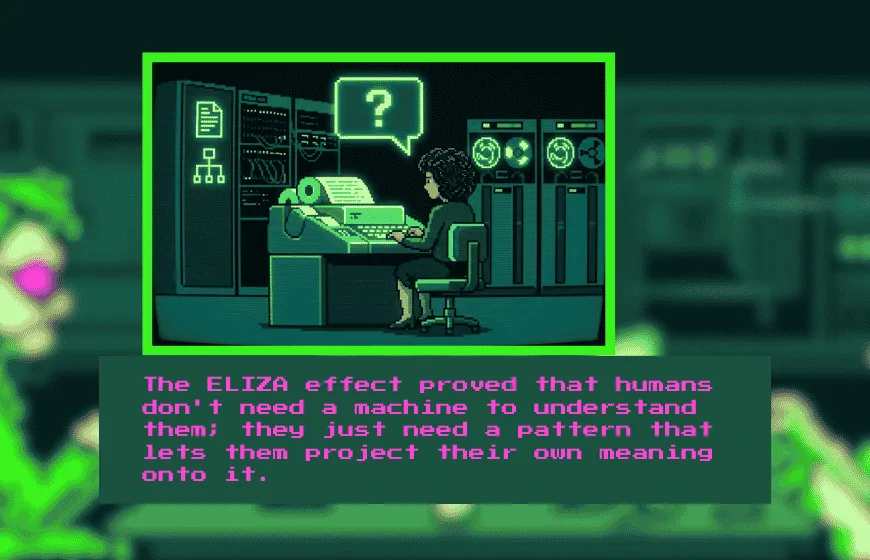
ELIZA didn't understand meaning, emotions, or context. It simply transformed text according to programmed rules.
What surprised researchers was how people reacted. Many users believed ELIZA understood them, even after being told it was a computer program. That reaction later became known as the "ELIZA Effect"—the tendency for people to attribute intelligence or emotions to software.
The technical achievement was relatively simple. The bigger discovery was that humans were willing to engage seriously with conversational software.
Early Chatbots Expanded the Idea Beyond Simple Pattern Matching
After ELIZA, researchers started experimenting with more advanced conversational systems.
PARRY arrived in 1972. It simulated a patient with paranoid schizophrenia and used internal assumptions and behavioral rules to make conversations feel more consistent than ELIZA's.
In 1984, Racter focused on computer-generated writing. It became well known after helping produce a published book. The output was often strange and unpredictable, but it showed growing interest in machine-generated language.
A.L.I.C.E. followed in 1995 and introduced AIML (Artificial Intelligence Markup Language). Developers used AIML to build large collections of conversational rules, and A.L.I.C.E. went on to win multiple chatbot competitions.
Despite their differences, these systems shared the same limitation: they relied on rules written by humans. They could only respond to situations their creators anticipated.
The Internet Era Changed the Evolution of Chatbots
The internet pushed chatbots out of research labs and into everyday use.
One of the biggest examples was SmarterChild, released in 2001 for AOL Instant Messenger and MSN Messenger. Millions of people used it to check weather forecasts, sports scores, movie times, and general information.
Unlike earlier chatbots, SmarterChild provided practical value. People returned because it was useful, not just because it was interesting technology.
Smartphones pushed things further.
Apple introduced Siri in 2011, bringing conversational software directly into consumers' pockets. Google Assistant followed in 2016 with stronger search capabilities and better contextual awareness.
At this point, chatbots were no longer experiments. They had become tools people used every day.
Machine Learning Transformed AI Chatbot Development
The next major shift happened when developers moved away from purely rule-based systems.
Earlier chatbots depended on programmers predicting possible conversations. Machine learning changed that. Instead of relying entirely on predefined rules, systems could learn patterns from large amounts of data.
Several things made this possible:
- More computing power
- Massive amounts of internet data
- Faster processing through GPUs
- Advances in neural networks
As a result, chatbots became more flexible and capable of handling situations they had never been explicitly programmed for.
This was one of the biggest turning points in chatbot history.
ELIZA followed rules. Machine-learning systems learned statistical relationships from data.
Transformer Models Created the Path From ELIZA to ChatGPT
The modern chatbot era began with transformer models.
Researchers introduced transformer architecture in 2017, and it quickly became the foundation of large language models.
Transformers improved how AI systems processed language, especially when handling longer passages and maintaining context. That breakthrough accelerated progress across the AI industry.
OpenAI launched the GPT series in 2018. Each version increased in size and capability, learning from enormous collections of text.
Then came ChatGPT in 2022.
For many users, ChatGPT felt completely different from previous chatbots. It could answer questions, write content, explain concepts, and maintain context across longer conversations.
It looked like a sudden breakthrough, but it wasn't.
ChatGPT was the result of decades of research, experimentation, and incremental improvements. The path from ELIZA to ChatGPT took more than 50 years.
What Changed During Each Major Chatbot Milestone?
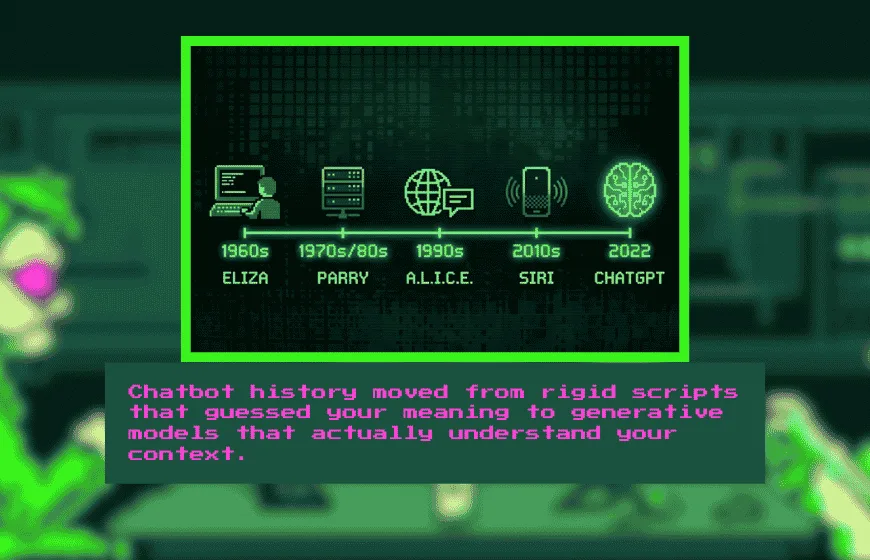
The easiest way to understand chatbot history is through the major breakthroughs:
- 1966 — ELIZA: Created by Joseph Weizenbaum at MIT, it used basic pattern matching to mimic a psychotherapist.
- 1972 — PARRY: Built by Kenneth Colby, PARRY simulated a person with paranoid schizophrenia and famously "chatted" with ELIZA.
- 1984 — Racter: A program that generated random text, famously credited with "authoring" the book The Policeman's Beard is Half Constructed in 1984.
- 1995 — A.L.I.C.E.: Richard Wallace created this chatbot using AIML (Artificial Intelligence Markup Language), setting the standard for rule-based bots in the late '90s.
- 2001 — SmarterChild: Developed by ActiveBuddy, it became a massive hit on AOL Instant Messenger (AIM) and MSN Messenger, bringing chatbots to mainstream consumer messaging.
- 2011 — Siri: Originally a standalone app, Apple integrated Siri into the iPhone 4S in October 2011, mainstreaming voice assistants.
- 2016 — Google Assistant: Launched in May 2016, it evolved from Google Now to provide two-way conversational, context-aware assistance.
- 2018 — GPT: OpenAI published its seminal paper "Improving Language Understanding by Generative Pre-Training" in June 2018, introducing the first GPT model based on Google's 2017 Transformer architecture.
- 2022 — ChatGPT: Released by OpenAI in November 2022, triggering the current wave of widespread consumer adoption and generative AI development.
Each generation improved the experience.
Early systems followed scripts. Later systems used machine learning. Today's AI assistants generate original responses, maintain context, and support more natural conversations.
Looking at the full timeline makes the progress much easier to appreciate.
ChatGPT Succeeded Because Technology Finally Caught Up With the Vision
Researchers had been chasing conversational AI for decades.
The idea wasn't new. The technology simply wasn't ready.
Three things changed:
- Modern hardware provided enough processing power.
- The internet supplied enormous training datasets.
- Transformer models improved how machines handled language.
ChatGPT combined those factors at the right time.
That's why it became a cultural phenomenon. It didn't invent conversational AI. It delivered the most capable version of a concept that began with ELIZA in 1966.
If someone asks when the first AI chatbot was released, the answer is straightforward: ELIZA, created by Joseph Weizenbaum at MIT and released in 1966.
It relied on pattern matching rather than true understanding, but it established the foundation for conversational AI.
Over the following decades, systems like PARRY, A.L.I.C.E., SmarterChild, Siri, and Google Assistant each pushed the technology forward. Advances in machine learning, neural networks, transformers, and large language models eventually led to ChatGPT.
While ChatGPT dominates today's AI conversation, its roots trace back to a simple MIT program released nearly six decades ago.
FAQs
Was ELIZA really the first AI chatbot?
Yes. ELIZA, released in 1966, is widely recognized as the first AI chatbot and one of the earliest examples of conversational computing.
What chatbot came before ChatGPT?
Several chatbots came before ChatGPT, including ELIZA, PARRY, Racter, A.L.I.C.E., SmarterChild, Siri, and Google Assistant.
How did chatbots evolve from ELIZA to modern AI assistants?
They evolved from rule-based systems and pattern matching to machine learning, neural networks, transformer models, and large language models.
Who created the ELIZA chatbot?
Joseph Weizenbaum created ELIZA at MIT and published it in 1966.
Why is ELIZA important in the history of AI chatbots?
ELIZA showed that people would engage seriously with conversational software, helping establish the foundation for modern chatbot development.