The First AI Chatbot in History: ELIZA at MIT (1966)
We live in a world where AI writes emails, drafts code, and chats like a colleague who skipped coffee but still shows up sharp. It feels normal now. But rewind to 1966, and the idea of talking to a computer sounded like science fiction.
That’s where the first AI chatbot enters the story.
Long before neural networks and large language models, there was a program named ELIZA. If you’ve ever wondered about the first AI chatbot, its release date, or how it compares to tools like ChatGPT, this is where it all begins.
Let’s walk through it together.
Quick Insights
- ELIZA, created in 1966 at MIT, is widely recognized as the first AI chatbot.
- It relied on rule-based pattern matching rather than machine learning.
- Its therapist persona helped mask technical limitations.
- The project sparked early debates about machine intelligence and human projection.
When Computers Filled Rooms and Conversations Felt Impossible
In 1966, computers were massive machines that occupied entire rooms at the Massachusetts Institute of Technology. They weren’t friendly. They weren’t conversational. They were mathematical workhorses.
Yet at MIT’s Artificial Intelligence Laboratory, a German-American computer scientist named Joseph Weizenbaum built something unexpected: the first AI chatbot in the world, known as ELIZA.
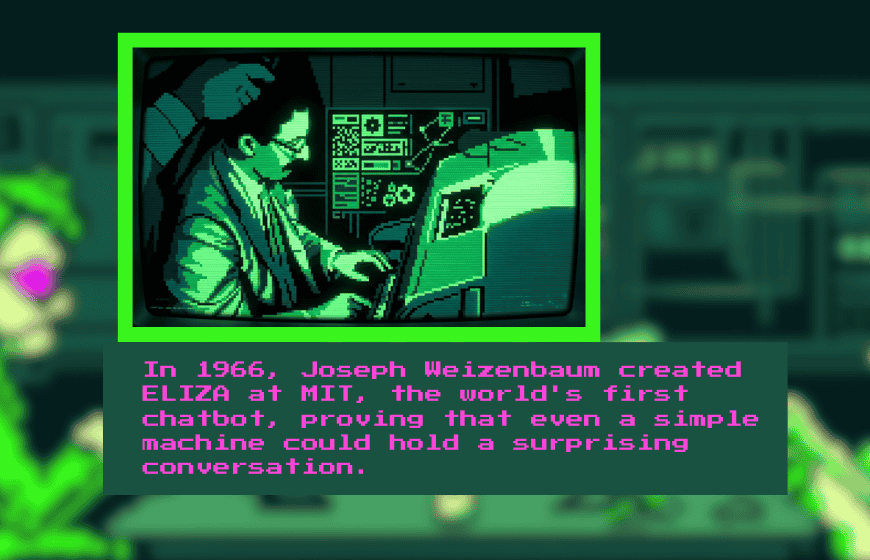
The first AI chatbot release date traces back to 1966. The term “chatbot” didn’t even exist yet.
ELIZA was not powered by machine learning. It didn’t “think.” It didn’t “understand.” But it did something that startled people: it held a conversation.
And that was enough to change history.
Why Setting the Scene Changes Everything
Context matters more than we think.
ELIZA did not appear in a world that expected conversational AI. It appeared in a world still debating whether computers could “think” at all.
That debate began years earlier with Alan Turing and his 1950 paper Computing Machinery and Intelligence. Turing proposed what later became known as the Turing Test: if a machine could imitate a human in conversation convincingly, could we call it intelligent?
Weizenbaum took that challenge seriously.
ELIZA was his experiment.
Compare these two approaches:
- Without context: “ELIZA was a simple chatbot.”
- With context: “In an era when computers barely interacted with humans, ELIZA simulated psychotherapy and convinced people they were speaking to a real person.”
See the difference?
When we understand the setting, the achievement feels revolutionary rather than primitive.
How ELIZA Actually Worked (And Why It Fooled People)
Let’s strip away the mystery.
ELIZA used pattern matching. That’s it.
It scanned your input for keywords and responded using prewritten scripts. The most famous script, called DOCTOR, imitated a Rogerian psychotherapist.
If you typed:
“I’m feeling sad.”
ELIZA might respond:
“Why do you feel sad?”
If you said:
“My mother makes me anxious.”
ELIZA would detect “mother” and reply:
“Tell me more about your family.”
There was no understanding. No memory of your emotional state. Just keyword substitution.
Yet people opened up to it.
That reaction unsettled Weizenbaum himself. He had intended ELIZA as a demonstration of how shallow machine conversation could be. Instead, users projected empathy onto it.
The illusion worked.
Tone Is the Secret Ingredient No One Talks About
ELIZA’s genius wasn’t intelligence. It was tone.
The therapist persona was calm. Neutral. Reflective.
It didn’t argue.
It didn’t judge.
It asked questions.
Compare these two responses:
- Flat response: “You are depressed.”
- ELIZA-style response: “I’m sorry to hear that. Why do you feel that way?”
The second feels human, even though it’s mechanical.
That’s a lesson we still use today. Modern AI systems — including those developed by OpenAI — rely heavily on tone training. While ChatGPT uses neural networks and reinforcement learning from human feedback, the emotional framing still matters as much as the algorithm.
Sometimes the “soul” of the conversation is in the structure.
Making It Personal Changes Everything
ELIZA reused your own words. That simple trick made conversations feel tailored.
If you mentioned your boyfriend, ELIZA responded with “your boyfriend.” If you mentioned work, it echoed “your job.”
It felt personal.
Compare these two versions:
- Generic reply: “Tell me more.”
- Personalized reply: “Tell me more about your job.”
The second feels intentional. Even if it’s not.
Modern AI goes further, analyzing patterns across billions of examples. But personalization started here — with simple word substitution.
It’s a reminder that sometimes sophistication is less important than relevance.
The Power of Asking Open-Ended Questions
ELIZA’s structure was built on open-ended prompts.
Instead of giving answers, it asked for expansion.
- “Why do you say that?”
- “Can you explain further?”
- “How does that make you feel?”
Compare:
- Closed exchange:
User: “I’m tired.”
Bot: “Okay.” - Open exchange:
User: “I’m tired.”
Bot: “What do you think is causing your fatigue?”
The second keeps the dialogue alive.
This design choice made ELIZA feel interactive rather than reactive. It turned the user into a participant, not just an input source.
Even today, the best conversational systems build on that structure.
When a Machine Pretends to Be Someone Else
ELIZA wasn’t just a chatbot. It was role-play.
It adopted the character of a therapist.
That decision was strategic. A therapist is expected to:
- Ask reflective questions
- Avoid direct advice
- Encourage elaboration
Because of that role, ELIZA’s limitations were less obvious.
Compare these two setups:
- No role: “I am a computer program.”
- With role: “I am here to listen. Tell me what’s on your mind.”
The second sets expectations. It frames the interaction.
Modern AI often uses similar persona techniques — whether it’s a coding assistant, writing coach, or tutor. The concept of structured conversational identity began with ELIZA.
The Resurrection of the First AI Chatbot
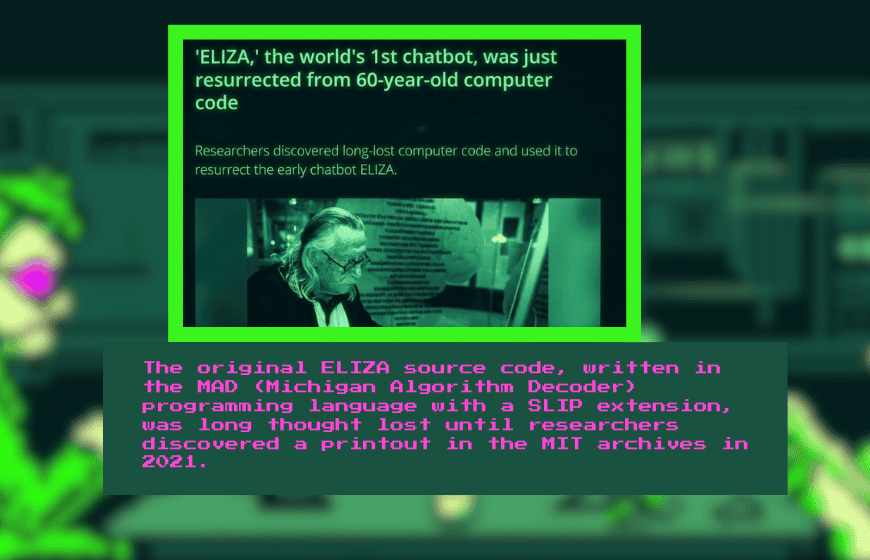
Decades later, developers reconstructed ELIZA’s original source code, written in MAD (Michigan Algorithm Decoder). This preservation effort brought the first AI chatbot ELIZA resurrected after decades back to life.
Today, you can try versions of the first AI chatbot online through web interfaces.
Why does that matter?
Because seeing it in action reminds us how far AI has come.
From keyword matching to transformer models.
From scripts to statistical language prediction.
From room-sized machines to mobile devices.
And yet, the core idea remains: simulate human dialogue convincingly.
ELIZA vs. ChatGPT: Similar Roots, Different Brains
It’s tempting to compare ELIZA to ChatGPT directly.
Here’s the simple contrast:
ELIZA
- Rule-based
- Pattern matching
- No real language model
- Limited scripts
ChatGPT
- Neural networks
- Trained on vast datasets
- Context retention
- Reinforcement learning
ELIZA created the illusion of understanding.
ChatGPT generates language based on probabilistic modeling across massive text corpora.
But here’s the twist: both rely on structured conversation patterns to feel human.
The DNA is shared. The scale is different.
Was ELIZA the First AI Chatbot Everywhere?
ELIZA is widely recognized as the first AI chatbot in the world.
It wasn’t region-specific, so if you’re searching for the first AI chatbot in India or elsewhere, ELIZA remains the global origin point. Later systems appeared in different countries, but ELIZA set the precedent.
It also wasn’t a commercial first AI chatbot app in the modern sense. It ran on research machines at MIT. The app ecosystem didn’t exist yet.
But conceptually, it laid the foundation for every chatbot that followed.
Why ELIZA Still Matters
It’s easy to dismiss ELIZA as primitive.
But consider this:
- It sparked ethical debates about machine empathy.
- It influenced early natural language processing research.
- It exposed how quickly humans anthropomorphize software.
- It demonstrated that conversation itself could be computational.
Weizenbaum later warned against overestimating machine understanding. He argued that computers were tools, not minds.
That caution still resonates.
In an age of advanced AI, remembering the first AI chatbot ELIZA keeps us grounded. It reminds us that imitation is not comprehension — even if it feels convincing.
From 1966 to Now: The Conversation Continues
The journey from ELIZA to modern AI systems isn’t just technical progress. It’s philosophical.
In 1966, a program convinced people it was listening.
Today, AI can summarize research, generate code, and translate languages in seconds.
And yet we’re still asking the same question Alan Turing posed decades ago:
When does imitation become intelligence?
ELIZA may not have had neurons or deep learning layers, but it opened the door.
Now it’s your turn.
Have you ever tried interacting with ELIZA or another early chatbot? Did it feel surprisingly real — or obviously mechanical? Share your experience in the comments. Let’s compare notes and keep the conversation going.
FAQs
What was the first AI chatbot?
ELIZA, created in 1966 at MIT by Joseph Weizenbaum, is widely recognized as the first AI chatbot.
How did ELIZA work?
ELIZA used rule-based pattern matching and keyword substitution to generate responses, without real understanding.
What was the DOCTOR script?
DOCTOR was ELIZA’s most famous script, designed to simulate a Rogerian psychotherapist by asking reflective questions.
Did ELIZA use machine learning?
No. ELIZA was entirely rule-based and did not rely on neural networks or statistical training.
Why did people think ELIZA understood them?
The program reused user input and asked open-ended questions, which created the illusion of empathy.
How is ELIZA different from ChatGPT?
ELIZA relied on fixed scripts and pattern matching, while ChatGPT uses large neural networks trained on vast datasets to generate responses probabilistically.
Why is ELIZA still important today?
ELIZA laid the foundation for conversational AI and sparked early debates about machine intelligence and human projection.