Gemini vs ChatGPT: Which One Actually Responds Better in Conversation?
When people compare Gemini vs ChatGPT, they usually ask one thing. Which one talks better?
Both tools answer questions. Both generate text. However, they were built with slightly different goals. To understand which responds better in talking, we need to look at design intent, benchmarks, and real statements from the companies behind them.
Let’s examine the evidence.
Quick Insights
- OpenAI states ChatGPT is trained to follow instructions and provide detailed responses.
- Google describes Gemini as its most capable and multimodal model.
- Gemini performs strongly on reasoning benchmarks like MMLU.
- GPT-4 scored in the top 10% on a simulated bar exam.
- ChatGPT often feels more conversational and context-aware.
- Gemini often delivers concise, structured answers.
- The better choice depends on whether you prioritize dialogue flow or technical precision.
What OpenAI Says About ChatGPT’s Conversation Style
To understand why ChatGPT often feels conversational, we should start with OpenAI’s own words.
When OpenAI launched ChatGPT, it described the model clearly:
“ChatGPT is a sibling model to InstructGPT, which is trained to follow an instruction in a prompt and provide a detailed response.” — OpenAI, 2022
That statement matters.
ChatGPT was trained specifically to follow instructions and produce detailed replies. This explains why many users experience smoother back-and-forth dialogue when comparing Gemini vs ChatGPT.
In practical use, ChatGPT often:
- Asks clarifying questions
- Expands on context
- Maintains conversational tone across messages
For users who want a flowing discussion, this design focus shows up quickly.
What Google Says About Gemini’s Strengths
Now let’s look at Gemini.
When Google introduced Gemini, CEO Sundar Pichai described it as:
“Our most capable and general model yet, built from the ground up to be multimodal.” — Sundar Pichai, Google DeepMind, 2023
Notice the difference in emphasis.
Google highlighted capability and multimodal design. That means Gemini focuses on reasoning across text, images, and structured data — not just conversation.
In addition, Google’s technical report states:
“Gemini demonstrates state-of-the-art performance across a wide range of benchmarks, including reasoning, coding, and multimodal understanding.”
So when comparing Gemini vs ChatGPT, we see different priorities:
- ChatGPT emphasizes instruction-following dialogue
- Gemini emphasizes broad reasoning and capability
That difference often shows up in how they “talk.”
Benchmarks: What the Numbers Show
Marketing claims matter less than measurable performance.
Google reported that Gemini Ultra achieved around 90% on the MMLU benchmark, which measures reasoning across academic subjects.
Meanwhile, OpenAI reported in its GPT-4 technical report:
“GPT-4 passes a simulated bar exam with a score around the top 10% of test takers.” — OpenAI GPT-4 Technical Report
Both companies show strong reasoning performance.
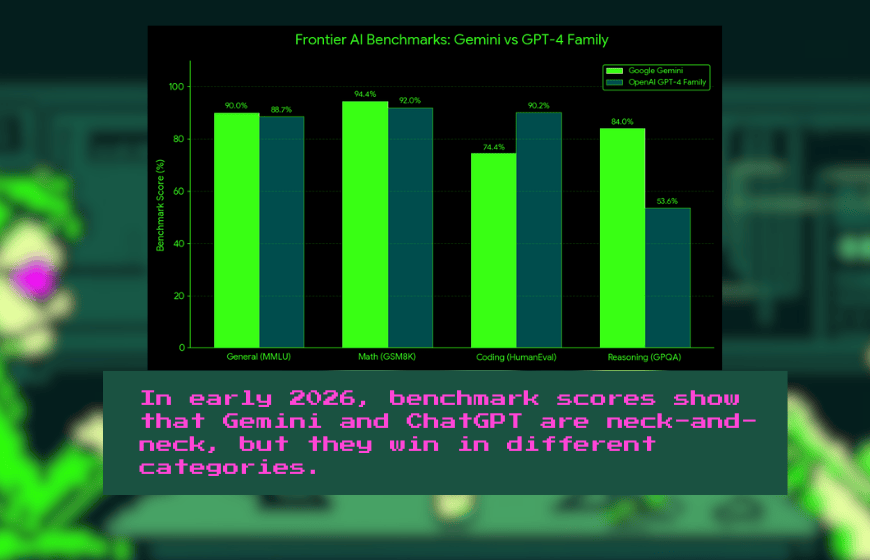
However, benchmarks like MMLU test structured reasoning. They do not measure conversational warmth or dialogue flow. That distinction is important in the Gemini vs ChatGPT debate.
Reasoning strength does not always equal conversational quality.
How This Affects Real Conversations
When you ask an open-ended question like:
“Can you help me think through this idea?”
ChatGPT often:bb
- Breaks the idea into parts
- Expands naturally
- Maintains a conversational rhythm
Gemini often:
- Provides concise structured output
- Prioritizes clarity and correctness
- Avoids extended elaboration unless requested
Neither approach is wrong.
However, if your goal is dynamic conversation, ChatGPT’s instruction-following training may create a smoother exchange. If your goal is technical clarity or quick summaries, Gemini may respond more directly.
Handling Ambiguity in Dialogue
Another difference appears when prompts lack clarity.
For example, if you ask, “Explain Mercury,” the system must choose an interpretation.
ChatGPT frequently asks a follow-up question to clarify meaning. That reflects its instruction-based training.
Gemini may choose the most statistically common interpretation and answer directly.
So in ambiguous situations, ChatGPT often extends the conversation. Gemini often resolves it quickly.
Your preference depends on whether you value clarification or speed.
Creativity vs Precision
Users often report that ChatGPT feels more expressive. That aligns with its conversational design.
Gemini, meanwhile, often feels more concise and factual.
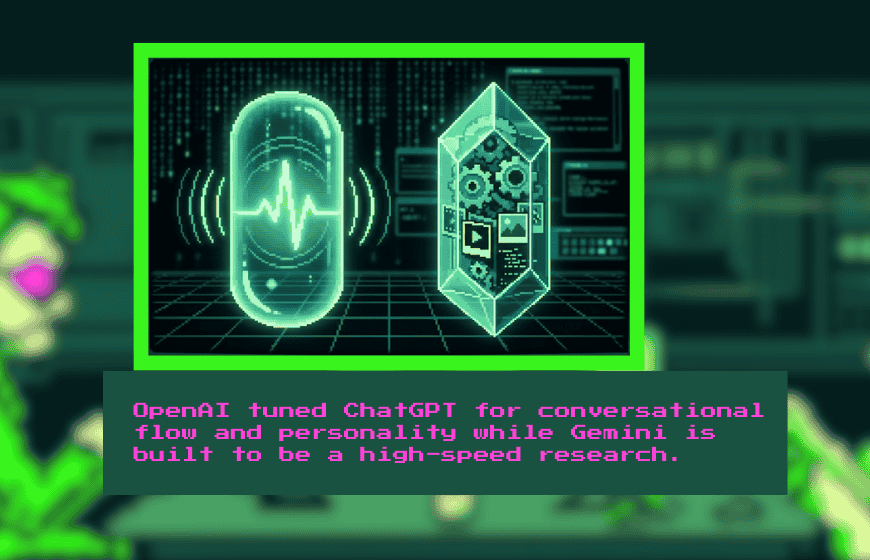
This difference does not mean one is “better.” Instead, it reflects architectural priorities. OpenAI focused heavily on dialogue alignment. Google emphasized multimodal capability and reasoning breadth.
In the Gemini vs ChatGPT comparison, conversation style reflects those goals.
So Which Responds Better in Talking?
If “talking better” means:
- Maintaining context
- Asking clarifying questions
- Producing natural dialogue
Then ChatGPT often feels stronger.
If “talking better” means:
- Giving precise, direct answers
- Staying concise
- Integrating with Google’s ecosystem
Then Gemini may feel more efficient.
The companies’ own statements support this difference.
OpenAI built ChatGPT to follow prompts conversationally.
Google built Gemini to be broadly capable and multimodal.
The Gemini vs ChatGPT comparison should not reduce to hype.
Both models score highly on reasoning benchmarks. Both companies publish strong technical results. However, their product philosophies differ.
If your primary goal is conversational depth, ChatGPT’s design supports that use case. If your goal is structured reasoning and concise answers, Gemini’s architecture aligns well.
Instead of asking which is superior, ask what you need from an AI conversation.
FAQs
What is the main difference between Gemini and ChatGPT in conversation?
ChatGPT emphasizes instruction-following dialogue and extended context, while Gemini prioritizes concise reasoning and multimodal capability.
Which model is better for natural back-and-forth discussion?
Many users find ChatGPT smoother for extended dialogue because it often asks clarifying questions and expands on ideas.
Which model performs better on benchmarks?
Gemini Ultra reportedly achieved strong MMLU results, while GPT-4 performed highly on professional exam simulations. Both show strong reasoning performance.
Is Gemini more advanced than ChatGPT?
Both models are advanced but optimized for different goals. Gemini emphasizes multimodal reasoning, while ChatGPT focuses heavily on conversational alignment.
Which is better for technical answers?
Gemini often provides concise, structured responses, which some users prefer for technical clarity.
Does benchmark performance reflect conversational quality?
Not necessarily. Benchmarks measure reasoning or knowledge, but conversational flow depends on alignment and dialogue training.
Which should I choose?
Choose based on your needs: ChatGPT for conversational depth and exploration, Gemini for concise reasoning and multimodal tasks.