The Turing Test and Its Relevance to Personhood
Ask a chatbot a question and it answers like a person. Does that make it one? In 1950, Alan Turing proposed a way around that question. If a machine can chat so well that a judge can't tell it from a human, he argued, we should stop quarrelling over whether it "really" thinks. More than 75 years later, conversational AI can pull this off in short chats. That has revived an old argument. A growing number of people say the Turing test has been comprehensively debunked as a measure of personhood.
This article takes that claim seriously. We cover what the test measures, why philosophers and scientists say it can't settle personhood, where real systems have fooled people, and why it says nothing about AI ethics. We also show where we think the word debunked goes too far.
The Turing Test Has Been Comprehensively Debunked. Or Has It?
It depends on which claim you mean. There are two.
Claim one: passing the test proves a machine is intelligent, or a person. This is the claim that fails. Debunking the Turing test is easy when you treat it as a measure of personhood. A chat transcript shows what a system says. It shows nothing about what, if anything, is going on inside.
Claim two: the test shows how well machines can imitate people. This claim survives. A system that can pass as human in conversation can also deceive, persuade, and impersonate. Those are real-world effects, whether or not any understanding sits behind them.
Turing himself was careful here. He swapped the vague question "can machines think?" for a practical one about behavior. He never said a pass would make a machine a person.
Our view: debunked is a fair label for personhood and too strong for the human vs. machine question. The test is a poor measure of personhood and a decent measure of imitation. The trouble starts when people mix the two up.
What the Turing Test Was Built to Measure
Turing called his setup the imitation game. A judge talks by text with two hidden partners, one human and one machine, and tries to say which is which. If the judge guesses wrong often enough, the machine has imitated well.
Three features matter for the personhood debate:
- It measures behavior only. The judge sees words on a screen. Nothing else counts.
- The judge is the instrument. Results shift with the judge's skill, expectations, and how long the chat lasts.
- There is no official pass mark. Turing guessed that by 2000, machines would fool an average judge about 30% of the time in five minutes. That was a forecast, not a standard.
The setup also affects the result. In a 2025 study on arXiv, judges chatted with a person and an AI at once. GPT-4.5 was picked as the human 73% of the time, but only when it was told to play a human-like persona. Live Science notes that the same model did much worse without that instruction.
For a plainer walkthrough, see our Turing test explainer.
Intelligence vs. Mimicry: What Philosophers Say
Two philosophers frame the gap between sounding human and being a person.
John Searle's Chinese Room. In 1980, Searle asked us to imagine him alone in a room, following written rules to match Chinese symbols with other Chinese symbols. People outside get fluent answers and assume a Chinese speaker is inside. Searle understands no Chinese. His point is that a program can shuffle symbols by rule without grasping what they mean. The Stanford Encyclopedia of Philosophy summarizes his conclusion this way: syntax alone is not enough to produce meaning.
Critics push back. The best-known reply says the man doesn't understand, but the whole system (man, rulebooks, scratch paper) might. Searle answered that memorizing the rules wouldn't change anything. The debate is still open. What matters here is narrower: a good conversation does not, by itself, settle the question.
David Chalmers's hard problem. In a 1995 paper, Chalmers split consciousness research in two. The easy problems ask how the brain performs functions such as paying attention or reporting what it senses. The hard problem asks why any of that processing comes with subjective experience at all. A test that looks only at outputs can speak to functions. It cannot reach experience.
Put together, these arguments explain the gap between intelligence and mimicry. Fluent talk is evidence of skill with language. Whether it is evidence of a mind is exactly what remains in dispute.
When Mimicry Fooled People
History offers a clear pattern: people read minds into talk.
- ELIZA (1960s). This simple program reflected users' words back as questions. The Stanford Encyclopedia notes that basic chatbots like it can look clever for a short while. It had no understanding at all.
- Eugene Goostman (2014). The chatbot played a 13-year-old boy, a persona that made its odd answers easy to forgive. It convinced 33% of judges in one small contest, and the Stanford entry cautions that such results can't be applied more widely.
- LaMDA (2022). This one was not a formal Turing test, but it shows the same error. Google engineer Blake Lemoine said the LaMDA chatbot had reached a level of consciousness, based on his long conversations with it. Google said it reviewed the claims and found them wholly unfounded, and later fired him for policy violations.
- GPT-4.5 (2025). With a persona prompt, it was picked as the human in 73% of chats. Without one, it did much worse. The result tells us more about prompting and judges than about personhood.
In every case, the system's talk looked better than what lay behind it. That is the gap the Turing test cannot see. Our view: these examples don't show that AI is hollow or that it can never be more. They show that conversation alone is a weak way to find out.
What Psychology, Sociology, and Neuroscience Add
Philosophy is only one lens. Three other fields push the debate further.
Psychology: we see minds quickly. People tend to treat anything that talks as someone. A 2024 survey of 300 U.S. adults, covered by Live Science, found that 67% thought ChatGPT could have some form of conscious experience. People who used such tools more often were more likely to say so. This is a fact about human perception, and it is why a human judge is a shaky instrument.
Sociology: personhood is partly social. Personhood is not only a question about inner life. Societies also grant it as a legal and moral status. Companies, for example, can sign contracts and be sued as legal persons, and nobody thinks they have minds. So when people ask whether an AI should count as a person, they are asking two things: what is it, and what role do we give it?
Neuroscience: look inside, not only at output. In 2023, a team of 19 researchers published a report on AI consciousness. They took five scientific theories of consciousness and turned each into a checklist of computational features. They then examined recent AI systems against it. Their conclusion was that no current system is conscious. They also saw no obvious technical barrier to building one that meets the indicators, so the question is open for the future.
This approach is the opposite of the Turing test. It asks how a system works, not how it sounds. It is imperfect, because the theories themselves are debated. Still, it is a more serious attempt at the question than a chat can offer.
AI Ethics Problems the Turing Test Never Touches
Most of the harm from artificial intelligence has nothing to do with whether a system sounds human. Three examples show the mismatch.
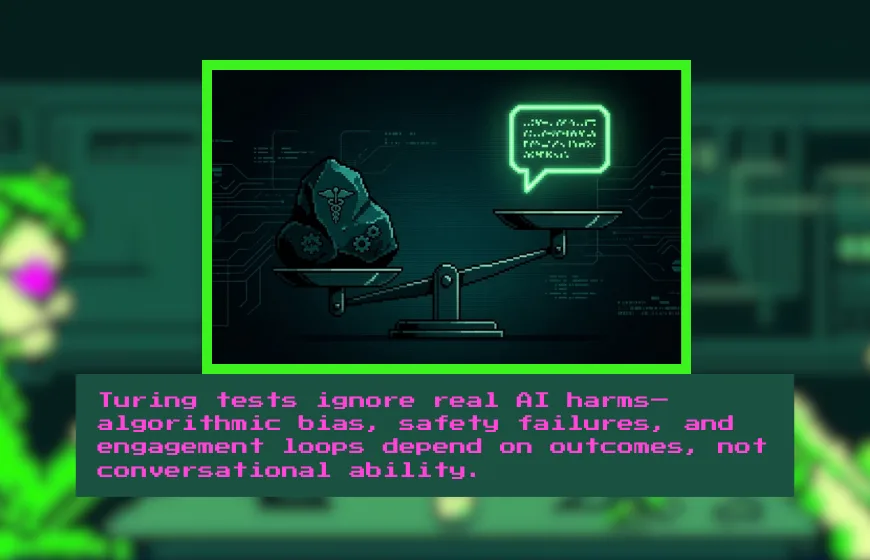
Healthcare. A 2019 study in Science examined an algorithm used on more than 200 million people in the U.S. to pick patients for extra care. It used past health spending as a stand-in for medical need. Black and white patients with the same score were not equally sick. Among patients scored as very high-risk, Black patients had 26.3% more chronic illnesses. No conversation would have revealed this flaw.
Autonomous vehicles. In March 2018, a self-driving Uber test car struck and killed a pedestrian in Tempe, Arizona. The NTSB found that the system detected her 5.6 seconds before impact but kept changing its label for her between vehicle, pedestrian, and other. It did not predict that she would cross, partly because she was outside a crosswalk. The safety driver was also distracted, and the NTSB faulted Uber's safety planning. How well the car could chat was beside the point.
Social media algorithms. Ranking systems decide which posts and videos reach billions of people. They are built to maximize measures like engagement, and none of them needs to talk like a human. How much they shape attention and belief is still debated, but the ethical questions are about design and accountability, not imitation.
The lesson for AI ethics is simple. Risk comes from what a system does, what data it learned from, and who answers for the outcome. A system can fail every ethical test and still pass as human in conversation, or the other way around.
Misconceptions That Make AI Look Smarter Than It Is
Public attitudes toward AI rest on a few shaky assumptions.
- "Fluent means it understands." Language models are trained to produce plausible text. Fluency is what they are optimized for, so it is weak evidence of comprehension.
- "If it passed, it's conscious." As the survey above shows, many people already lean this way. The Turing test feeds the belief by turning a chat result into a headline.
- "AI is one thing." A chatbot, a hospital risk score, and a driving system are very different tools with different failure modes. Praise or blame for one doesn't transfer to the others.
- "A human-like voice means human-like judgment." A system can sound caring and still be wrong, biased, or unsafe.
These beliefs matter because they shift responsibility. If a system is seen as a quasi-person, mistakes start to look like its choices rather than the choices of the people who built and deployed it.
Personhood, Law, and Policy
How we define personhood for machines will shape rules, not just debates. Two recent moves show the tension.
The "electronic person" proposal. In 2017, a European Parliament report floated giving the most sophisticated autonomous robots a status of "electronic persons," mainly to settle who pays when they cause harm. In 2018, 156 experts from 14 countries signed an open letter against it. They argued that it overstated what robots can do and could let manufacturers dodge responsibility.
The EU AI Act. Instead of grading human-likeness, the law demands disclosure. Under Article 50, which applies from 2 August 2026, providers must design chatbots so people are told they are talking to an AI, unless that is obvious. This rule assumes the human vs. machine line is blurry and puts the duty on the builder.
Our view: policy works best when it targets what we can measure, such as transparency, testing, and accountability. If evidence ever suggests an AI system has experiences of its own, the personhood question will need a far better tool than a chat. Until then, treating human-like talk as a sign of personhood invites mistakes in both directions: too much trust in the machine and too little responsibility for its makers.
Test Your Own Judgment
The 2023 Human or Not experiment had more than 1.5 million players guess whether a two-minute chat partner was a person or a bot. They were right 68% of the time overall, and only 60% of the time when the partner was a bot. Try it yourself at Human or Not:
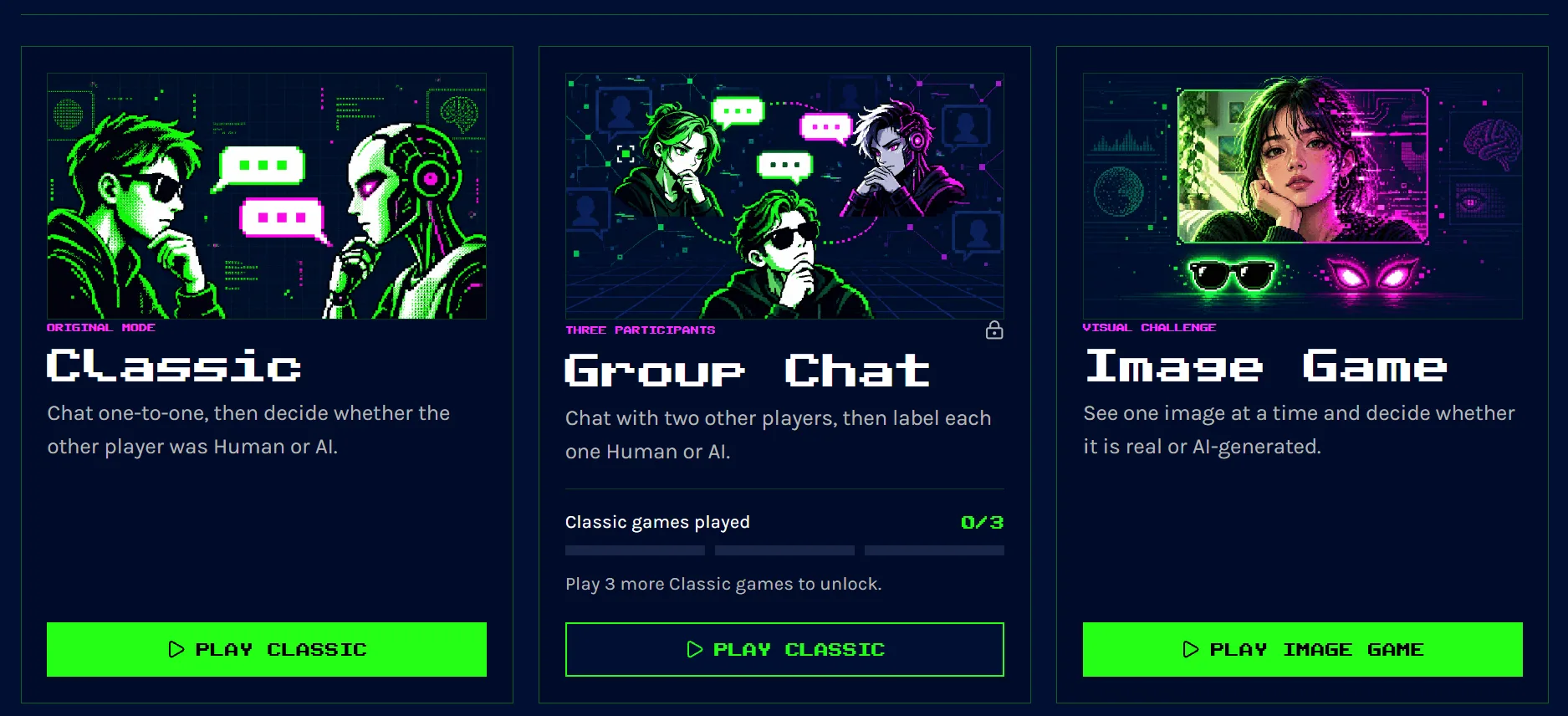
- Classic: Chat one-on-one, then call your partner Human or AI. Play Classic.
- Group Chat: Spend three minutes with two other players, then label each one. Play Group Chat.
- Image Game: Decide whether each image is real or AI-generated. Play the Image Game.
A game is not a scientific test, but it shows how hard the call can be. Do you think the Turing test still has value? Share your view in the humanornot subreddit.
FAQ
Has the Turing test been debunked? As a measure of personhood or consciousness, largely yes. As a measure of how well a machine imitates a person in conversation, no.
Can the Turing test measure personhood? No. It records behavior in a chat. Personhood involves experience, moral status, and social roles, none of which a transcript shows.
What is the difference between intelligence and mimicry? Intelligence involves understanding and flexible problem-solving. Mimicry means producing outputs that look like the real thing. Conversational AI can do the second without clear evidence of the first.
Has any AI passed the Turing test? Some studies say yes under specific conditions. In a 2025 study, GPT-4.5 was picked as the human 73% of the time, but only with a persona prompt. There is no agreed pass mark.
Why does the Turing test matter for AI ethics? It shows how easily people trust systems that sound human. That trust can hide real problems, such as bias, safety flaws, and unclear accountability.
Sources
Figures were checked on October 21, 2026.
- Stanford Encyclopedia of Philosophy: The Turing Test
- Stanford Encyclopedia of Philosophy: The Chinese Room Argument
- David Chalmers: Facing Up to the Problem of Consciousness (1995)
- Large Language Models Pass the Turing Test (arXiv, 2025)
- Live Science: GPT-4.5 is the first AI model to pass an authentic Turing test
- AZ Family: Google fires employee who claimed AI system had become sentient
- Live Science: Most ChatGPT users think AI models have conscious experiences
- Consciousness in Artificial Intelligence: Insights from the Science of Consciousness (arXiv, 2023)
- Scientific American: Racial bias found in a major health care risk algorithm
- Smart Cities Dive: Uber AV in fatal crash couldn't detect jaywalkers
- Interesting Engineering: Experts denounce EU proposal granting robots personhood
- European Commission: Transparency obligations under Article 50 of the AI Act
- Human or Not? A Gamified Approach to the Turing Test (arXiv, 2023)