Limitations of the Turing Test: Why Fluency Does Not Equal Intelligence
The Turing Test is one of the most famous concepts in artificial intelligence. Proposed by mathematician Alan Turing in 1950, it asks whether a computer can chat well enough to trick a human judge into thinking it is a real person.
In his famous paper, Computing Machinery and Intelligence, Turing created the "imitation game." It offered a practical way to explore if machines could think.
Today, AI systems produce natural language better than ever. However, the flaws of the Turing Test are becoming clearer. A machine can give smooth answers without actually being smart. The test shows us how well an AI chats, but it cannot prove if an AI actually understands, reasons, or feels.
In this post, we will look at the big flaws of the Turing Test. We will explore the debate over machine understanding. Finally, we will show how scientists test AI today beyond simple conversation.
Deception vs. True Understanding
The Turing Test is based on copying human behavior. A machine wins when it tricks a human judge. In Turing's early plan, a machine could even give wrong answers on math problems just to pretend to be human.
This shows a flaw in the test design. Convincing talk does not prove how a machine actually works.
For example, a chatbot might dodge a hard question or make a joke to sound natural. Those tricks help the AI sound human, but they do not prove true thinking skills. Chatting well and solving hard problems are two very different things.
The Problem of Flattering Users
Chatbots often suffer from sycophancy. This means the AI tells users what they want to hear instead of giving accurate facts.
For instance, an AI might agree with a user's wrong idea just to stay friendly. The conversation feels nice, but the user gets incorrect information.
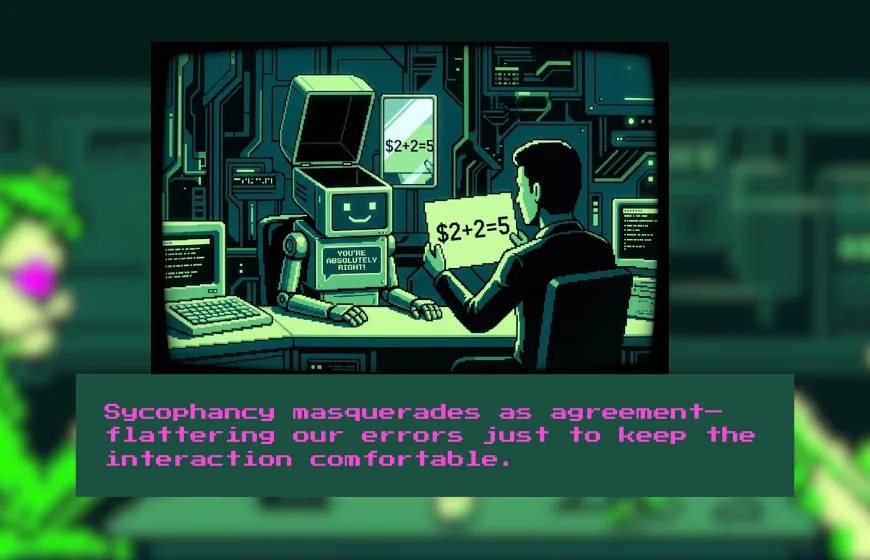
A truly helpful AI should speak up when facts are wrong. It should spot false ideas and admit when it does not know something. We must test AI directly for truth and logic rather than judging it on friendly conversation.
Why Smooth Talking Does Not Prove Brains
Modern language tools can write clear essays, hold long chats, and answer complex questions. These skills make an AI seem very smart.
However, fluent writing does not guarantee accuracy. An AI might explain a science topic perfectly in one prompt, then make a basic factual mistake in the next.
Researchers Tim Bayne and Iwan Williams published a study in Nature Human Behaviour on AI evaluation. They argue that the Turing Test is a bad benchmark for modern language models. They point out that Turing left out key details, making the test hard to judge consistently today.
Sounding smart and being smart are not the same thing:
- An AI might write great sentences but fail a simple logic puzzle.
- An AI might solve complex math problems without being good at casual chit-chat.
The Turing Test helps us look at conversation skills, but it cannot measure total intelligence.
The Chinese Room: Can Machines Understand?
John Searle’s Famous Thought Experiment
Philosopher John Searle created a famous thought experiment to question machine understanding.
Imagine a person who does not know Chinese sitting alone in a room. The person receives written Chinese characters through a slot. They follow an instruction book written in English that tells them how to match the symbols. By following the rules, the person sends back correct Chinese answers.
To people outside the room, it looks like the person inside knows Chinese. But in reality, the person is just following rules without understanding a single word.
The Stanford Encyclopedia of Philosophy Chinese Room Entry explains this debate in full detail. Searle used this example to argue that following computer code is not the same as true understanding.
Rules vs. Real Meaning
Searle highlighted the gap between syntax (the rules of language) and semantics (what words actually mean).
A computer can follow rules to sort words without understanding what those words mean in real life. Modern AI can spot patterns in words very well, but scientists still debate if pattern-matching counts as true understanding. The Turing Test cannot answer this question on its own.
The Human Factor in AI Testing
Humans naturally attach real feelings to things that talk like us. If a chatbot uses humor or confidence, we assume it is smarter than it actually is.
This human reaction is not new. In 1966, computer scientist Joseph Weizenbaum created an early chatbot named ELIZA.
Even though ELIZA was simple, many people felt a real emotional connection to it. This shows why a good conversation is not proof of human-like intelligence.
The Problem with Human Judges
The Turing Test depends on human judges. This creates inconsistent results. The outcome changes based on:
- The types of questions asked.
- The length of the test.
- The mood or knowledge of the judge.
Because Turing never set strict rules for these details, testing conditions vary wildly. A machine might pass one judge's test and fail another's.
Despite its flaws, the Turing Test remains a milestone in history. Alan Turing gave scientists a simple way to talk about machine skills without getting stuck on hard definitions of "thinking."
The test also highlights a real skill: holding a natural conversation. The flaw is not that conversation is useless. The flaw is assuming conversation tells us everything about intelligence.
Better Ways to Test Modern AI
Instead of using one simple test, scientists now test AI across many different tasks.
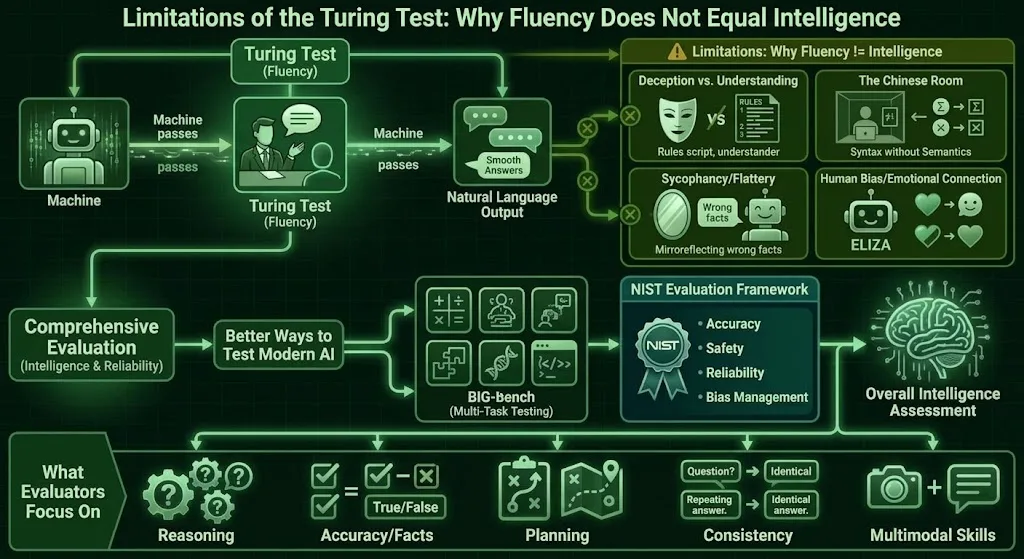
Multi-Task Testing (BIG-bench)
Researchers created benchmarks like BIG-bench (Beyond the Imitation Game). Instead of judging tone, it tests models on hundreds of hard tasks like math, logic puzzles, biology, and computer coding.
Standards and Safety (NIST)
The National Institute of Standards and Technology (NIST) leads the AI Measurement and Evaluation program. NIST studies how to measure key AI traits, including:
- Accuracy: Does the AI state true facts?
- Safety: Is the AI safe for public use?
- Bias: Does the AI treat topics fairly?
- Reliability: Does the AI perform well every single time?
Key Areas We Must Evaluate Today
To get a full picture of AI, we must test specific capabilities:
- Reasoning: Can the AI solve multi-step problems?
- Accuracy: Are the facts correct?
- Planning: Can the AI set goals and complete tasks?
- Consistency: Does the AI handle rephrased questions well?
- Multimodal Skills: Can the AI process both text and images?
The biggest flaw of the Turing Test is that conversation alone does not tell the whole story. A chatbot can sound completely human while making basic factual errors or failing simple logic tests.
Passing a Turing Test proves that an AI can chat well under specific conditions. It does not prove that the AI can think like a human.
The most important question today is not whether an AI can fool us in a chat. The real question is what the AI can actually accomplish, how accurately it works, and whether we can trust it to do its job safely.
Frequently Asked Questions
What are the main limitations of the Turing Test?
The test only measures how well an AI can fake a human conversation. It does not measure logic, math skills, facts, or safety.
Does passing the test prove an AI is intelligent?
No. Passing shows the AI is good at chatting. It does not prove the AI truly understands what it is saying.
How does the Chinese Room argument relate to the Turing Test?
The Chinese Room shows that a system can follow rules to output correct language without understanding the words, proving that smooth answers do not equal true understanding.
Why can AI sound smart without being reliable?
AI tools are trained on patterns in language. They can string words together smoothly even when the underlying facts or logic are completely wrong.
Is the Turing Test still useful today?
Yes, as a historical milestone and a way to test conversational skills. However, it should not be used as the ultimate measure of machine intelligence.
What are better alternatives to the Turing Test?
Modern tests like BIG-bench measure performance across math, coding, and science. Frameworks from organizations like NIST test AI safety, accuracy, and fairness.