Is There a Replacement for the Turing Test?
The Turing test is more than 75 years old, yet it keeps making headlines. In 2025, a study posted on arXiv said GPT-4.5 passed a version of it. In October 2026, the AI company Tavus said its Griffin model passed a video version.
So people are asking: is there a replacement for the Turing test? Is the old test still any good?
The short answer is that no single Turing test replacement has been agreed on. But researchers have proposed several new tests, and each one checks something different. In this post, we explain what the test is, where it falls short, whether it is still used, and what could come next.
What Is the Turing Test?
Alan Turing proposed the test in 1950 and called it the "imitation game." A person chats with an unseen partner and tries to guess whether it is a human or a machine. If they can't tell, the machine has done well at the game.
Turing's version used text only. There is also no single score that counts as a pass. That gap is one reason people still argue about what "passing" means. For more background, see our Turing test explainer.
Is the Turing Test Reliable?
Not very, say many critics. A pass depends a lot on who is judging and how the test is set up. Here are the main problems:
- People are easy to fool. The Stanford Encyclopedia of Philosophy describes how basic chatbots such as ELIZA can look clever to people for a short time. It also covers earlier claims of a pass, including Eugene Goostman convincing 33% of judges in 2014. Those were small trials, and the entry cautions that their results can't be applied more widely.
- Tricks can help. IEEE Spectrum notes that Eugene Goostman played a 13-year-old boy, a persona that made its odd answers easier to forgive.
- Setup changes the result. In the 2025 study, GPT-4.5 won only with a human-like persona prompt. Live Science says models run without that prompt scored far lower, and that judges seemed to react to how a chatbot came across.
- A pass isn't proof of intelligence. Live Science cautions that beating people at this game does not mean a machine thinks like a person.
Defenders reply that a tougher version is harder to beat. In it, the judge knows a machine is present and keeps asking hard questions. That is a fair point, but many pass claims have come from short, small tests.
So the test can show that people were fooled in one setting. It is much weaker at showing that a machine is smart, honest, or safe.
Is the Turing Test Obsolete?
It depends on what you want the test to do. As a measure of intelligence, many people say it is outdated. As a measure of whether humans can spot AI, it still matters.
The case that it's obsolete. In 2023, DeepMind co-founder Mustafa Suleyman said language models have nearly beaten the test in text chats. In an essay for MIT Technology Review, he argued that a chat score says little about what an AI can actually do. He wants a test built around useful work instead.
The case that it still matters. The question the test asks has become more urgent. If people can't tell a bot from a person, scams, fake accounts, and false trust get easier. Even Tavus, the company behind Griffin, says that lifelike AI could trick people into thinking they are not talking to a machine.
The numbers back this up. In a 2023 Human or Not experiment, over 1.5 million players had two-minute chats and guessed whether their partner was a person or a bot. They were right 68% of the time overall. When the partner was a bot, they were right only 60% of the time, which the authors saw as only a little better than guessing.
Our view: the Turing test is a weak yardstick for intelligence, but it is still a useful check on how well AI can pass as human.
Is the Turing Test Still Used Today?
Yes, though it looks different now. Instead of a single judge and a single chat, today's versions run at larger scale, in new formats, and often as games. Three examples:
- Text studies. In the 2025 arXiv study, each judge held five-minute chats with a person and an AI side by side, then guessed which one was the human. With a persona prompt, GPT-4.5 was chosen as the human 73% of the time.
- Video tests. Tavus reports that 26 of 54 testers (48%) took Griffin for a real person after a one-minute video call. The company ran the test itself with a small group, so outside checks are needed.
- Large online games. The 2023 Human or Not experiment turned the test into a game with more than 1.5 million players. Games like ours carry on that idea.
What has changed is the goal. In many of today's versions, the question is less about whether a machine thinks. It is more about how well AI can pass as human, and how well people can tell.
Is There a New Turing Test?
Not one that everyone accepts. But several ideas for a Turing test replacement have been proposed. Each checks a different skill.
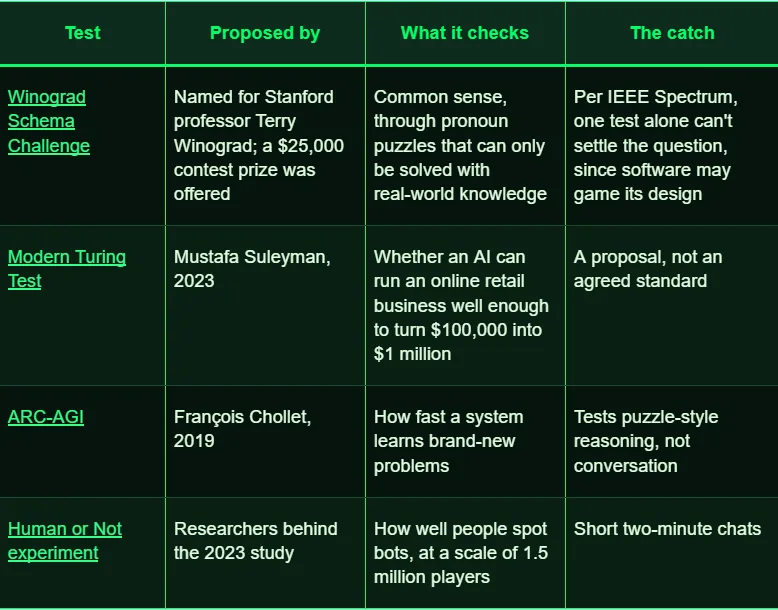
The Stanford Encyclopedia also mentions older proposals, like the Total Turing Test and the Lovelace Test, so searching for a replacement is nothing new.
The tests also differ in what they ask. The Turing test asks, "Can it fool me?" The Winograd test asks, "Does it have common sense?" Suleyman's test asks, "Can it get real work done?" ARC-AGI asks, "Can it learn something new?" DZone reports that when the newest version launched in March 2026, leading AI models managed less than 1%, while top human testers cleared all of its environments.
So the best answer to "is there a replacement for the Turing test?" is: no single one, but a growing set of tests that each cover a different gap.
Try a Turing-Style Test Yourself
The best way to judge the Turing test is to take one. At Human or Not, our game follows the same core idea as the original 2023 experiment. It is a fun test of your instincts, not a scientific one. You can try three modes:
- Classic: Chat one-to-one, then decide whether your partner was Human or AI. Play Classic.
- Group Chat: Chat with two other players for three minutes, then label each one. Play Group Chat.
- Image Game: Decide whether each image is real or AI-generated. Play the Image Game.
You can play without registering. Everything on the site is public, so keep personal details out of your chats.
FAQ
Is there a replacement for the Turing test? No single replacement is widely accepted. Proposed tests include the Winograd Schema Challenge, Suleyman's Modern Turing Test, and ARC-AGI. Each checks a different skill.
Is there a new Turing test? There are newer ideas, but none has taken over. Some keep the human-or-AI idea and update it with video or large online games. Others test common sense, reasoning, or real-world tasks.
Is the Turing test obsolete? As a measure of intelligence, many people think so. As a way to check whether people can spot AI, it is still useful.
Is the Turing test reliable? Not very. Results depend on the judges, the setup, and tricks like persona prompts. A pass doesn't prove a machine is intelligent.
Is the Turing test still used today? Yes. Researchers, companies, and online games still run versions of it, including a 2025 text study and a 2026 video claim from Tavus.
Has AI passed the Turing test? It depends on the version. A 2025 study found GPT-4.5 was picked as the human 73% of the time with a persona prompt. Others say that result needs context, because there is no agreed pass mark.
Sources
Figures were checked on October 18, 2026.
- Large Language Models Pass the Turing Test (arXiv, 2025): three-party text test results
- Live Science: GPT-4.5 is the first AI model to pass an authentic Turing test: persona prompt, caveats
- Stanford Encyclopedia of Philosophy: The Turing Test: objections, past pass claims, alternatives
- IEEE Spectrum: Winograd Schemas as a Turing test replacement: Winograd Schema Challenge, Eugene Goostman
- MIT Technology Review: Mustafa Suleyman, My new Turing test: Modern Turing Test
- DZone: The only AI test that still humbles every machine: ARC-AGI
- Human or Not? A Gamified Approach to the Turing Test (arXiv, 2023): 1.5 million players, 68% and 60% correct
- Tavus: Griffin announcement: video Turing test claim, safety note
- Human or Not: Game Modes: Classic, Group Chat, and Image Game