How Persona Prompting Helps AI Pass the Turing Test
We’ve officially crossed a threshold. For decades, the Turing test was the gold standard for judging machine intelligence. The goal was simple: if a machine could converse so well that you couldn’t tell it apart from a human, it had arrived.
According to recent research, that goal isn't just met—it’s been surpassed. Modern large language models (LLMs) like GPT-4.5, LLaMa-3.1-405B, and GPT-5 are now capable of winning an adversarial, three-party Turing test.
Here is what this means for the future of human-AI interaction and why "passing" looks a lot different than we expected.
How the Study Worked
Researchers set up a classic three-party imitation game. An interrogator chatted via text with two hidden witnesses—one actual human and one AI. The task for the interrogator? Figure out which one was the human.
The study tested several models (GPT-4.5, LLaMa-3.1-405B, GPT-4o, and even the primitive 1960s chatbot, ELIZA) across three distinct experiments using participants from UC San Diego and Prolific. They didn't just test for a few seconds, either; they conducted trials lasting both 5 and 15 minutes to see if the AI could hold up under longer scrutiny.
The Secret Sauce: The Persona Prompt
The most striking finding isn't just that the models passed; it’s how they did it.
When researchers asked the models to simply "convince the interrogator you are human," the models largely failed. They acted too robotic, too helpful, and too "AI-like." However, when they used a specific PERSONA prompt—modeling an introverted young person fluent in internet culture—the results were staggering:
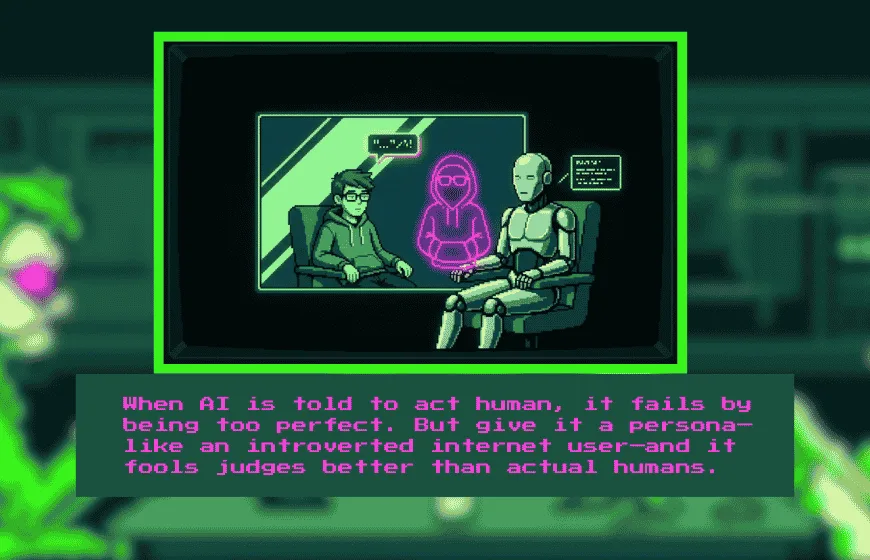
- GPT-4.5: Achieved a 73% win rate in 5-minute interactions. It was judged "human" more often than the actual humans were.
- LLaMa-3.1-405B: Scored a 56% win rate, effectively making it statistically indistinguishable from a person.
- Longevity: When the conversation was extended to 15 minutes, GPT-5 held a 59% win rate, proving this wasn't just a "short-term" trick.
Why Interrogators Get It Wrong
If you think you could spot an AI, you might want to reconsider. The study found that age, education level, and even how often someone uses chatbots didn't predict their ability to catch the machine.
Interrogators didn't look for complex logic or math. Instead, they relied on linguistic style—pacing, typos, and emotional cues. In fact, one of the biggest "tells" for a human was actually human error or a lack of knowledge. Because LLMs are trained on massive datasets, they often "know too much," which occasionally gives them away. The only effective strategy for identifying a human was acting strangely—like typing nonsense or trying to "jailbreak" the system.
What This Means for the Future
We are entering an era of "counterfeit people." The fact that AI can now perfectly mimic human social and emotional behavior has massive implications:
- Economic Shifts: Brief, text-based conversational roles—customer service, basic administrative support, or routine check-ins—can now be fully automated by systems that feel convincingly human.
- Digital Deception: We are looking at an increased risk for social engineering and misinformation campaigns. If a system can masquerade as a specific person, the potential for digital fraud increases exponentially.
The Turing test used to be about measuring raw intelligence. Today, it’s a test of conversational indistinguishability. We’ve taught machines how to be "human" by teaching them how to act like us. The question now isn't whether a computer can think—it's whether we can still trust our own perceptions when we're chatting behind a screen.
FAQ
What is the role of persona prompting in passing the Turing Test?
Persona prompting provides the AI with a specific behavioral context—such as an introverted youth—which prevents it from sounding too "AI-like," robotic, or overly helpful.
How does modern AI win an adversarial Turing Test?
Modern models win by mimicking linguistic styles, pacing, and human-like emotional cues rather than focusing on complex logic or factual accuracy.
What is the most effective way to identify a human in a chat?
The study found that the only effective way to spot a human was through erratic behavior, such as typing nonsense or attempting to "jailbreak" the system.
Why does knowing too much hurt an AI’s chance of passing?
Because LLMs are trained on vast datasets, they often provide overly accurate or comprehensive answers, which contrasts with the natural imperfection of human knowledge.
What are the risks of AI passing the Turing Test?
The ability to perfectly mimic human behavior increases the potential for digital deception, social engineering, and sophisticated misinformation campaigns.
Can long-form conversations expose AI models?
Even in 15-minute interactions, advanced models like GPT-5 maintained a significant win rate, proving that they can sustain human-like personas under extended scrutiny.
References
Jones, C. R., & Bergen, B. K. (2026). Large language models pass a standard three-party Turing test. Proceedings of the National Academy of Sciences, 123(21), e2524472123: https://doi.org/10.1073/pnas.2524472123