Has AI Passed the Turing Test? Tavus Says Its Griffin Model Did, on Video
You may have heard that AI has already passed the Turing test. In a 2025 study posted on arXiv, people picked GPT-4.5 as the human 73% of the time in short text chats. Others say that result needs context. The model needed a special persona prompt, the study was posted before peer review, and winning the imitation game isn't proof of real intelligence, as Live Science pointed out.
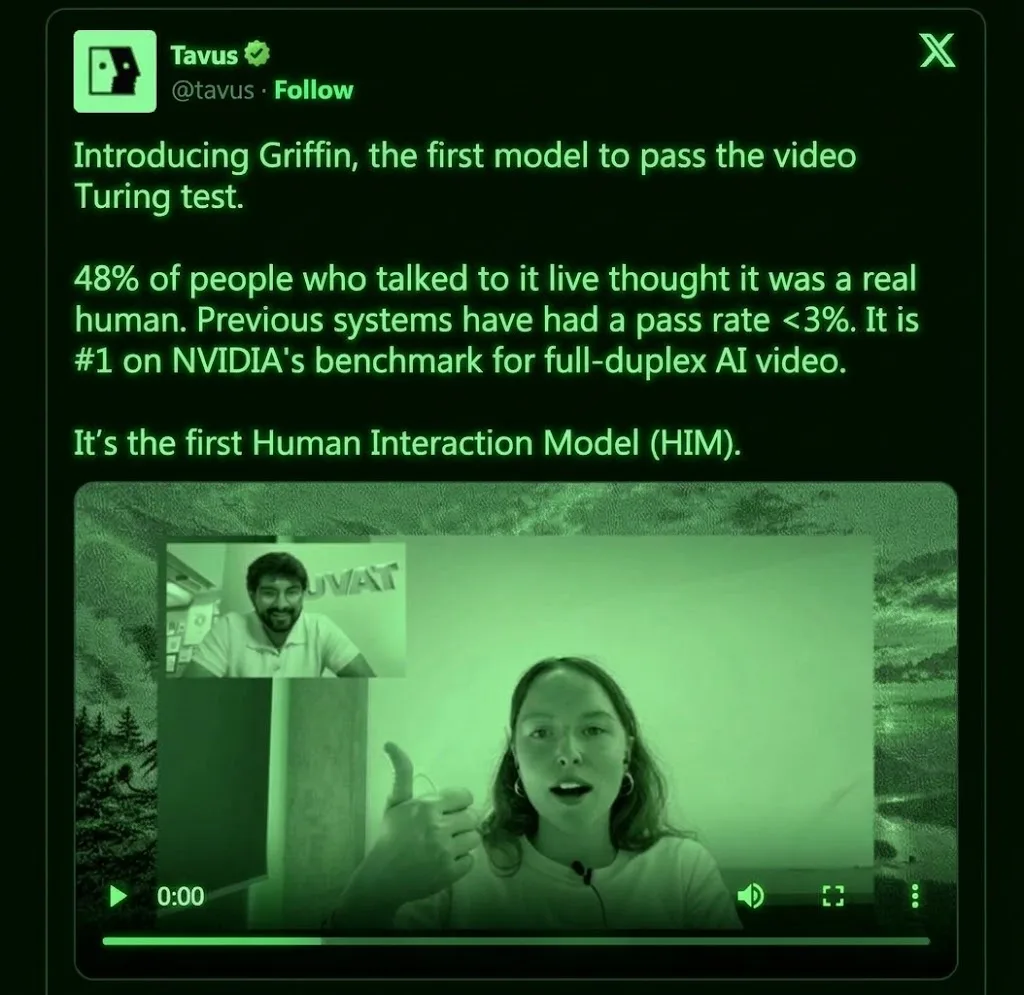
Now a new claim has joined the debate, and this one is on video. The AI company Tavus says its model Griffin is "the first model to pass the real-time, video Turing test." On its announcement page, Tavus says 48% of testers (26 of 54) believed Griffin was a real person after a one-minute video call.
So who is right? We read the reports. Below, we lay out what Tavus says, how the test seems to have been run, and what it means for the oldest question in AI: can you tell who you're talking to? We have not tested Griffin ourselves, and it is not publicly available. Everything about the model comes from Tavus or from outside coverage, and we say which is which.
The Turing Test in 60 Seconds
Alan Turing proposed his "imitation game" in 1950. A person chats with an unseen partner and tries to guess whether it is a human or a machine. If they can't tell, the machine is doing well at the game. Turing's version used text, and no single score has been agreed as a pass. For more background, see our Turing test explainer.
The 2025 study ran five-minute chats in which each person talked to a human and an AI at the same time, then picked which one was the human. The results:
- GPT-4.5, given a human-like persona prompt, was picked as the human 73% of the time.
- LLaMa-3.1-405B, with the same prompt, was picked 56% of the time.
- ELIZA and GPT-4o, the baseline models, were picked 23% and 21% of the time.
Live Science reports that the persona was an introverted young person who uses internet slang, and that models without the prompt did much worse. It also says people judged mostly on conversational style and personality, not on knowledge or reasoning.
Tavus's test is a different kind of test. In the 2025 study, people chose between a human and an AI, so 50% is the chance level. In Tavus's test, the review we read describes one partner per call and no human comparison group. A 48% there can't be lined up directly with a 73% in a three-party test.
What Tavus Says Griffin Can Do
Tavus calls Griffin a Human Interaction Model, or HIM, and says it is the company's first. It describes a video-to-video system that talks face to face in real time. Most AI avatars wait for you to finish, then answer. Tavus says Griffin listens while it talks, and that it pays "attention to expressions and pauses, not just words."
The company lists five abilities:
- Behavior and emotion: It shows emotions and gestures that fit the conversation.
- Full-scene video: It generates every frame live from one reference image, including the background and shadows.
- Full-duplex talk: It can interrupt, give small cues like "mm-hm," or be interrupted without losing its place.
- Perception: It reacts to what it sees, not only what it hears.
- Timing: It tracks how long a silence lasts and decides when to speak again.
Tavus also describes two engines under the hood. One decides when and how to speak. The other makes the speech and video. The company says decisions happen many times a second instead of once per turn. Demos described by Cybernews show Griffin laughing, showing surprise, and reacting when interrupted.
The Numbers Tavus Reports
Tavus's headline result is 48% of testers fooled, against 2.4% for its previous system. Every figure below comes from Tavus's announcement page, and none has been checked by an outside group except where noted. RuntimeWire reports the same 26-of-54 result, based on Tavus's post on X.
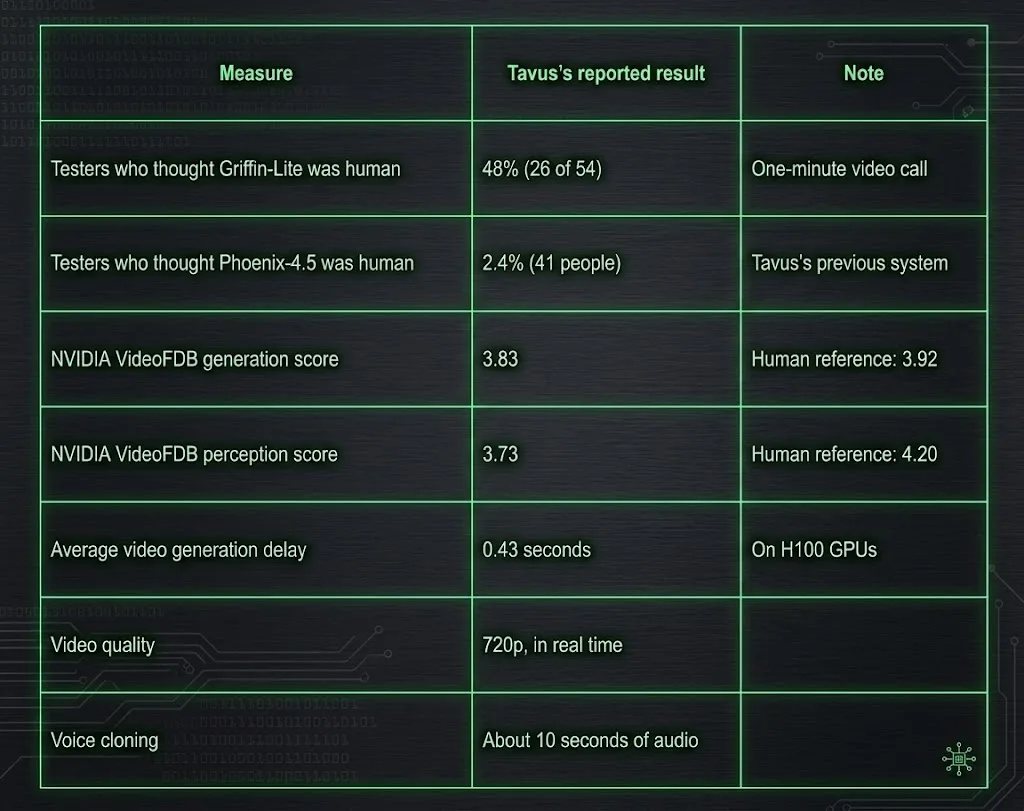
The NVIDIA scores are the closest thing to an outside check. They put Griffin close to the human reference on generating video, and further behind on perceiving what happens in a conversation. Tavus did not state the languages Griffin supports or any pricing.
How the Test Was Run
Coverage differs on how much is known. One independent review lists these details:
- Each call lasted one minute, and 54 people took part in the Griffin-Lite test.
- Participants were told they would chat with another participant about what they were looking forward to this year.
- They were not told they were testing an AI.
- Tavus asked about the partner's identity only after other survey questions.
- The only comparison was Tavus's older system. The review describes no separate human control group.
Two news reports say otherwise on the details. RuntimeWire says it does not know how participants were recruited or what they were told, and Cybernews says it found no details on design, sample size, or method. Treat the setup as unconfirmed until Tavus publishes full methods.
What the Result Does and Doesn't Show
The 48% shows that a short video call with Griffin can fool many people. It does not show that Griffin can pass as human in general. Several limits matter:
- Small sample. 54 people is a small group, and no breakdown of who they were has been reported.
- Company-run study. Tavus ran and reported the test on its own product. Neither news report independently verified the 48%.
- One minute only. The review notes that a minute can't test memory, consistency, or long conversations.
- An easy topic. Chatting about what you look forward to this year doesn't push as hard as a debate or a technical problem.
- Testers weren't warned. People who aren't looking for an AI may be easier to fool than people who are.
- No standard test. There is no accepted protocol for a "video Turing test," so the name is Tavus's own.
There is a fair point on the other side. The older system fooled only 2.4% of testers in the same kind of test. A jump from 2.4% to 48% is large, even in a small study. It suggests real progress in how natural these systems look and sound.
Still, passing as human only means people failed to spot the AI under set conditions. It doesn't say the AI is smart, honest, or safe.
Safety, Limits, and Availability
Griffin is not something you can use today. Tavus says the preview version, Griffin-Lite, is a research preview for select trusted testers, and that Griffin is not on its platform yet. Interested people can join a waitlist.
Tavus also names the risk itself. It says the same qualities that make these models convincing could let them trick people into thinking they are not talking to an AI. The company says more safety work is needed before a wider release.
Public reaction has focused on misuse. In comments on the Cybernews report, some readers worried that remote job interviews could become harder to trust, and one said disclosure is the only reliable way to know you're talking to an AI. Those are reader opinions, not findings.
Tavus points to uses like tutoring, practicing hard conversations at work, and customer support. The same realism could also help scammers or people who pose as someone else on a call.
Think You Can Spot the AI? Try It Yourself
Reading about a Turing test is one thing. Taking one is another. At Human or Not, you can try a Turing-style game and see how good your instincts really are. We offer three modes:
- Classic: Chat one-to-one with another player, then decide whether they were Human or AI. Play Classic.
- Group Chat: Chat with two other players for three minutes, then label each one Human or AI. Either could be a person or a bot. Play Group Chat.
- Image Game: See one image at a time and decide whether it is real or AI-generated. Play the Image Game.
You can play without registering. An account is optional and lets you appear on the leaderboard, save your stats, and keep your chat history.
A few tips before you start:
- Ask unusual questions. Bots do well with generic small talk but can struggle with recent events or deeply personal experiences.
- Don't trust typos or fast replies. Bots can be built to make casual mistakes and to type at a human pace.
- Compare players in Group Chat. Send both players the same prompt and see how each one answers.
- Keep personal details out. Everything on the site is public, so don't share private information in chats.
If Tavus's numbers hold up, a one-minute video call can fool nearly half of a small group. It is worth knowing how often your own guesses are right. Take a round and find out.
FAQ
Has AI passed the Turing test?
It depends on the test. A 2025 text study found GPT-4.5 was picked as the human 73% of the time, but it needed a persona prompt and was posted before peer review. Tavus now says its Griffin model passed a video version, based on 26 of 54 testers (48%). There is no agreed pass mark, so both claims need context.
What is the Turing test?
It is a game proposed by Alan Turing in 1950. A person chats with an unseen partner and tries to tell whether it is a human or a machine. Turing's version used text.
Is 48% a pass?
There is no agreed pass mark. In three-party tests, where people pick which of two partners is the human, 50% is the chance level. Tavus's test is set up differently, so the numbers don't line up directly.
Can I use Griffin now?
No. Griffin-Lite is a research preview for select trusted testers, and Tavus offers a waitlist.
Where can I try a Turing-style game myself?
At Human or Not. You can chat one-to-one, join a three-player Group Chat, or try the Image Game.
Sources
Figures were checked on October 17, 2026. Tavus's own claims are labeled as such in the post.
- Tavus: Griffin announcement: product description, 48% and 2.4% results, NVIDIA scores, latency, safety note, availability
- Remio: Tavus Griffin fooled 48% of callers, but its video Turing test needs context: test setup, one-minute calls, caveats
- RuntimeWire: Tavus says Griffin fooled 48% of testers in one-minute video calls: 26 of 54, sample size, availability
- Cybernews: Meet Griffin: demos, reader reactions, no stated test details
- Large Language Models Pass the Turing Test (arXiv, 2025): three-party text test results
- Live Science: GPT-4.5 is the first AI model to pass an authentic Turing test: persona prompt, peer review status, caveats
- Human or Not: Game Modes: Classic, Group Chat, and Image Game