Who Created the First AI Chatbot? Meet Joseph Weizenbaum
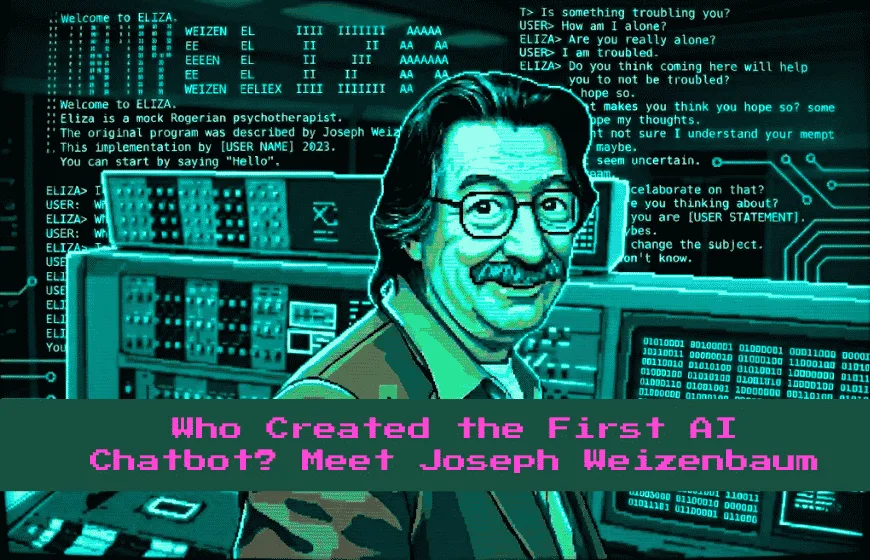
The person most widely credited with creating the first AI chatbot is Joseph Weizenbaum, a computer scientist at MIT who developed ELIZA in 1966. While ELIZA became famous as one of the earliest conversational computer programs, the story behind it is really the story of Weizenbaum himself.
His work helped shape the early history of AI, but what makes him especially interesting is that he later became one of the strongest critics of artificial intelligence. More than half a century after creating ELIZA, his ideas about technology, ethics, and human judgment remain surprisingly relevant.
Who Was Joseph Weizenbaum?
Joseph Weizenbaum was born in Berlin, Germany, in 1923. As the Nazi regime gained power, his Jewish family left Germany and emigrated to the United States in 1936.
After settling in America, Weizenbaum developed an interest in mathematics and computing. He eventually built a successful career in computer science during a time when computers were still new and largely limited to universities, governments, and large organizations.
His expertise led him to the Massachusetts Institute of Technology (MIT), where he became a professor and researcher. During the 1950s and 1960s, AI research was gaining momentum, and many scientists believed computers would eventually be able to mimic human intelligence.
Weizenbaum was interested in a slightly different question: how would people communicate with machines if computers could use language instead of commands?
How Joseph Weizenbaum Created the First AI Chatbot
In 1966, Weizenbaum created ELIZA while working at MIT. The program allowed users to type messages and receive responses through a text-based conversation.
Today, that may sound ordinary. At the time, however, most computers required technical commands and specialized knowledge. A program that appeared to hold a conversation with a human felt groundbreaking.
Because ELIZA simulated a dialogue between a person and a computer, many historians and AI researchers consider it the first recognized chatbot.
The program's success quickly attracted attention within the academic community and helped introduce the idea of conversational computing to a wider audience.
What Motivated Weizenbaum's Research?
Contrary to what many people assume, Weizenbaum was not trying to create an intelligent digital companion.
His goal was to explore communication between humans and computers. He wanted to see how language could be used as an interface and how people would react when a machine appeared to understand them.
The results surprised him.
Many users became deeply engaged with ELIZA and treated it as more than a simple computer program. Some even shared personal thoughts and feelings during their conversations.
Weizenbaum had expected people to recognize the limitations of the system. Instead, many responded as if the machine genuinely understood them.
That reaction would have a lasting impact on his views about artificial intelligence.
How ELIZA Changed Joseph Weizenbaum's Views on AI
The public response to ELIZA led Weizenbaum to question how much trust people should place in computers.
He became concerned that users were assigning human qualities to machines that merely followed programmed instructions. While others viewed these reactions as evidence of AI's potential, Weizenbaum saw a warning sign.
Over time, he became increasingly vocal about the ethical limits of artificial intelligence.
He argued that computers could be valuable tools, but they should not replace human judgment in areas involving empathy, morality, or important decision-making. In his view, some responsibilities belonged to people, regardless of how advanced technology became.
These concerns made him one of the earliest and most influential critics of unchecked AI adoption.
Joseph Weizenbaum's Legacy in Artificial Intelligence
Joseph Weizenbaum's legacy extends beyond creating the first AI chatbot.
His work demonstrated that humans could interact with computers through conversation, helping inspire future generations of AI researchers and chatbot developers. At the same time, his criticism of technology encouraged deeper discussions about ethics, responsibility, and the role of humans in an increasingly automated world.
Today, as AI chatbots become more advanced and widely used, many of the questions Weizenbaum raised decades ago remain at the center of public debate.
His contributions helped launch conversational AI, but his warnings remind us that technological progress should be approached thoughtfully.
If you're asking who created the first AI chatbot, the answer is Joseph Weizenbaum. In 1966, he developed ELIZA at MIT, creating one of the earliest programs capable of carrying on a text-based conversation with users.
While ELIZA secured his place in the history of AI, Weizenbaum's influence goes far beyond a single invention. Through both his pioneering work and his later ethical concerns, he helped shape how we think about artificial intelligence and its role in society.
FAQs
Who created the first AI chatbot?
Joseph Weizenbaum is widely credited with creating the first AI chatbot. He developed ELIZA at MIT in 1966.
What was Joseph Weizenbaum known for?
Joseph Weizenbaum was a computer scientist best known for creating ELIZA, one of the earliest chatbot programs, and for his later criticism of artificial intelligence.
Did Joseph Weizenbaum believe in artificial intelligence?
He contributed to early AI research, but he later warned against relying too heavily on machines for decisions that require human judgment, empathy, and ethics.
Why is Joseph Weizenbaum important in the history of AI?
He created ELIZA, which helped pioneer conversational computing, and he played a major role in shaping discussions about the ethical use of artificial intelligence.
What was Joseph Weizenbaum's biggest contribution?
His most famous contribution was creating ELIZA in 1966, a program widely recognized as the first chatbot.