What Are Some Criticisms of the Turing Test?
A few years ago, headlines started appearing with a familiar claim: a computer had finally passed the Turing Test. Some outlets framed it as a breakthrough and called it a landmark moment, while others questioned whether the achievement actually meant much at all. That split reaction points to a bigger question people have debated for decades: if a machine can successfully imitate a human conversation, does that mean it actually thinks?
That question sits at the center of many discussions about AI and the Turing Test. While the test remains one of the most famous ideas in artificial intelligence, it has also attracted some of the strongest criticism from philosophers, psychologists, and computer scientists.
We’ll look at what the Turing Test actually measures, explore the historical context behind it, and examine why many experts argue that passing it tells us less about intelligence than people often assume.
Key Takeaways
- Behavioral Trap: Intelligence is not defined solely by observable actions.
- Imitation vs. Understanding: Producing fluent text does not signify genuine cognition.
- The Chinese Room: Follow rules perfectly without ever grasping the underlying meaning.
- Subjectivity: Recognize that internal consciousness remains impossible to observe directly.
- Beyond Dialogue: Move assessments toward physical interaction and real-world environmental reasoning.
- Evolving Benchmarks: Stop relying on conversation to prove advanced machine intelligence.
- Historical Legacy: Use the test to question intelligence rather than measure it.
Behaviorism and the Turing Test
The Turing Test works only if you accept one major assumption: human-like behavior equals human-like intelligence. At first, that sounds reasonable because humans often judge intelligence through observable actions. But when you think about your own experiences, the idea becomes less straightforward.
People constantly experience internal mental states that never appear externally. You can feel pain without reacting, experience anxiety without speaking, become curious without acting, or process complex thoughts without visible behavior. The existence of internal experience suggests that mental activity and observable behavior are not identical.
This creates one of the biggest criticisms of the Turing Test. If cognition exists separately from behavior, then behavior alone cannot prove cognition. A machine may reproduce the external signs of intelligence while lacking actual understanding, and that distinction remains at the heart of many discussions about Turing Test flaws.
Simulating Intelligence Is Not the Same as Duplicating Intelligence
One of the strongest criticisms of the Turing Test is that imitation is not the same as intelligence. Imagine talking to someone who gives perfect responses in every conversation. That alone does not automatically prove they understand what they are saying because they may simply be exceptionally good at pattern matching.
This criticism becomes even more relevant in modern AI. Today’s large language models can generate fluent responses, explain concepts, and mimic human conversation with surprising accuracy. Yet many researchers argue this does not necessarily demonstrate consciousness, self-awareness, intentional thought, or subjective understanding.
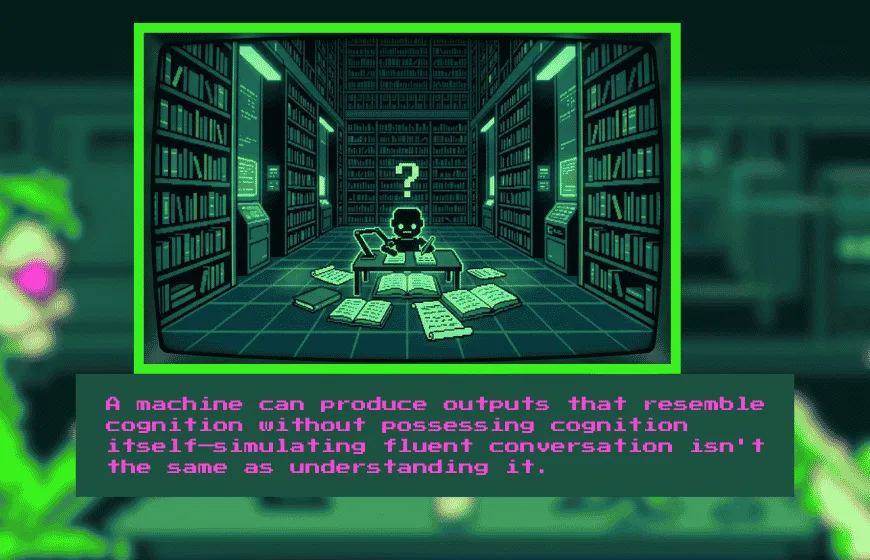
In other words, a machine may produce outputs that resemble cognition without possessing cognition itself. Passing a conversational test measures performance, but it does not reveal whether any internal understanding exists.
Philosophical Arguments Against the Turing Test
Several philosophical objections challenge the idea that conversation alone reveals intelligence.
The Chinese Room Argument
Philosopher John Searle introduced the famous Chinese Room thought experiment to challenge assumptions about machine understanding. Imagine a person sitting inside a room following instructions to manipulate Chinese symbols. To observers outside the room, it appears the person understands Chinese.
However, internally there is no understanding—only rule-following. Searle argued that computers may operate in a similar way by processing symbols without understanding meaning. This argument directly attacks the idea that passing the Turing Test proves cognition.
Consciousness Cannot Be Observed Directly
Another criticism is that intelligence may involve subjective experience. Even if a machine perfectly imitates human conversation, there is still no direct way to observe whether it experiences awareness.
This creates what philosophers call the “other minds problem.” If internal consciousness cannot be directly measured, then conversational behavior becomes incomplete evidence for determining intelligence.
Philosophical Arguments Against the Turing Test
Several philosophical objections challenge the idea that conversation alone reveals intelligence.
The Chinese Room Argument
Philosopher John Searle introduced the famous Chinese Room thought experiment to challenge assumptions about machine understanding. Imagine a person sitting inside a room following instructions to manipulate Chinese symbols. To observers outside the room, it appears the person understands Chinese.
However, internally there is no understanding—only rule-following. Searle argued that computers may operate in a similar way by processing symbols without understanding meaning. This argument directly attacks the idea that passing the Turing Test proves cognition.
Consciousness Cannot Be Observed Directly
Another criticism is that intelligence may involve subjective experience. Even if a machine perfectly imitates human conversation, there is still no direct way to observe whether it experiences awareness.
This creates what philosophers call the “other minds problem.” If internal consciousness cannot be directly measured, then conversational behavior becomes incomplete evidence for determining intelligence.
Human Errors Are Not Proof of Human Thought
Some AI systems can intentionally imitate mistakes, hesitation, humor, or emotional responses. These behaviors may feel realistic and create the impression of genuine thinking.
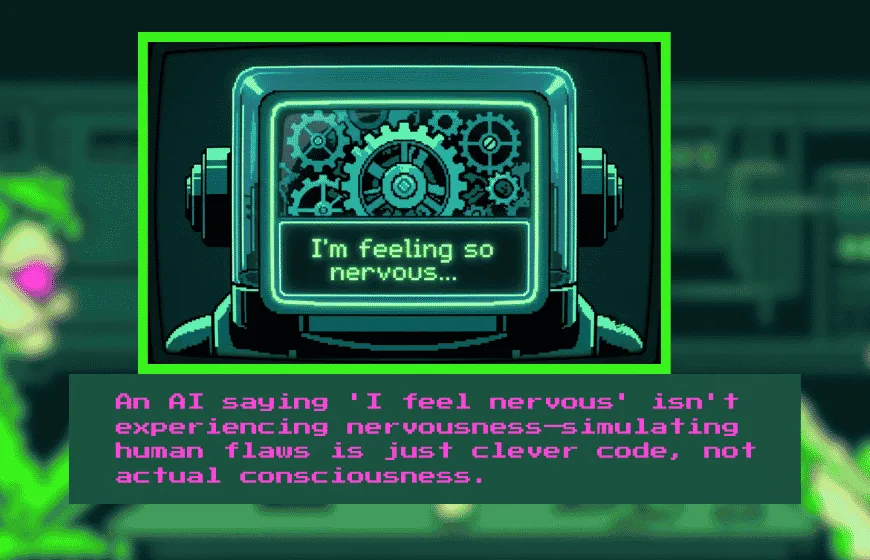
But reproducing those patterns does not automatically mean those experiences are real. A chatbot saying “I feel nervous” is different from actually experiencing nervousness.
Limitations of the Turing Test in Modern AI
As AI has improved, the limitations of the Turing Test have become easier to recognize. Modern systems can imitate language extremely well without necessarily understanding the world behind the words.
Narrow Focus on Conversation
The original test evaluates text interaction but ignores physical understanding, perception, and action. Human intelligence extends beyond dialogue alone.
Encourages Deception
Success often depends on appearing human rather than demonstrating genuine capability or understanding.
Rewards Surface-Level Behavior
Systems may optimize for believable responses instead of meaningful reasoning or accurate knowledge.
Ignores Internal Processes
The test evaluates outputs while remaining silent about how those outputs are generated and whether any understanding exists.
These limitations explain why many researchers no longer treat the Turing Test as the ultimate benchmark for AI progress.
Turing Test vs Total Turing Test: A Broader Alternative
Because of these criticisms, researchers proposed expanded approaches. One of the best-known alternatives is the Total Turing Test.
Unlike the original version, this approach evaluates more than conversation. It includes visual perception, physical interaction, reasoning, language understanding, and environmental awareness. The idea behind it is straightforward: human intelligence involves more than producing convincing dialogue.
If an AI truly understands the world, it should demonstrate that understanding across multiple domains. This comparison between the Turing Test vs Total Turing Test shows how AI evaluation has evolved over time.
Other Alternatives to the Turing Test
Researchers have proposed additional frameworks to address Turing Test flaws and broaden how intelligence is measured.
The Lovelace Test
This framework focuses on whether an AI can create something genuinely original rather than simply imitate existing patterns.
Winograd Schema Challenge
This approach measures contextual understanding and reasoning instead of conversational realism.
Embodied AI Evaluation
These evaluations test whether systems can interact with and respond to real environments.
Multi-Domain Benchmarking
This method combines language, logic, memory, planning, and perception into a broader assessment.
Each alternative attempts to answer a larger question: not “Can AI imitate humans?” but “Does AI actually understand?”
Real-World AI and the Turing Test
Modern AI systems have reignited interest in these debates. Some systems generate responses that feel natural enough to temporarily confuse users and create the impression of intelligence.
However, confusion is not the same as proof. Many models still struggle with long-term consistency, causal reasoning, understanding context, and grounding language in reality.
That gap reminds us that convincing interaction and genuine cognition may be different things. The ability to simulate intelligence remains impressive, but whether it equals intelligence is still unresolved.
The Future of AI Assessment
The future of AI evaluation will likely move beyond a single conversation-based benchmark. Researchers increasingly explore combinations of reasoning tests, memory evaluation, creativity benchmarks, multimodal understanding, and real-world interaction.
The goal is shifting from measuring imitation toward measuring capability. That does not make the Turing Test irrelevant—it still holds historical and philosophical importance.
Its biggest contribution may not be measuring intelligence itself, but changing how people think about intelligence and forcing researchers to ask difficult questions that still matter today.
Is Passing the Turing Test Evidence of Intelligence?
So, what are some criticisms of the Turing Test?
At its core, the criticism is simple: behavior is not necessarily thought. The Turing Test assumes that if a machine behaves intelligently, intelligence must be present.
But many philosophers, psychologists, and AI researchers argue that cognition may involve far more than outward performance. A machine can imitate conversation, but that does not automatically mean it understands. Until we understand consciousness and cognition more clearly ourselves, the debate around AI and the Turing Test is probably far from over.
FAQ
What is the main criticism of the Turing Test?
The core criticism is that the test measures behavior rather than actual cognition, meaning a machine can imitate intelligence without truly understanding what it is saying.
Does a chatbot that feels real possess consciousness?
No; producing human-like responses or expressing emotions like nervousness is merely pattern matching and does not indicate the machine is actually experiencing those feelings.
What is the Chinese Room argument?
Proposed by John Searle, this thought experiment suggests that a computer can manipulate symbols to give correct answers without ever understanding the meaning behind them.
What is the difference between the Turing Test and the Total Turing Test?
The original Turing Test focuses strictly on text-based conversation, while the Total Turing Test includes physical interaction, visual perception, and environmental reasoning.
Why is modern AI better at passing the Turing Test?
Modern large language models are highly skilled at generating fluent, human-like text, which allows them to simulate conversation successfully despite lacking genuine internal understanding.
Is there a better way to measure AI intelligence?
Researchers now prefer multi-domain benchmarking that combines logic, creativity, physical interaction, and reasoning to assess a system's true capabilities.