How Do We Make a Robot to Pass the Turing Test?
When people ask, “How do we make a robot to pass the Turing test?”, they’re usually imagining something straight out of science fiction—a machine that talks naturally, understands people, and becomes impossible to distinguish from a human.
But that question hides something interesting.
Passing the Turing test and creating true intelligence are not necessarily the same thing.
That distinction matters because the Turing Test was never introduced as the final exam for artificial intelligence. It started as a thought experiment—one that became far more influential than its creator may have intended.
Today, AI systems are getting surprisingly good at sounding human. Yet many researchers would argue that success in conversation tells us more about human expectations than actual machine understanding.
So if someone genuinely wanted to build a robot capable of passing the Turing Test, what would that involve?
Let’s walk through it.
Key Takeaways
- Prioritize NLP. Build systems that interpret language and maintain conversational flow.
- Master Learning. Train models on diverse datasets to mimic human reasoning patterns.
- Simulate Flaws. Incorporate hesitation and uncertainty to avoid appearing overly perfect.
- Retain Context. Implement memory systems to track long-term dialogue and consistency.
- Understand Psychology. Leverage human shortcuts to project confidence and emotional smoothness.
- Evaluate Beyond. Use physical and creative tests for a true measure of intelligence.
- Address Ethics. Manage the risks of deception and emotional manipulation in development.
Alan Turing 1950 Paper
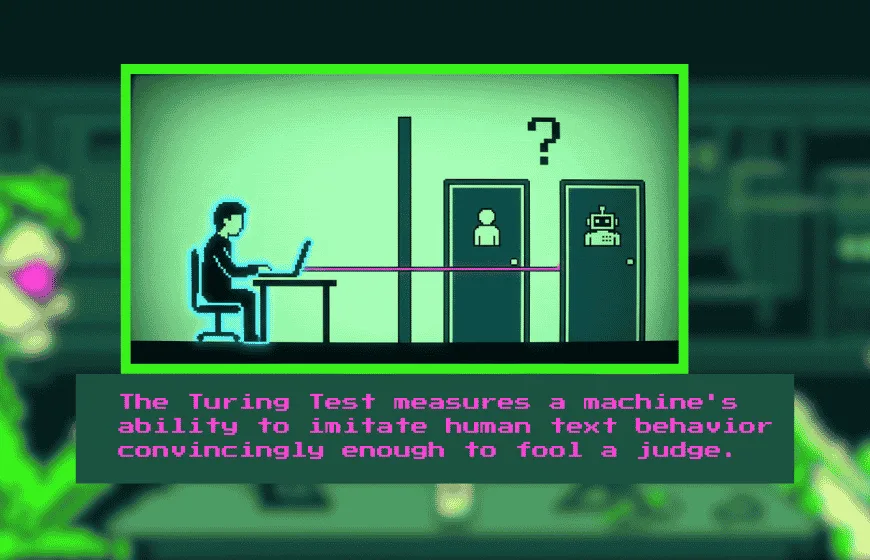
The Turing Test comes from a 1950 paper called Computing Machinery and Intelligence by British mathematician Alan Turing.
Instead of asking:
“Can machines think?”
Turing proposed a different question:
“Can a machine imitate human responses well enough that a person cannot reliably tell the difference?”
The setup was simple.
A human judge communicates through text with two participants:
- One human
- One machine
If the judge cannot consistently identify which is the machine, the machine is said to pass.
That’s it.
No brain scans. No consciousness measurement. Just interaction.
This is why the Turing Test significance extends beyond engineering—it changed how people think about intelligence itself.
Understanding Turing’s Goal
A lot of people misunderstand Turing’s goal.
He was not creating the ultimate certification for artificial intelligence.
In his original paper, Turing was responding to objections people had about intelligent machines.
People argued things like:
- Machines only follow instructions
- Machines cannot think creatively
- Machines cannot reason
The Turing Test became a way to explore those objections.
It was essentially:
“If behavior looks intelligent, maybe our definition of intelligence deserves another look.”
That’s very different from saying:
“If a machine passes, it is definitely intelligent.”
That nuance gets lost surprisingly often.
How Do We Make a Robot to Pass the Turing Test?
If the goal is purely to pass the test—not necessarily achieve human cognition—you can think of it as solving five major challenges.
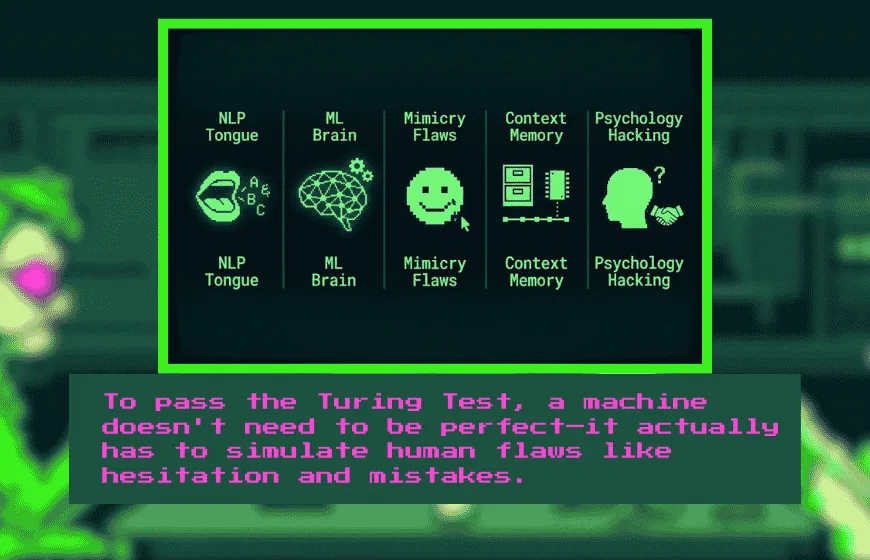
1: Build Strong Natural Language Processing
The first requirement is obvious.
A robot has to communicate.
Modern natural language processing (NLP) allows machines to:
- interpret language
- generate responses
- maintain context
- follow conversational structure
Without NLP, conversations fall apart almost immediately.
Early chatbots relied on templates and keyword matching.
Modern systems instead predict likely responses based on massive language patterns.
Simplified, they work something like this:
A system estimates:
“Given everything already said, what word is most likely to come next?”
That sounds simple.
But repeated billions of times, that process becomes surprisingly powerful.
2: Train Through Machine Learning
Conversation alone isn’t enough.
The robot must adapt.
This is where machine learning becomes essential.
Machine learning allows systems to improve through data instead of fixed rules.
Rather than programming:
If user says X → respond Y
Developers train models on huge collections of language examples.
The system gradually learns:
- sentence structure
- conversational timing
- humor
- common assumptions
- patterns of human reasoning
Ironically, humans themselves are inconsistent enough that perfect logic often sounds less human.
3: Mimic Human-Like Interaction
This is where things get strange.
The Turing Test measures whether something feels human.
Not whether it is human.
That means successful systems often simulate imperfections.
Human-like interaction includes:
- hesitation
- uncertainty
- emotional language
- changing opinions
- occasional mistakes
- imperfect memory
Oddly enough, being too perfect can make an AI easier to identify.
Humans interrupt themselves.
Humans wander.
Humans sometimes answer questions badly.
Machines that never do that can feel suspicious.
4: Maintain Context Across Conversations
One reason humans feel intelligent is continuity.
People remember earlier points.
They reference old information.
They adjust their answers.
To create convincing conversational AI, developers work on:
- context windows
- memory systems
- long-term consistency
- dialogue tracking
Without context retention, conversations quickly reveal robotic patterns.
5: Understand Human Psychology
This may be the most overlooked part.
Modern Turing-style systems are often exploiting human psychology as much as advancing AI.
People assume intelligence from:
- confidence
- emotional language
- detailed explanations
- conversational smoothness
That means appearing intelligent and being intelligent are not always aligned.
Some researchers even joke:
Modern Turing Tests reveal human shortcuts more than machine understanding.
Why Passing the Turing Test Isn’t the Same as Artificial Intelligence
This is where criticism enters.
Even if a robot passes, many researchers would not call that proof of intelligence.
Why?
Because the test measures outputs.
It doesn’t examine internal understanding.
A machine might:
- produce realistic conversation
- imitate reasoning
- simulate emotions
without possessing awareness.
That’s why artificial intelligence research increasingly focuses on broader evaluation.
Passing the Turing Test can demonstrate capability.
It does not settle questions of consciousness.
Why Modern Language Models Feel Different
People often say AI suddenly became impressive. But the shift happened gradually. Years ago, conversational systems felt obviously robotic. Responses were repetitive. Context disappeared quickly. Now something changed.
Many systems produce coherent, focused answers. That change resembles what happened in another field: computer Go. At one point, Go programs were around 4–5 dan level. Strong enough to surprise people. But they made recognizable mistakes.
Then major algorithm improvements happened. Performance jumped dramatically. Humans could still notice “machine mistakes,” but exploiting them became unrealistic. Language models seem to be following a similar pattern. Today’s systems still make unusual errors. But spotting those errors is becoming harder.
Turing Test vs Other Ways of Measuring Intelligence
Because of these limitations, researchers created alternatives.
The Lovelace Test
Measures creativity.
Can a system produce something genuinely original?
The Coffee Test
Can a robot enter a home and successfully make coffee?
That requires:
- perception
- reasoning
- movement
- adaptation
The Total Turing Test
Expands beyond conversation.
It evaluates:
- physical interaction
- vision
- language
- reasoning
This addresses one weakness of text-only evaluation.
Ethical Challenges of Building Human-Like Robots
Once robots become difficult to distinguish from humans, ethics becomes unavoidable.
Questions start appearing quickly.
Should machines identify themselves?
Should people know when they’re speaking to AI?
Could highly convincing systems manipulate users?
Some major AI ethics concerns include:
- deception
- misinformation
- emotional dependency
- privacy
- accountability
Building robots that pass the Turing Test creates responsibilities alongside technical achievements.
Future Trends: Will Robots Eventually Pass the Turing Test?
Probably.
At least under ordinary conversational conditions.
But that may not be the milestone people imagine.
Future systems will likely combine:
- language understanding
- robotics
- memory
- perception
- reasoning
- multimodal learning
The interesting question may stop being:
“Can robots pass the Turing Test?”
And become:
“What should passing actually prove?”
So, How Do We Make a Robot to Pass the Turing Test?
Technically, you combine:
- natural language processing
- machine learning
- conversational AI
- context management
- human-like interaction
But there’s another layer.
Passing the Turing Test was never intended to be final proof of intelligence.
Alan Turing used it to challenge assumptions—not end debates.
And today, as AI gets better at conversation, the question becomes less about whether machines can sound human and more about whether sounding human means anything at all.
FAQ
What are the five main technical requirements to pass the Turing Test?
To pass, a system requires robust Natural Language Processing, advanced machine learning, the ability to mimic human imperfections, long-term context retention, and an understanding of human psychology.
Why is being "too perfect" a disadvantage for an AI?
Humans are naturally inconsistent, often hesitating, making mistakes, or wandering in conversation; an AI that is too perfect or logical is easily identified as a machine.
Is passing the Turing Test proof that a robot is intelligent?
No. The test measures the ability to imitate human output, not the presence of internal awareness, consciousness, or true cognitive understanding.
How does context management affect the Turing Test?
Convincing conversation requires remembering earlier points and referencing them later; without this continuity, a system will quickly reveal its robotic, non-human nature.
What is the difference between the Turing Test and the Coffee Test?
The Turing Test is a text-based conversational benchmark, whereas the Coffee Test evaluates physical interaction, vision, and real-world reasoning by tasking a robot to navigate a home and make coffee.
Why are modern AI ethics concerned with convincing robots?
Highly convincing robots pose risks regarding deception, misinformation, emotional manipulation, and the potential for users to form unhealthy emotional dependencies.