Turing Test Classroom Activity for Teachers: Can Your Students Spot the Machine?
Key Takeaways
- Run a Turing test with three volunteers, scripted answers, and zero devices.
- Use blind answer-sorting for a low-prep, whole-class version.
- Teach that passing the test measures humanlikeness, not intelligence.
- Debrief with the clues students trusted, because those clues are the real lesson.
- Set rules first: never type personal information into a chatbot.
Turing Test Classroom Activity for Teachers: Can Your Students Spot the Machine?
Here's a Turing test classroom activity for teachers that fits in one period and works with or without devices. It also gives students something rare: a fair reason to question their own confidence about spotting AI.
The Study That Makes This Lesson Timely
UC San Diego cognitive scientists Cameron Jones and Benjamin Bergen ran a three-party Turing test, where each judge chatted with a human and an AI at the same time. GPT-4.5 was judged to be the human 73% of the time when it was given a persona to play, which was more often than the real human participants. Without persona instructions, it dropped to 36%, and the 1960s chatbot ELIZA landed at 23%.
Here's the catch for your classroom. Most students walk in sure they can spot AI by its stiff grammar or its lack of typos. This lesson lets them test that confidence, and it shifts the question from "is it smart?" to "what makes writing feel human?" That's a much better question for a 45-minute class.
The No-Devices Version: Three Volunteers and a Stack of Cards
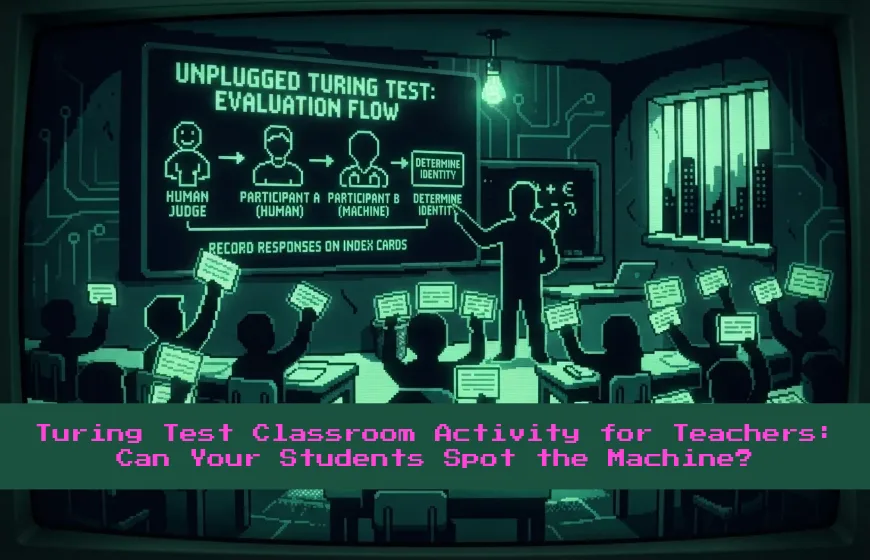
ISTE+ASCD describes a classic unplugged setup: three volunteers, one scripted "computer," and a class of judges. One volunteer answers only with provided responses, another answers freely as the human, and both wait outside. The third relays their answers to the class, who decide which is which.
Here's how I'd run it in about 40 minutes:
- Before class: write 12 questions and 12 answer cards for the "computer." Make some cards fit and some deliberately miss.
- Brainstorm (5 min): ask the class which questions might trip up a machine.
- Rounds (15 min): relay each question, read both answers aloud, and let students jot a guess.
- Vote (5 min): a silent hand-raise, then the reveal.
- Debrief (10 min): see the questions below.
I'd keep the brainstorm even when time is tight. It's where students form hypotheses they can actually test.
Here's how a good round sounds:
Student asks: "What did you have for breakfast?"
Computer card: "I do not eat. Please ask another question."
Human volunteer: "Cold pizza. Don't judge."
And here's the one that does the teaching:
Student asks: "What does rain smell like?"
Computer card: "Rain is water falling from clouds."
Human volunteer: "Hot sidewalk, with something kind of metallic."
The card isn't wrong. It just doesn't answer the question that was asked. Point that out, because it's the heart of the lesson.
The Low-Prep Version: Sort the Answers Blind
Aarhus University describes an activity where students judge whether a chatbot or classmates wrote each answer. If the chatbot's answers can't be identified, it has passed. The same format can be tried with an image generator.
To run it:
- Pick three prompts, such as "Describe your best Saturday in three sentences."
- Have students write anonymous answers on slips.
- Generate AI answers ahead of time and mix them in with five or six student slips. Number everything.
- Let the class vote, tally the results, and reveal which slips were which.
Fair warning: use a school-approved tool and check your district's AI policy before any student touches a chatbot. Keep prompts free of names, locations, and personal details.
Debrief: Where the Real Learning Happens
Bjorn Geoghegan of the University of Gothenburg designed a classroom Turing test built around culturally specific language markers, such as vocabulary. Geoghegan argues that practice parsing human-to-human versus human-to-machine communication helps students use generative AI skillfully.
For your debrief, give students three questions:
- What clue did I trust?
- Was that clue about intelligence, or about style?
- Could a person or a program fake that clue?
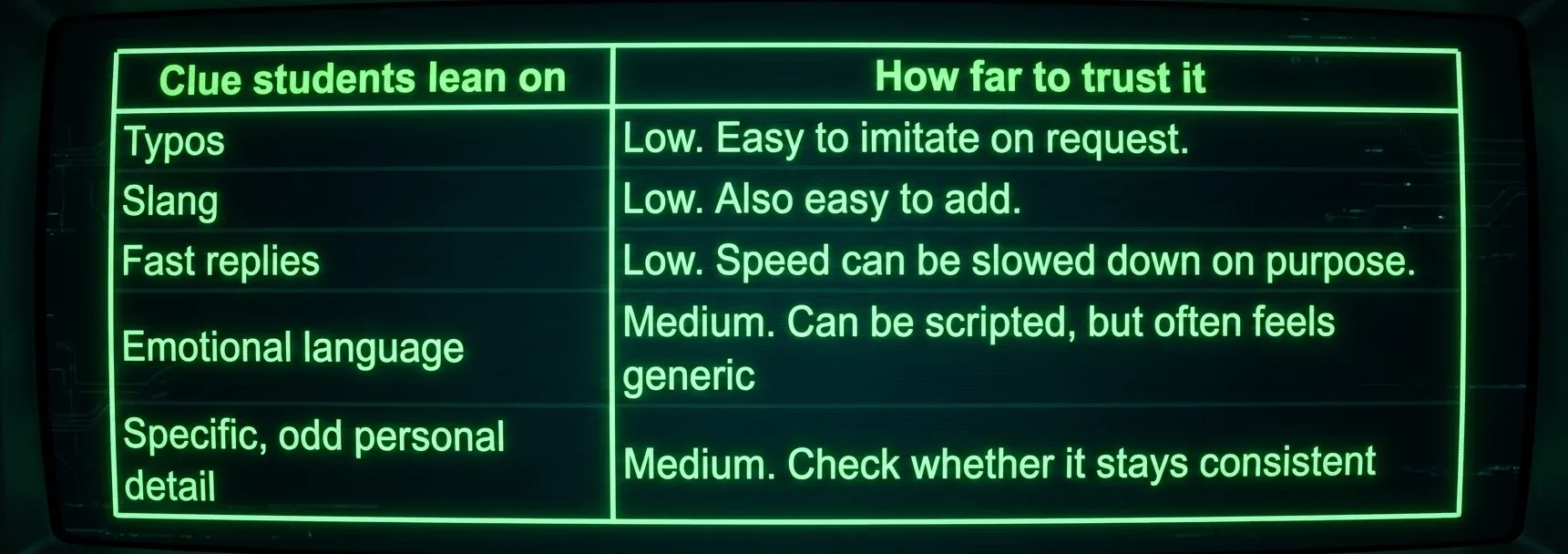
Then show them how reliable their favorite clues really are:
My pet peeve is closing with "So did the machine win?" It's the least interesting question in the room. I'd ask what clues the winners relied on instead.
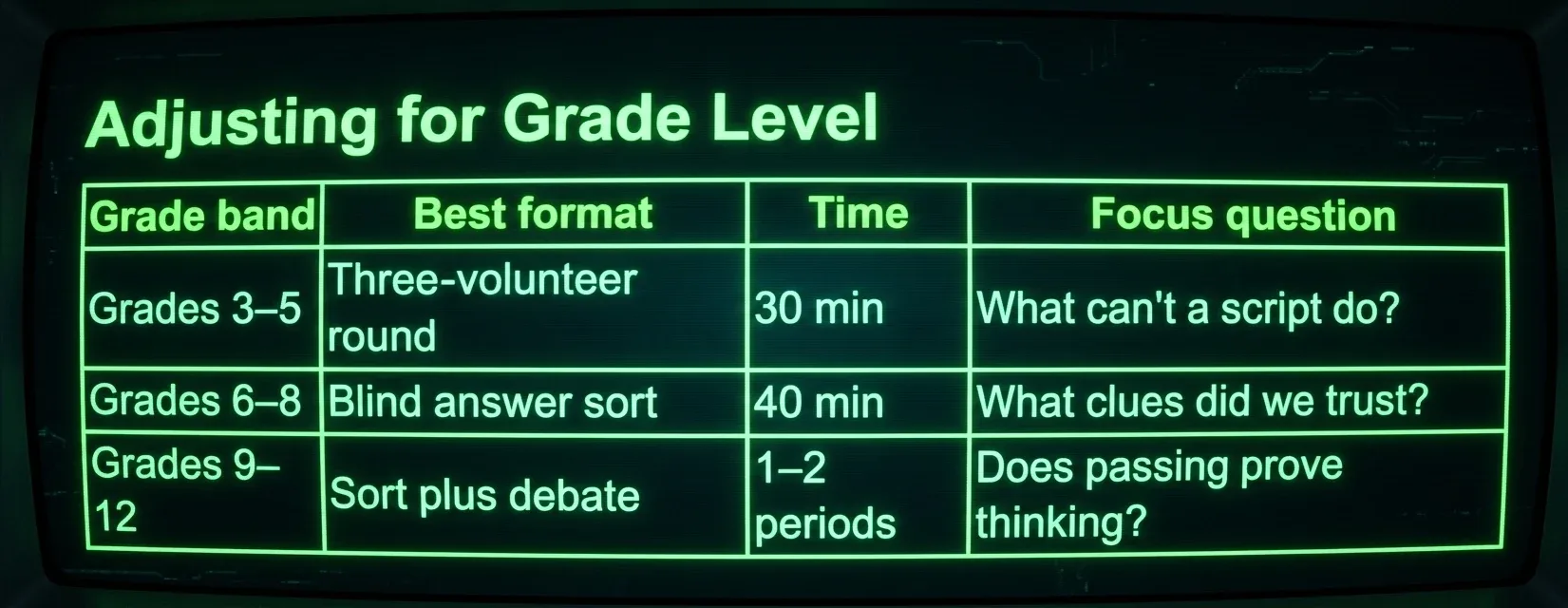
One classroom round can't prove anything about real machines. Treat it as a discussion prompt, not an experiment.
Your Next Class Period
Pick one format, write your cards or prompts tonight, and save ten minutes for the debrief. The game gets students engaged, but the conversation afterward is what they'll remember.
FAQs
Can I use a live chatbot with students?
Only on a school-approved tool, with you controlling the screen. Let students suggest questions, but don't let anyone type names, locations, or other personal details. Check your district's AI policy first, since rules differ by age and platform.
Does an AI "passing" mean it's intelligent?
Not necessarily. UC San Diego's Ben Bergen says the test increasingly measures humanlikeness rather than raw brainpower. That makes a strong prompt for older students: can something imitate a person convincingly without understanding anything?
What if students guess right every time?
That's a result, not a failure. Scripted cards are easy to spot, and noticing why is the lesson. To raise the difficulty, write better cards, narrow the question list, or switch to the blind sort using AI-written answers.
How do I assess it?
Grade reasoning, not accuracy. Ask each student to name two clues they used and say whether each could be faked. A quick exit ticket works well: "One clue I'd trust less next time, and why."
Is this only for computer science class?
No. English classes can focus on voice, social studies on misinformation, and philosophy on imitation versus understanding. Jones and Bergen warn that convincing humanlike bots could be misused for social engineering or misinformation, so the topic reaches well beyond coding.
Sources
- Cameron R. Jones and Benjamin K. Bergen, UC San Diego, "Large Language Models Pass the Turing Test," arXiv, 2025, https://arxiv.org/abs/2503.23674v1 (also https://ar5iv.labs.arxiv.org/html/2503.23674)
- UC San Diego, "AI can seem more human than real humans in a classic Turing test, study finds" (title inferred from URL), UC San Diego Today, year not seen, https://today.ucsd.edu/story/ai-can-seem-more-human-than-real-humans-in-a-classic-turing-test-study-finds
- UC San Diego, news release on the same study (title not seen), EurekAlert, https://www.eurekalert.org/news-releases/1128875
- Nicole Krueger, "3 Unplugged Activities for Teaching About AI," ISTE+ASCD Blog, 2022, https://www.ascd.org/blogs/3-unplugged-activities-for-teaching-about-ai
- Aarhus University, "The Turing Test," Aarhus University Educate, year not seen, https://educate.au.dk/en/activities/the-turing-test
- B. D. Geoghegan, University of Gothenburg, "GIFT-AI: The Cringe Test: student evaluations of intelligence with LLMs in a Turing Test adapted for classroom use," Frontiers in Education, 2026, https://www.frontiersin.org/journals/education/articles/10.3389/feduc.2025.1629513/full