Reverse Turing Test: When AI Agents Try to Spot the Human Imposter
For decades, the Turing test asked a simple question: can a machine imitate a human well enough to fool us?
Now that question is flipping.
The reverse Turing test asks something more uncomfortable: can AI agents identify a human hiding among them?
And in some environments—especially agent-to-agent systems—the answer is increasingly yes.
Not perfectly. Not reliably. But often enough to raise real questions about how we interact with machines, and how machines interpret us.
This isn’t a theoretical exercise anymore. It’s showing up in security systems, content moderation tools, and AI-driven platforms where distinguishing human behavior from machine behavior actually matters.
The twist is how AI figures it out.
Because it’s not always what you’d expect.
Key Takeaways
- AI can now detect human behavior patterns
- Humans appear as anomalies in AI systems
- Detection relies on structure, timing, and consistency
- Reverse Turing tests are already in use
- Human vs AI distinction is becoming less clear
From Turing’s Question to Its Mirror Image
The original Turing test, proposed by Alan Turing in 1950, was never really about trickery. It was about indistinguishability.
If a human couldn’t reliably tell whether they were talking to a machine or another person, the machine could be considered “intelligent” in a practical sense.
For decades, that was the benchmark.
Then something changed.
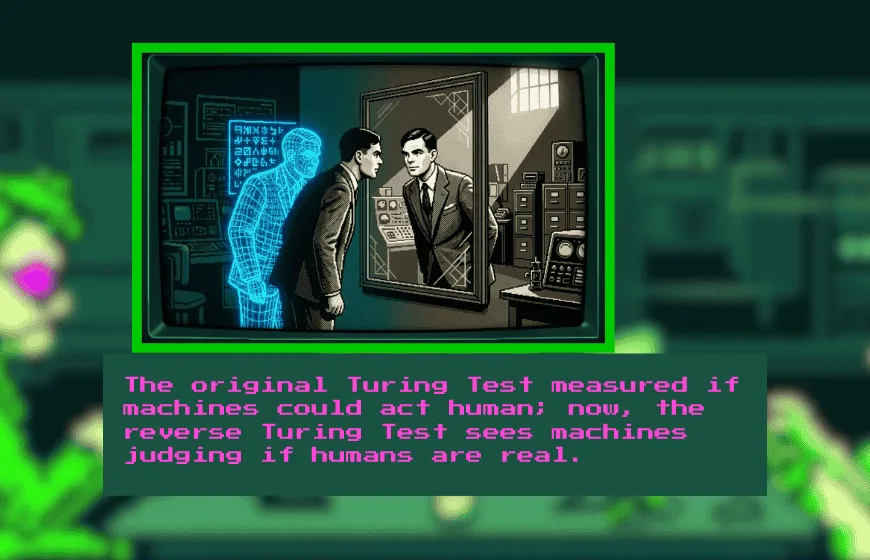
Large language models, advances in machine learning, and improvements in natural language processing pushed AI closer to that threshold. Suddenly, the question wasn’t just whether machines could pass as human.
It was whether humans could still pass as human in systems increasingly shaped by machine logic.
That’s where the reverse Turing test comes in.
Instead of humans judging machines, machines are now judging humans.
Also Read: Who Is Alan Turing? The Man Behind the Turing Test
What Is a Reverse Turing Test, Really?
At its core, a reverse Turing test flips the roles.
AI agents analyze behavior. The subject may be human or machine. The goal is to detect the human.
That might sound backwards, but it reflects a real shift.
In many digital environments today—automated platforms, AI-driven forums, trading systems, or bot-heavy networks—machines are the majority participants. Humans become the anomaly.
And anomalies are easier to detect than norms.
The reverse Turing test isn’t one single method. It’s a category of techniques used by AI systems to evaluate patterns in language, response timing, consistency, and decision-making.
AI isn’t asking, “does this sound human?”
It’s asking, “does this behave like a system?”
If the answer is no, that’s when suspicion starts.
How AI Actually Spots a Human Imposter
Most people assume AI detects humans by looking for emotion, slang, or creativity.
That would make sense.
It’s also not the main signal.
AI systems trained in cognitive computing environments tend to focus on structure, not personality.
Some of the strongest indicators include:
Inconsistency across interactions. Humans contradict themselves more often. Not dramatically, but enough to create detectable variation over time.
Irregular timing patterns. Machines respond with measurable consistency. Humans pause, hesitate, multitask, or reply in bursts.
Non-optimized decision-making. AI systems lean toward efficiency. Humans take detours, change direction, or act on incomplete logic.
Context leakage. Humans bring in outside knowledge unpredictably. AI agents usually stay within defined bounds unless prompted otherwise.
What makes humans human—flexibility, unpredictability, context-switching—can make them easier to detect in machine-dominated environments.
Where Reverse Turing Tests Are Already Being Used
This isn’t just theoretical.
Variations of the reverse Turing test are already embedded in real systems.
In security and fraud detection, banks and platforms use AI models to flag unusual behavior. If a system expects consistent, machine-like patterns and sees human irregularity, it can trigger alerts. In some contexts, the human becomes the suspicious actor.
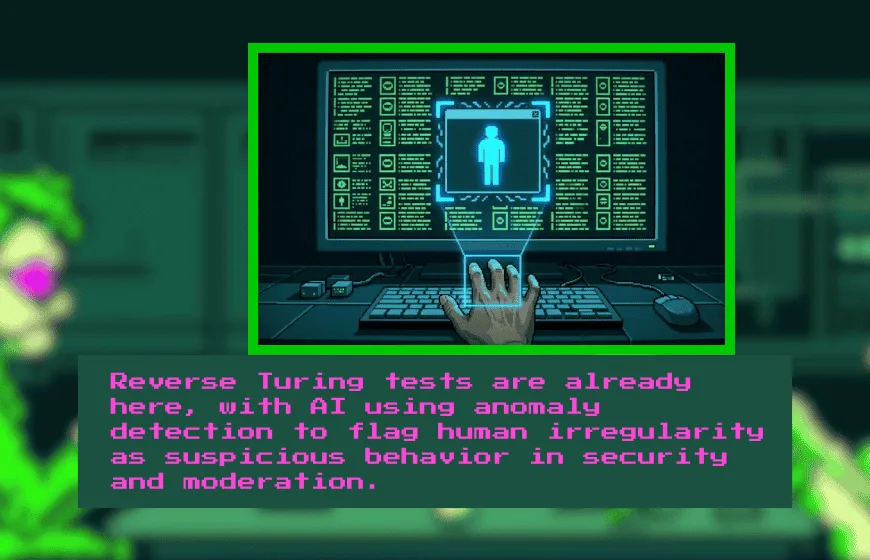
In content moderation, platforms use AI to separate spam, coordinated campaigns, and genuine interaction. The challenge is that humans often behave like bots, and bots increasingly behave like humans.
In AI-to-AI networks, especially in experimental or autonomous environments, identifying a human becomes a form of anomaly detection. If most participants are AI agents, the human stands out by default.
A Case Worth Noting: When AI Flags the Human
In controlled environments, AI agents trained on behavioral consistency have shown a pattern.
They don’t just detect weak bots.
They sometimes flag humans as the anomaly.
A human might shift tone, introduce unrelated context, or make decisions that don’t follow a clear pattern. From a system trained on structured outputs, that looks like noise.
And noise is treated as a signal.
For years, human behavior was the reference point. In some AI systems, that’s no longer true.
The Weak Spots: Where Reverse Turing Tests Fail
These systems are far from perfect.
False positives are common. Highly structured humans—engineers, analysts, disciplined writers—can appear machine-like.
Adaptive AI behavior complicates things further. Advanced models can simulate hesitation, inconsistency, and even “mistakes.”
Context blindness remains a major issue. AI can detect deviation but not always understand why it happens.
Training bias also plays a role. Systems trained on narrow datasets may misclassify behavior that falls outside expected patterns.
Reverse Turing tests are good at spotting patterns.
They’re less reliable at interpreting them.
The Ethical Problem No One Likes to Talk About
There’s a quieter issue behind all of this.
If AI agents are constantly analyzing behavior to determine whether someone is human, it raises concerns about privacy and consent.
Most users don’t know when they’re being evaluated.
And unlike traditional methods like CAPTCHAs, reverse Turing tests are often invisible. There’s no prompt, no challenge, no clear boundary.
There’s also the issue of consequences.
If a system decides you don’t behave like a human—or behave too much like one in the wrong context—what happens?
Access could be restricted. Content could be flagged. Visibility could change.
The detection layer exists, but the accountability layer is still catching up.
Where This Is Heading Next
Reverse Turing tests are evolving quickly.
Future systems will likely rely more on behavior than text. How something is done will matter more than what is said.
Detection models will become more integrated, combining timing, structure, and interaction patterns.
At the same time, AI systems will continue adapting. They will learn to mimic human inconsistency more convincingly, making detection harder.
The boundary between human and machine behavior will keep blurring.
At some point, the distinction may become less useful than we assume.
So What Does a Reverse Turing Test Really Tell Us?
It doesn’t prove intelligence or consciousness.
What it reveals is simpler.
AI systems are becoming very good at recognizing patterns. And humans don’t always fit those patterns.
That’s the shift.
For decades, we measured machines against ourselves.
Now, in some systems, we are being measured against them.
The reverse Turing test is not just a technical idea.
It’s a sign that the environment has changed.
When AI agents can question whether you’re human, it means human behavior is no longer the default reference point everywhere.
And that leads to a slightly uncomfortable question.
If a machine decides you don’t behave like a human, is that a limitation of the system—
or a reminder that humans were never as consistent as we thought?
FAQs
What is a reverse Turing test?
A reverse Turing test is when AI systems analyze behavior to determine whether a subject is human or machine.
How does AI detect humans?
AI detects humans by analyzing inconsistencies, response timing, decision patterns, and deviations from machine-like behavior.
Where are reverse Turing tests used?
They are used in fraud detection, content moderation, AI networks, and automated systems that monitor behavior patterns.
Can AI accurately identify humans?
Not always. AI can misclassify humans due to bias, limited context, or overly rigid pattern recognition.
Why do humans appear as anomalies to AI?
Humans behave inconsistently, switch context, and make unpredictable decisions, which differ from structured AI patterns.
Is the reverse Turing test about intelligence?
No. It focuses on detecting behavioral patterns rather than measuring intelligence or consciousness.