How Does Human Or Not Work? Tricks That Fool 1.5M Players
Ever wondered if that funny online chat partner is a real person or just code? That is the exact setup for Human or Not.
Created by AI21 Labs, this viral online game tests if people can tell the difference between a real human and an AI chatbot in under two minutes. You jump into a fast text chat, send a few messages, and then guess who you were talking to.
It sounds simple, but winning is tricky. Modern bots are very good at acting human. Here is how the game works and how developers make their AI models so hard to spot.
How The Game Works
When you start a match, the system pairs you up with a random partner. You have 2 minutes and 20 seconds total to chat.
- You Send a Text: You type a message to start the conversation.
- You Take Turns: You and your partner send messages back and forth.
- You Make Your Guess: When time runs out, you select either Human or AI.
- You See the Truth: The game reveals what your partner actually was.
The game matches you with real human players about half the time. The other half of the time, you speak with advanced language models like GPT-4, LLaMa, or Jurassic-2.
How Bots Learn To Imitate Us
Chatbots do not think like humans. Instead, they study billions of sentences from old chats, internet posts, and online articles. They learn which words usually come after other words.
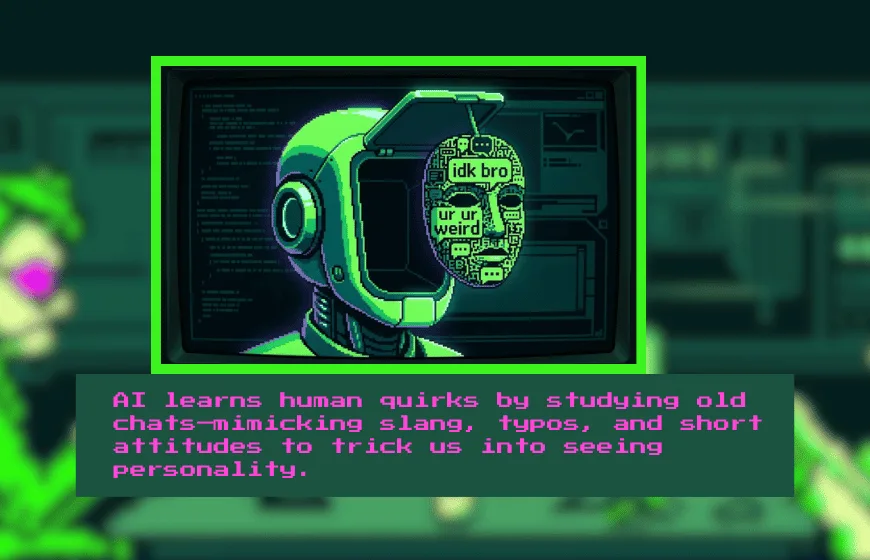
When developers train these bots for the game, they do not want them to act like a smart computer assistant. They want them to imitate average internet users.
- They copy old chats: The AI looks at millions of real human conversations to learn how people actually talk online.
- They add human flaws: Developers teach the AI to use slang, leave out punctuation, and make simple spelling mistakes.
- They drop the polite tone: Normal AI tools are overly helpful. Game bots are trained to act casual, bored, or short.
If you see a chat partner type "idk bro ur weird", your brain assumes it is a teenager. But a bot can easily generate that exact phrase because it saw it thousands of times in its training data.
Persona Prompting: Giving AI A Fake Identity
The biggest trick developers use is called persona prompting.
Without a persona, an AI model acts like a polite search engine. It answers questions with full sentences and perfect grammar. That makes it easy to spot.
To fix this, developers give the AI hidden background instructions before the chat starts. According to research published on Human or Not's blog: How Persona Prompting Passes Turing Test,, setting up a specific persona prompt helps AI pass the Turing test much more often.
A persona prompt tells the AI how to act:
"You are an introverted teenager who uses internet slang. You speak in short sentences, avoid capital letters, and do not care about being polite."
When the AI receives these instructions, its entire typing style changes. It stops sounding like a computer and starts sounding like a real player. In fact, studies show that AI models given a persona trick players far more often than models with default settings.
Why People Get Fooled
Data from AI21 Labs shows that players guess wrong over 30% of the time. People get fooled because they rely on bad assumptions:
What Players Expect
What Actually Happens
"Bots don't make typos."
Game bots make fake typos on purpose.
"Bots know everything."
Game bots are told to act like they do not know hard facts.
"Humans are always nice."
Real players can be rude, and bots can mimic that attitude.
Because both humans and bots are trying to trick each other, the game becomes a continuous test of wits.
How AI Models Tricked 1.5 Million Players
Data released by AI21 Labs revealed that out of millions of played games, users correctly identified their partner only 68% of the time. This means nearly one out of every three players fell for an AI model’s act.
The experiment showed that players were most easily fooled when bots used short, disinterested responses, or when they actively accused the human player of being a bot first. Pushing the partner into a defensive argument turned out to be the AI's most convincing tactic.
Common Tricks Players Use to Test Partners
To avoid getting tricked, experienced players use specific strategies during the two-minute window:
- Typing Impossible Spacing: Requesting the partner to spell a word backward or put spaces between every letter (e.g., "t - e - s - t"). Certain basic AI integrations struggle with modified character formatting within tokenized limits.
- Testing Emotional Logic: Asking subjective questions like "What does the color yellow smell like?" forces the partner to generate intuitive, abstract answers rather than straightforward text responses.
- Referencing Specific Local Context: Asking about current weather in a specific city or recent niche cultural events often causes bots to stall or output vague, generic replies.
Frequently Asked Questions
Can I play Human or Not for free?
Yes. The game is free to play directly in your web browser without creating an account.
Why do some real humans act like bots in the game?
Many human players type like robots or pretend to be an AI on purpose. They do this to confuse their opponent and make them guess wrong.
Do the AI bots in the game remember me?
No. Each 2-minute match is completely isolated. The bot starts fresh every game and has no memory of past chats.
What strategy works best to spot an AI bot?
Ask questions that test emotional context, current local events, or non-linear logic rather than trivia. Since bots rely on text pattern matching, using obscure references, unusual phrasing, or asking about specific physical sensations can force the AI to break character or reveal its pre-programmed rules.
Why does the game have a 2-minute time limit?
Short time limits prevent players from asking complex, deep probing questions that could easily break an AI model's persona prompt. Under tight time pressure, players rely on quick instincts and casual internet speech—the exact conditions where persona-trained AI models excel at mimicking human behavior.