The Evolution of Virtual Assistants: From SmarterChild to Mobile AI
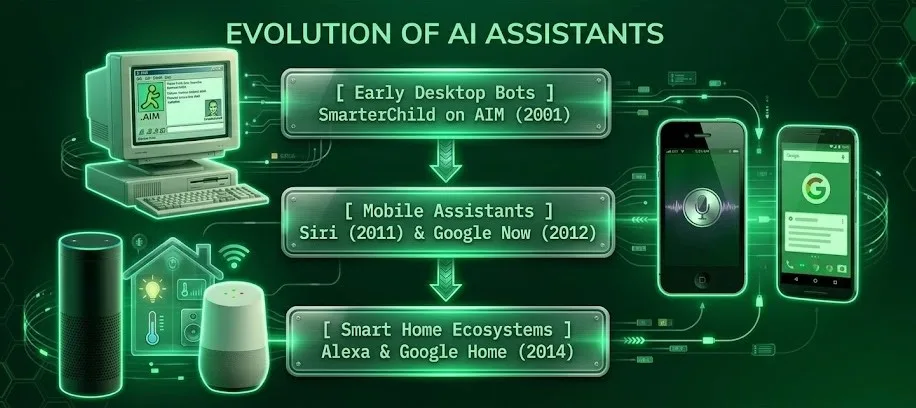
Before Siri checked your calendar or Alexa turned off your living room lights, millions of teenagers were typing random questions to a bot named SmarterChild on AIM. Back then, it felt like magic. Today, looking back at the evolution of virtual assistants, those early tools feel like digital stone tools.
Understanding how we got from simple text scripts on desktop computers to voice-activated software in our pockets helps explain where artificial intelligence is headed next. The jump from fun desktop novelties to daily digital helpers did not happen overnight. It took two decades of massive changes in mobile hardware, natural language processing, and cloud networks.
SmarterChild (2001): The Instant Messaging Benchmark
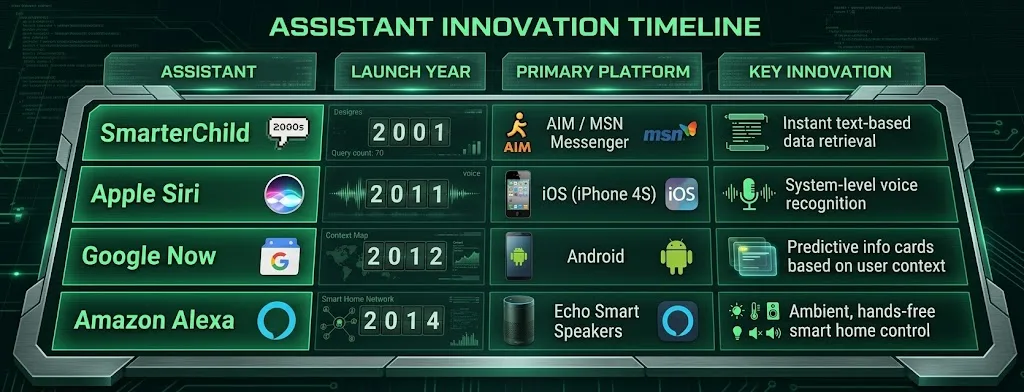
In the early 2000s, messaging apps ruled desktop computers. Active Messaging Technologies created SmarterChild in 2001 to see if software could hold a conversation inside these chat networks. It quickly became an internet sensation.
AIM and MSN Messenger Integrations
SmarterChild lived directly inside your buddy list. Users added the bot just like a real friend on America Online Instant Messenger (AIM) and MSN Messenger. According to historical analytics published by Wired magazine, SmarterChild interacted with over 30 million unique users at its peak, accounting for a massive chunk of daily instant messaging traffic. It was always online, ready to chat at any hour.
Real-Time Data Fetching (Sports, Weather, Movie Times)
What made smarterchild aim messenger conversations so useful was its connection to live data. You could type "weather Dallas" or "movie times," and the bot pulled live info from external databases. It relied on strict rule-based trees. If you phrased a query outside its programmed scripts, the bot broke down. Yet, it proved that people loved instant, automated answers inside chat apps.
The Smartphone Shift: Siri (2011) and Google Now (2012)
Smartphones changed everything. Mobile devices brought built-in microphones, GPS chips, and constant internet access. Virtual assistants moved out of static chat windows and became system-level software.
Voice Recognition Meets Mobile Operating Systems
The apple siri launch history began as a standalone iOS app before Apple bought the technology and built it into the iPhone 4S in 2011. Siri let users speak plain English instead of typing rigid commands. A year later, Google introduced Google Now on Android. Instead of just waiting for questions, Google Now analyzed your search history, emails, and location to display helpful info cards before you even asked.
Task Execution and API Integrations
These mobile assistants went beyond answering basic trivia. They could interact with your phone's apps. Research from the Pew Research Center indicates that over 46% of U.S. adults began using voice assistants regularly on their smartphones by 2017, mainly for hands-free tasks like setting alarms, reading text messages, and placing calls.
Smart Speakers and Conversational Interfaces (2014–2016)
The next big step removed screens completely. Tech companies wanted software to sit in your kitchen and listen for spoken commands across the room.
Amazon Alexa and Echo Integration
Amazon shocked the tech world in 2014 by introducing the Echo speaker powered by Alexa. Looking at the alexa vs google assistant timeline, Amazon won early market share by opening its system to outside developers. Anyone could build custom "skills" for Alexa. According to consumer data from Consumer Intelligence Research Partners (CIRP), Amazon sold over 100 million Alexa-enabled Echo devices by 2019, turning the software into a household staple for playing music and setting kitchen timers.
The Structural Limits of Command-and-Control Voice Bots
Despite widespread sales, these early messaging bots and voice assistants hit a hard technical ceiling. They used fixed command structures. If you did not say a phrase using exact keywords, the assistant failed. I cannot count how many times my smart speaker yelled back, "Sorry, I don't understand that one."
These systems lacked real context memory. They could not hold a true multi-turn conversation or understand complex, rambling requests. They were glorified voice switches, not smart companions. This frustration ultimately pushed developers toward the modern shift from command voice bots to large language models.
The Path Forward for Voice AI
The evolution of virtual assistants shows a clear pattern: we keep moving toward natural, human interactions. We started with rule-bound text bots like SmarterChild. We moved to mobile screen assistants like Siri, and then to ambient home speakers like Alexa. Each phase solved a technical barrier while revealing new limits in how machines understand human intent. Today, generative models are fixing those old boundaries, turning clunky command bots into truly smart digital partners.
Frequently Asked Questions
Why was SmarterChild so popular on AIM?
SmarterChild succeeded because it lived directly inside popular instant messaging apps like AIM and MSN Messenger. Users did not need to download new software. It offered real-time information—like weather, sports scores, and movie times—directly through text chats long before smartphones existed.
How did Siri change the way people used mobile phones?
Siri integrated voice recognition directly into the iPhone's operating system. Instead of navigating menus by hand, users could set reminders, send text messages, or call contacts using natural spoken language, making hands-free smartphone control mainstream.
What was the main difference in the alexa vs google assistant timeline?
Amazon launched the Echo powered by Alexa in 2014, targeting home use with hands-free smart speaker hardware. Google released Google Assistant in 2016, leveraging its deep search database and contextual knowledge from Android phones to answer complex queries more accurately.
Why did early voice assistants often fail to understand complex questions?
Early virtual assistants relied on rigid intent-matching code. They searched for specific keywords rather than understanding contextual meaning. If a user asked a multi-part question or used informal slang, the system could not parse the request.
How do early messaging bots differ from modern generative AI?
Early messaging bots used pre-written scripts and fixed decision trees to return canned responses or pulled data points. Modern generative AI uses massive neural networks to analyze context, write original sentences, and handle open-ended conversations dynamically.
What aspect of early AI assistants like SmarterChild or early Siri do you remember most clearly?