Bots Now Outnumber Humans Online: Is the Internet Broken?
The idea that the internet belongs to people no longer feels automatic. A growing share of online activity now comes from software agents, crawlers, automation systems, and AI tools that browse, collect, compare, generate, and act without a person clicking every step. That shift changes more than website analytics. It changes how businesses earn money, how users experience websites, and how digital systems are designed.
The sentiment that bots now outnumber humans online is no longer just a dramatic claim; it is a measurable reality. Because the internet was never built for this level of automation, the transition from background tools to human-like AI agents is creating significant challenges for infrastructure, security, and digital trust.
This post explains what changed, why experts disagree on the numbers, and what the next phase of the web may look like.
The Internet Was Designed Around Human Behavior, Not Machine Conversations
The early internet assumed people would search, click, read, and interact through browsers. Protocols such as HTTP, DNS, and HTML focused on delivering pages to human visitors. Search engines later introduced automated crawlers, but they remained limited and predictable.
Today, that assumption is breaking down.
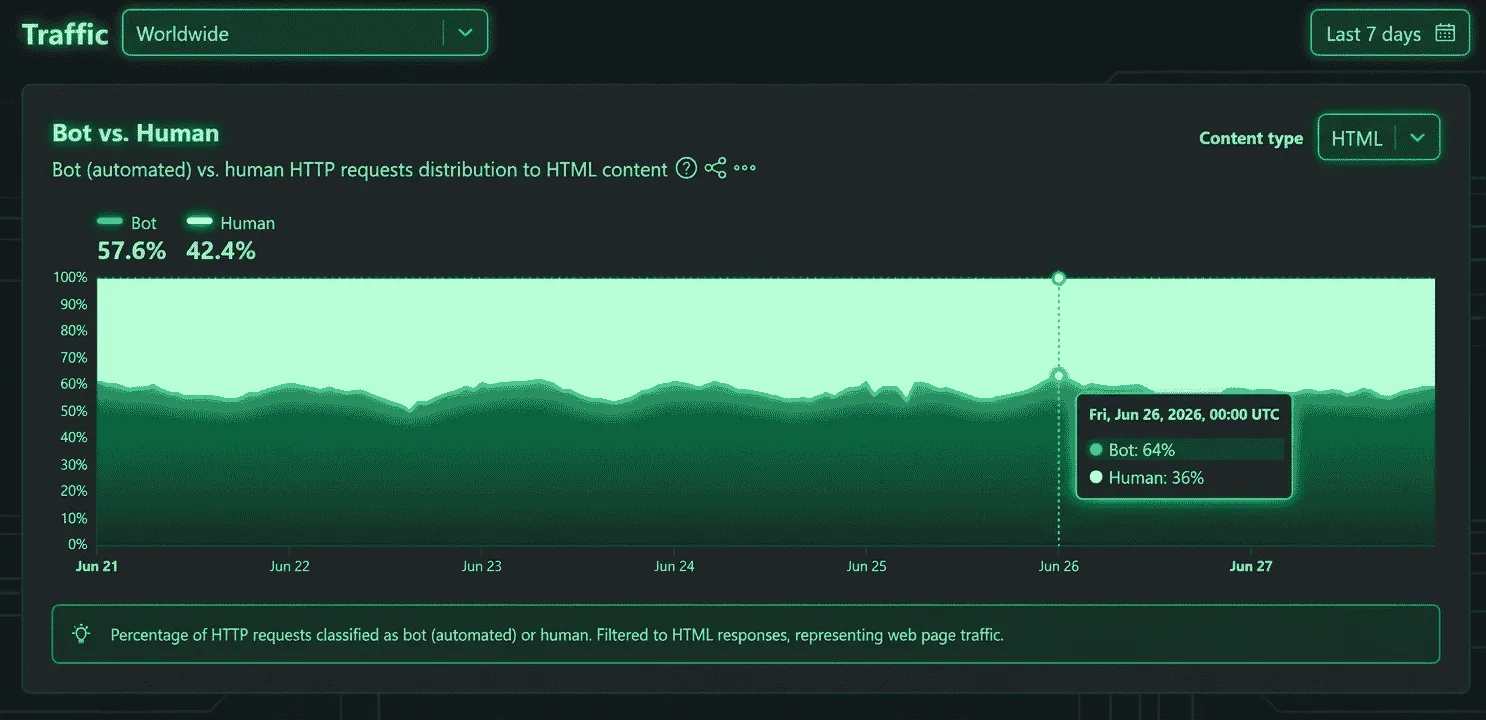
Measurements from Cloudflare Radar show that humans still account for 36% of observed HTTP traffic, while bots represent 64% of web traffic as of June 2026. Cloudflare separates verified automation from broader bot categories, which creates a more conservative estimate.
At the same time, Imperva’s 2026 Bad Bot Report reached a different conclusion. Based on its methodology and security telemetry, automated traffic represented 53% of all web traffic during 2025, while human traffic fell to 47%.
This disagreement matters because definitions matter.
One measurement focuses on identified web requests. Another focuses on the broader attack and automation surface. The gap reveals something important: the question is no longer “Are bots growing?” The real question is how we define participation online.
That distinction sits at the center of the current digital landscape evolution.
AI Agents Changed the Rules and Turned Browsing Into Execution
Older bots mostly indexed pages or scraped data. New systems perform tasks.
AI agents can compare products, collect information, fill forms, execute workflows, and trigger transactions. Some bypass websites entirely and interact directly with APIs. Security researchers increasingly describe this shift as moving from a “Search and Click” internet into an “Ask and Execute” internet, a trend explored in Imperva’s report on the Agentic Age.
This is one of the biggest examples of the rise of AI in online spaces.
Think about common behavior today. A person asks an AI assistant to summarize ten articles, compare prices, plan travel, or gather recommendations. The AI performs dozens of requests behind the scenes. The human sees one response. Websites receive automated traffic instead of engaged visitors.
That creates a new kind of user experience with bots.
Users save time. Platforms lose direct interaction.
Publishers and online businesses already worry that AI systems collect information without returning visitors. An Akamai State of the Internet report found that referral traffic from AI chatbots was 96% lower than traditional Google search during Q4 2024, raising concerns about crawler-to-referral imbalance and publisher revenue pressure.
The internet still appears busy. The difference is that more activity happens machine to machine.
Internet Infrastructure Challenges Are Becoming Economic Problems
Most people think bot growth is mainly a cybersecurity issue.
It is increasingly an economic issue.
Web infrastructure costs money. Every request consumes bandwidth, storage, processing power, and protection systems. When automation increases, businesses pay more to serve traffic that may never convert into customers.
E-commerce provides one of the clearest examples.
According to the Radware 2026 report, malicious bots represented 43% of holiday e-commerce traffic, nearly reaching the volume of legitimate human shoppers.
For online stores, this creates multiple problems:
- Higher hosting and infrastructure costs
- Distorted analytics and conversion data
- Inventory hoarding and checkout abuse
- Lower trust in campaign performance
Marketing teams already struggle with attribution. If automated traffic inflates visits and reduces meaningful engagement, traditional dashboards become less useful.
This changes digital strategy.
Companies now invest in bot management, behavioral analysis, API security, identity verification, and traffic quality instead of pure visitor growth.
These internet infrastructure challenges may become standard operating costs across industries.
The Impact of Bots on Online Interactions Extends Beyond Security
People usually notice bots only when something goes wrong.
The deeper change happens quietly.
Recommendation systems, engagement metrics, customer support, reviews, and content discovery increasingly interact with automated participants. A user may read AI-generated summaries, respond to automated support, and trigger AI actions without realizing it.
That changes expectations.
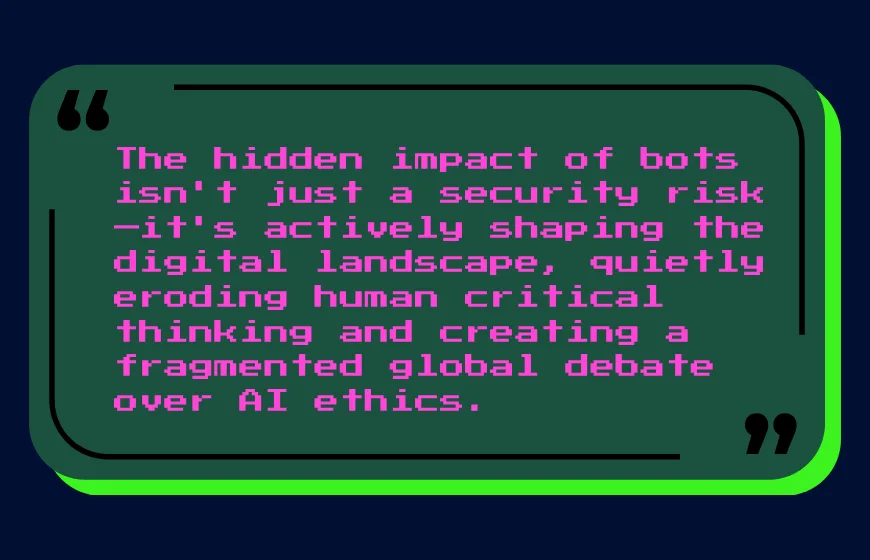
Studies have started examining how heavy reliance on AI support tools affects decision-making and critical thinking. Reporting on an MIT study covered by The Guardian noted that participants using AI for misinformation detection showed a 15.3% decline in unassisted critical thinking performance.
Ethics enters the conversation quickly.
Who owns information gathered by AI crawlers?
Should websites charge AI systems differently?
Should users know when they are interacting with agents?
Different regions answer these questions differently. Some governments emphasize regulation and disclosure. Others prioritize open access and innovation.
The result is an uneven global response to automation.
That tension will shape the next decade of digital landscape evolution.
Security Implications of Bots Will Push the Internet Toward Verification
Security teams no longer ask if traffic is automated.
They ask what the automation wants.
Reports summarized by TechRadar’s coverage of emerging bot trends show growing concern around AI-driven automation targeting APIs instead of visible interfaces.
Traditional defenses show limits.
CAPTCHAs frustrate users.
Rate limits block legitimate sessions.
Simple fingerprinting becomes easier to evade.
Researchers now explore methods such as protocol-level identification and traffic fingerprinting to distinguish humans from advanced automation with greater accuracy, including work published on arXiv.
Large platforms have started experimenting with privacy-preserving identity systems. Coverage from TechRadar discussed new efforts designed to authenticate human traffic without exposing identity.
The long-term direction appears clear.
Trust may become infrastructure.
Instead of assuming visitors are human, systems may require proof of intent, proof of identity, or proof of authorization.
The Future of Internet Technology May Depend on Protecting Human Agency
The next internet probably will not look like today’s browser-first experience.
Human users may interact through personal AI agents that negotiate, retrieve, and complete actions across services.
That future creates opportunity and risk.
Automation can reduce friction and expand access. Small businesses can automate support. Users can manage digital tasks faster. Services become more personalized.
Yet convenience creates dependence.
If every decision flows through automated systems, people risk losing direct visibility into how information reaches them.
A more human-centered internet will need principles that preserve agency: transparent automation, clear attribution, user consent, machine-readable rules, and business models that reward original creators.
The future of internet technology may not depend on stopping bots.
It may depend on making sure humans remain visible inside a machine-heavy web.
This captures a real shift, even if experts disagree on exact percentages. Some measurements still show humans leading web traffic. Others argue automation already crossed the majority threshold.
The bigger story is not replacement.
It is redesign.
The web grew around human attention. The next version may revolve around human intent expressed through AI systems. That transition will shape business models, security practices, user experience with bots, and the broader digital landscape evolution.
The goal is not to win a war against automation.
The goal is to build an internet where automation serves people instead of replacing their role.
FAQs
How can I tell if a website’s traffic spike is caused by real users or AI bots?
Look for unusual bounce rates, extremely short sessions, repeated navigation patterns, odd geographic clustering, and traffic that produces little conversion activity.
Are AI agents and search engine crawlers the same thing?
No. Search engine crawlers index content for discovery. AI agents perform actions, gather information, and complete tasks on behalf of users.
What happens to my online business if AI bots stop sending traffic to my site?
Businesses may shift toward subscriptions, licensing, API access, direct partnerships, and new monetization models.
Why do experts disagree on whether bots outnumber humans?
Different organizations measure different forms of traffic and define automation differently.
Will the rise of AI in online spaces make websites disappear?
Probably not. Websites may evolve into service layers for humans and machines instead of remaining destination pages.