AI Agent Examples: Real-World Applications Transforming Modern Business
Artificial intelligence has moved beyond simple automation, and AI Agents now show how systems can act, decide, and improve workflows. These AI agents do more than follow rules. They analyze data, interact with tools, and complete multi-step tasks across systems. These systems can operate across platforms using APIs and human-facing tools.
This article explores real-world AI agent examples, detailed case studies, and their impact on industries. It also explains challenges, future trends, and how companies can use AI in business to gain measurable results.
Key Takeaways
- Orchestration. Switch from automating small tasks to managing entire workflows.
- Independence. Agents use reasoning loops to complete jobs without human input.
- Finance. Deploy fraud detection agents to monitor transactions continuously 24/7.
- Support. Use AI co-pilots to handle routine queries while humans scale.
- Versatility. Niche agents now personalize education and monitor crop health.
- Reliability. Maintain human oversight to ensure agents succeed in complex tasks.
- Redesign. Change how work gets done to capture true AI value.
AI Agents Execute Complex Workflows Across Systems
AI agents differ from traditional automation because they can plan and act independently. They combine machine learning, reasoning, and tool usage to complete tasks from start to finish. For example, an AI agent in finance can monitor transactions, detect fraud, and trigger alerts without human input.
This ability matters because businesses no longer rely on fragmented tools. Instead of separate systems for data analysis and execution, AI agents connect everything into one workflow. Research from McKinsey shows that companies see stronger results when they redesign workflows around AI agents.
As a result, AI in business is shifting from automation to orchestration. This shift allows companies to operate faster, reduce errors, and improve decision-making.
Customer Support AI Enhances Service Quality and Efficiency
Customer support AI is one of the most common examples of AI agents in real-world use. These systems analyze customer queries, detect intent, and suggest responses in real time. They do not replace human agents. Instead, they act as co-pilots that improve performance.
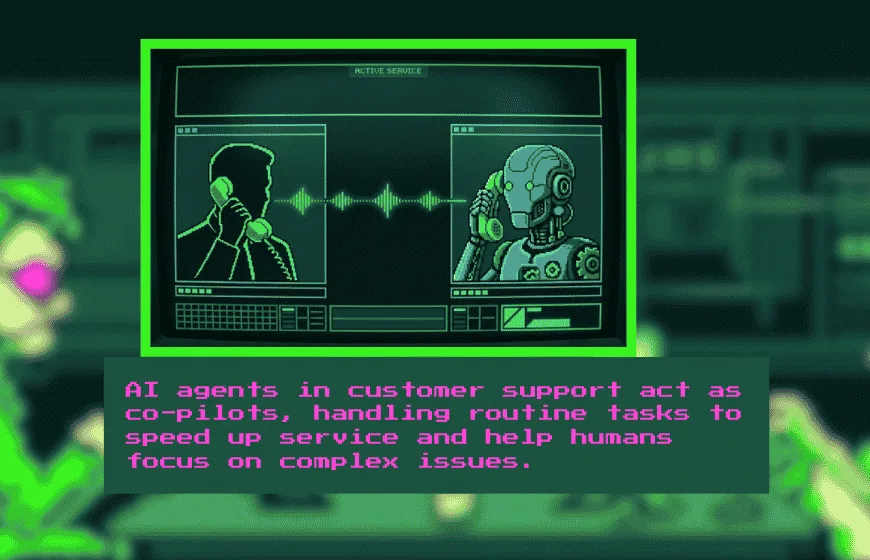
A research study highlights how AI agents assist support staff by providing contextual answers during conversations. This reduces response time and improves accuracy. For example, large e-commerce platforms use AI agents to handle routine queries such as order tracking. Human agents then focus on complex issues.
The impact of AI agents in this field is measurable. Companies report shorter handling times and higher customer satisfaction scores. This shows how AI agents enhance human work rather than replace it.
Fraud Detection AI Reduces Risk Through Continuous Monitoring
Fraud detection AI uses AI agents to monitor transactions continuously and detect anomalies. These systems analyze patterns in real time and flag suspicious behavior instantly. This approach is far more effective than manual checks.
Banks and financial institutions rely heavily on these systems. AI agents can scan thousands of transactions per second, which no human team can match. AI agents enable 24/7 monitoring, catching fraud earlier and reducing risk exposure.
The financial impact is significant. Some reports show cost reductions of up to 20% in banking operations. This makes fraud detection AI one of the most valuable real-world AI agents today.
Autonomous Driving AI Demonstrates Real-Time Decision Making
Autonomous driving AI is a strong example of AI agents working in complex, real-world settings. These systems process sensor data, make decisions, and control vehicles in real time. They must respond to changing conditions such as traffic, weather, and road hazards.
Companies in the automotive industry use AI agents to improve safety and efficiency. For instance, self-driving systems rely on multiple agents that handle perception, planning, and control. Each agent works together to ensure smooth operation.
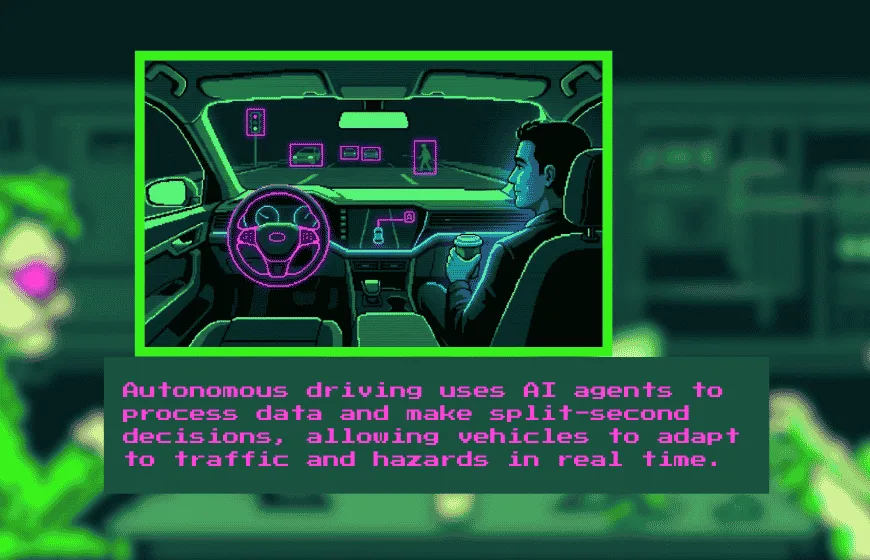
This use case highlights a key strength of AI agents. They can handle uncertainty and adapt to new situations. While full autonomy still faces challenges, progress in this area shows the future potential of AI agents across industries.
Industry-Specific AI Agents Expand Use Cases Beyond Core Sectors
AI agents are not limited to finance or customer service. Many industries now use them in specialized ways that often go unnoticed. These niche applications show the versatility of AI agents.
- In agriculture, AI agents monitor crop health using satellite data and recommend actions to farmers.
- In education, they personalize learning by adjusting content based on student progress.
- In healthcare, AI agents assist doctors by analyzing patient records and suggesting diagnoses.
These examples of AI agents show how technology adapts to different environments. Each use case focuses on improving efficiency, accuracy, and outcomes within a specific domain.
The Impact of AI Agents Depends on Workflow Design
The impact of AI agents is not automatic. Many companies struggle to see results because they focus only on the technology. Organizations often fail when they optimize the agent instead of redesigning the workflow.
This means businesses must rethink how work gets done. AI agents work best when they replace entire processes rather than small tasks. For example, a company that uses AI agents for end-to-end order processing will see more value than one that only automates data entry.
Another challenge is reliability. Some AI agents succeed in complex tasks less than 25% of the time on the first attempt. This highlights the need for human oversight and gradual implementation.
Despite these challenges, adoption continues to grow. Around 23% of organizations are already scaling AI agents, while many others are still experimenting.
Future Trends Show AI Agents Becoming More Collaborative
The future of AI agents lies in collaboration and improved intelligence. Advances in natural language processing allow agents to understand context better and communicate more effectively. This leads to smoother interaction between humans and machines.
Another trend is multi-agent systems. Instead of one agent handling everything, multiple agents work together to complete tasks. This approach improves efficiency and reduces errors.
Experts also expect AI agents to move from support roles to decision-making roles. However, human involvement remains important. The best systems combine human judgment with AI speed and scale.
These trends suggest that AI agents will play a central role in business transformation over the next decade.
AI Agents Show a Shift Toward Intelligent Systems
The growing number of AI Agents shows a clear shift in how businesses operate. AI agents no longer act as simple tools. They function as intelligent systems that manage workflows, improve decisions, and enhance productivity.
Real-world AI agents in customer support AI, fraud detection AI, and autonomous driving AI demonstrate measurable value. They reduce costs, improve accuracy, and enable faster operations. At the same time, challenges such as workflow design and reliability require careful planning.
The key takeaway is clear. Companies that treat AI agents as workflow transformers, not just tools, will gain the most value. As adoption grows, AI agents will continue to reshape industries and redefine how work gets done.
FAQs
What are real-world examples of AI agents in business?
Companies use AI agents in customer support for order tracking, in finance for fraud detection, and in supply chain management to automate end-to-end logistical workflows.
How do AI agents improve efficiency and productivity?
They handle repetitive, multi-step tasks autonomously and operate continuously without human fatigue, which significantly reduces processing time and human error.
What industries benefit most from AI agents?
The finance, healthcare, retail, and automotive industries see the strongest impact due to their high data volumes and the need for complex, real-time decision-making.
Are AI agents replacing human workers?
No, they typically act as "co-pilots," handling routine and data-heavy tasks so that human workers can focus on high-level strategy, creativity, and complex problem-solving.
What is the biggest challenge in implementing AI agents?
The main challenge is redesigning entire business workflows to accommodate autonomous agents rather than simply plugging them into old, fragmented processes as isolated tools.
How do AI agents differ from traditional automation?
Traditional automation follows rigid, pre-defined rules, while AI agents use reasoning and machine learning to plan and execute tasks even when conditions change.