Alan Turing: Betrayed by the Country He Saved
We all know Alan Turing as the man behind the Turing Test. Back in 1950, he asked a bold question. If a machine could talk so convincingly that you could not tell it apart from a real person, should we consider it intelligent?
The idea was surprisingly simple. A human judge chats with two hidden participants, one human and one machine. If the judge cannot confidently answer “human or not,” the machine passes. That single question still shapes how we think about artificial intelligence today.
You can see echoes of it everywhere now. Games challenge players to guess who is real. Online platforms experiment with similar setups. Even everyday conversations about AI circle back to the same concept.
But there is more to Alan Turing than just the test that carries his name.
His life story is far more complex than most people realize.
Quick Insights
- Alan Turing helped break the German Enigma codes at Bletchley Park.
- His work shortened World War II and saved many lives.
- He developed foundational ideas in computer science and artificial intelligence.
- In 1952, Britain prosecuted him for homosexuality.
- He received a Royal Pardon decades after his death.
- Turing remains a central figure in AI history and human rights discussions.
Who Was Alan Turing?
Alan Turing was born in 1912 in London, England. From a young age, he showed unusual intelligence and curiosity.
He loved mathematics and science. However, his school did not always recognize his talent. His headmaster once suggested that focusing only on science was a waste at a public school.
Even so, Turing pushed forward.
On his first day at boarding school, a train strike disrupted travel. Instead of giving up, he rode his bicycle nearly 60 miles to arrive on time. That determination would define his life.
The Friendship That Shaped His Thinking
In 1928, Turing met Christopher Morcom at school. The two became close friends and explored physics and mathematics together.
They exchanged notes during class and discussed deep scientific questions. During this time, Turing likely developed romantic feelings for Morcom.
Tragically, Morcom died of tuberculosis in 1930. Turing was only 17 years old.
After his friend’s death, Turing became obsessed with understanding consciousness. He began asking a radical question: could the human mind work like a machine?
That idea later shaped modern computer science and artificial intelligence.
Academic Brilliance at Cambridge and Princeton
Turing attended King’s College, Cambridge. He earned a distinguished mathematics degree in 1934.
Soon after, he received a Fellowship at King’s College. That honor recognized his groundbreaking work in mathematical logic.
Later, he studied at Princeton University in the United States. There, he expanded his research on computability and algorithms.
During this period, Turing developed the concept now known as the “Turing Machine.” This theoretical device became the foundation of modern computing theory.
According to historians of computer science, Turing’s 1936 paper on computable numbers laid the groundwork for digital computers.
Bletchley Park and the Enigma Code
When World War II began in 1939, Turing joined Britain’s secret codebreaking center at Bletchley Park.
At Bletchley Park, mathematicians and linguists worked around the clock. Their goal was to decrypt German military communications, especially those encoded by the Enigma machine.
Turing worked in Hut 8. His colleagues called him “Prof.”
The German Navy used Enigma to direct U-boat submarines. These submarines attacked Allied ships in the Atlantic Ocean.
Winston Churchill later described the U-boat threat as the only thing that truly frightened him during the war.
Turing helped design improved codebreaking machines, building upon earlier Polish efforts. These machines rapidly analyzed encrypted messages.
At its peak, Bletchley Park decrypted tens of thousands of messages each month.
Historians widely agree that breaking Enigma shortened the war and saved countless lives. Some estimates suggest the war ended at least two years earlier because of Allied codebreaking success.
Alan Turing played a central role in that effort.
The Eccentric Genius
Turing did not behave like a typical war hero.
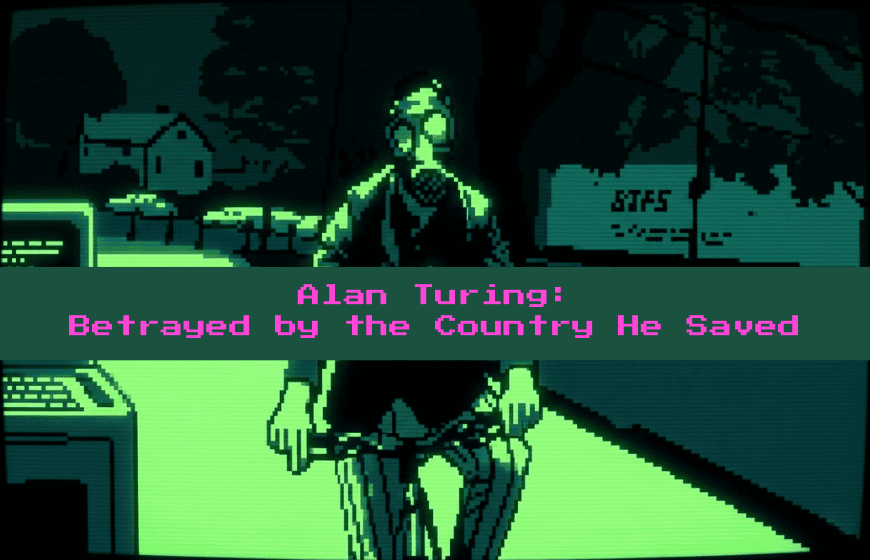
He often wore a gas mask while cycling to work to protect against pollen. Instead of fixing his bicycle chain, he memorized when it would slip and adjusted it just in time.
He even chained his tea mug to a radiator to prevent others from taking it.
These habits made him seem unusual. However, his colleagues respected his brilliance.
His work during the war earned him the Order of the British Empire. Yet the achievement remained classified for years.
The Turing Test and Artificial Intelligence
After the war, Turing continued exploring machine intelligence.
In 1950, he published a paper titled “Computing Machinery and Intelligence.” In it, he proposed what became known as the Turing Test.
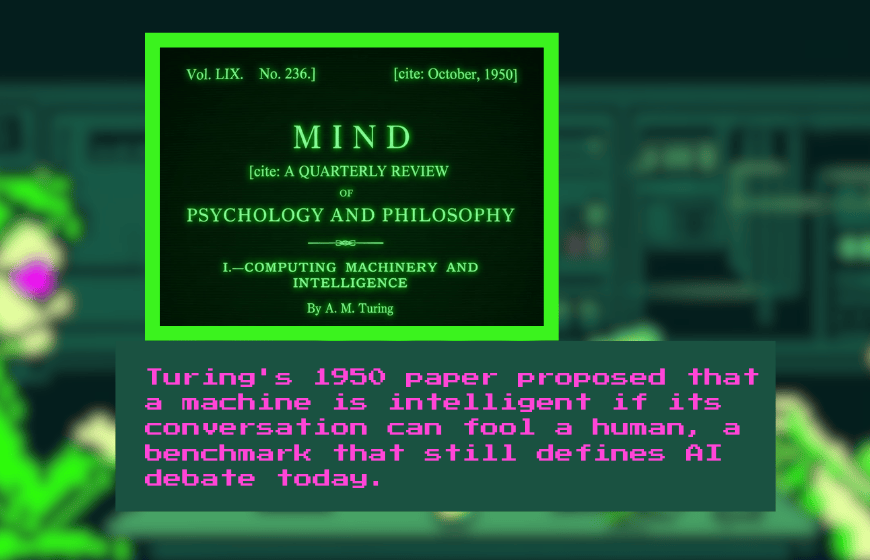
The idea was simple but powerful. If a machine could carry on a conversation that fooled a human judge, it could be considered intelligent.
Today, the Turing Test remains central to debates about artificial intelligence.
Many AI researchers still reference Turing’s work when discussing chatbots and human-like machines.
The Arrest That Changed Everything
Despite his wartime heroism, Turing’s life took a devastating turn.
In 1952, police investigated Turing after a burglary at his home. During questioning, he admitted to a relationship with another man.
At that time, homosexuality was illegal in Britain. Turing was charged with “gross indecency.”
He accepted a guilty plea.
Instead of prison, the court offered probation. However, probation required chemical hormone treatment designed to suppress his sexuality.
This “treatment” caused severe physical and emotional side effects.
Worse still, the government revoked his security clearance. Authorities feared he could be blackmailed during the Cold War.
No evidence ever suggested he posed any security risk.
The country he had helped save now treated him as a criminal.
His Death and Lingering Questions
In June 1954, Turing’s housekeeper found him dead.
A half-eaten apple sat near his bed. The official ruling stated suicide by cyanide poisoning.
However, some historians question aspects of the investigation. The apple was never tested for poison.
Debate continues today, although most scholars accept the suicide verdict.
Turing was only 41 years old.
Recognition, Apology, and Royal Pardon
For decades, Turing’s work remained secret.
Gradually, historians and scientists began recognizing his enormous contributions to computing and war efforts.
In 2009, the British Prime Minister formally apologized for Turing’s treatment.
In 2013, Queen Elizabeth II granted him a Royal Pardon.
Stephen Hawking and many other public figures supported that effort. Actor Stephen Fry publicly called for further recognition.
In 2019, the Bank of England announced that Alan Turing would appear on the £50 note. The note features one of his quotes:
“This is only a foretaste of what is to come, and only the shadow of what is going to be.”
The quote feels fitting.
Why Alan Turing’s Story Still Matters
Alan Turing helped shape modern computing and artificial intelligence. Without his theoretical and wartime work, the digital age might have developed differently.
Yet his persecution reveals a painful truth. Societies can celebrate brilliance while punishing difference.
Today, discussions about LGBTQ rights, AI ethics, and government secrecy often reference Turing’s life.
His story teaches two lessons.
First, innovation often comes from those who think differently.
Second, justice sometimes arrives too late.
Alan Turing was betrayed by the country he saved. Yet his ideas continue shaping the world we live in today.
FAQs
Who was Alan Turing?
Alan Turing was a British mathematician and computer scientist who helped break the Enigma code during World War II and proposed the Turing Test for machine intelligence.
What is the Turing Test?
The Turing Test is a thought experiment where a machine tries to convince a human judge that it is human through conversation.
How did Alan Turing help in World War II?
Turing worked at Bletchley Park, helping design machines that decrypted German Enigma communications, which significantly shortened the war.
What is a Turing Machine?
A Turing Machine is a theoretical computational model introduced in 1936 that forms the foundation of modern computer science.
Why was Alan Turing prosecuted?
In 1952, Turing was convicted under British laws criminalizing homosexuality, which was illegal at the time.
Did Alan Turing receive a pardon?
Yes. In 2013, Queen Elizabeth II granted Alan Turing a Royal Pardon, decades after his death.
Why is Alan Turing important today?
Turing’s work laid the foundations of artificial intelligence and modern computing, and his life remains central to discussions about innovation and human rights.