Agentic AI vs Generative AI: What Sets Them Apart (And Why It Matters)
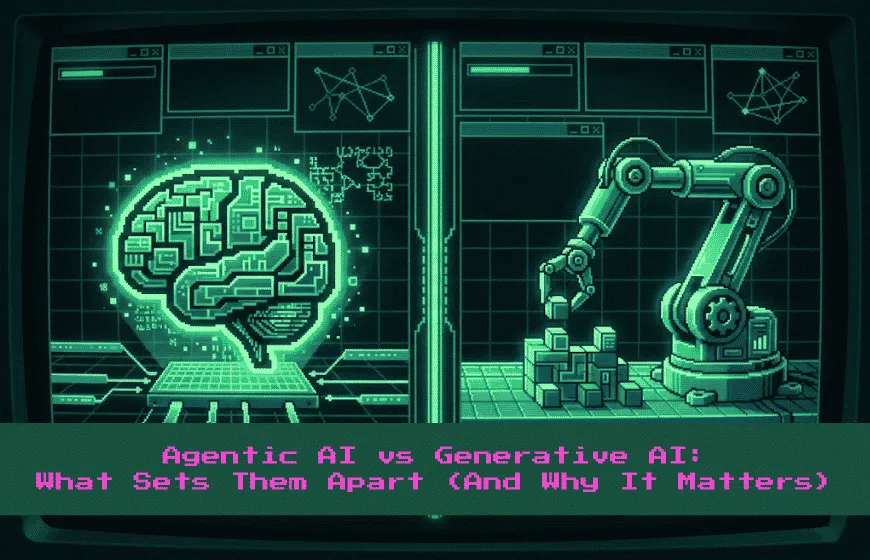
Artificial intelligence is evolving quickly, and the comparison between agentic AI and generative AI is now shaping business strategy. While both rely on machine learning, they serve different roles. Generative AI creates content, while agentic AI focuses on action and execution.
Understanding this distinction helps companies choose the right approach and avoid wasted investment.
Key Takeaways
- Content. Generative AI creates text and media based on statistical patterns.
- Execution. Agentic AI works toward goals with minimal human supervision.
- Structure. Coordination between multiple agents defines a truly agentic system.
- Proactivity. Anticipate user needs with agents that act before being prompted.
- Integration. Connect agentic systems to legacy software for real-world results.
- Risk. Monitor both systems to prevent hallucinations or coordination errors.
- Hybrid. Combine both capabilities to build the strongest possible business solutions.
Generative AI: Built for Creating Content
Generative AI learns patterns from large datasets and produces new outputs based on those patterns. These outputs can include text, images, code, and video.
This generative AI relies on statistical relationships rather than true understanding. This explains why it performs well with prompts but struggles with deeper reasoning.
Today, generative AI powers tools such as chatbots, writing assistants, and design platforms. Businesses use it to create marketing copy, respond to customer inquiries, and summarize long documents.
Its main advantage is speed. It can generate content in seconds. However, it is reactive. It only responds when prompted.
There are also clear limitations. Generative AI can produce inaccurate or misleading outputs, often called hallucinations. Without external validation, it is not reliable for tasks that require high accuracy.
Agentic AI: Focused on Action and Decision-Making
Agentic AI shifts the focus from content to outcomes. Instead of waiting for prompts, it works toward defined goals. It can plan, make decisions, and execute tasks with limited human input.
According to IBM’s explanation of agentic AI, these systems often use multiple agents that collaborate to complete complex workflows.
Google Cloud also describes agentic AI as capable of setting goals and carrying out tasks with minimal supervision.
This allows the system to act proactively. It can analyze a situation, decide what to do next, and execute tasks without constant input.
In practice, agentic AI works well in complex environments. It can manage supply chains, monitor systems, and automate financial or customer service processes from start to finish.
Key Differences That Shape Their Roles
The difference between generative AI and agentic AI becomes clear when you look at how they function.
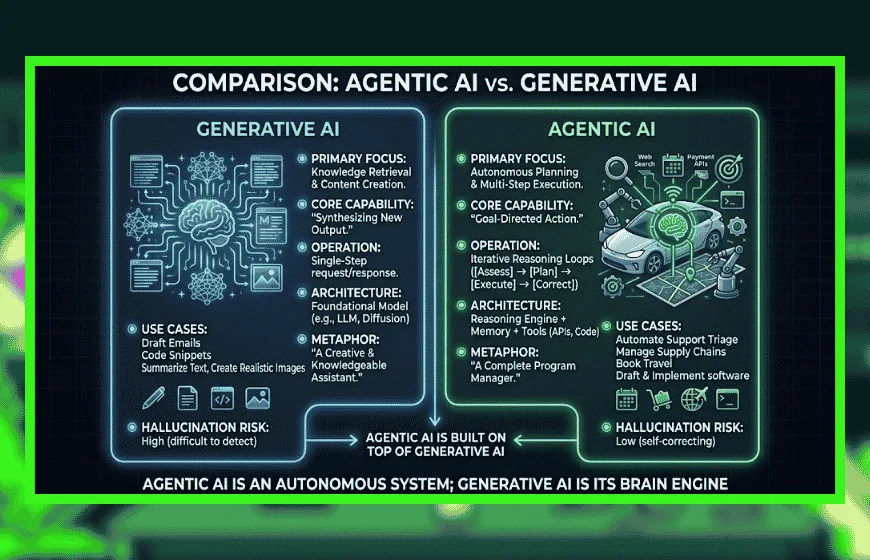
Generative AI produces outputs based on prompts. It does not plan or set goals. Agentic AI focuses on outcomes. It can define goals, break them into steps, and complete them.
Another difference is structure. Generative AI usually relies on a single model. Agentic AI uses multiple agents that must coordinate with each other.
According to AWS insights on agentic AI, some systems can even anticipate user needs before they are explicitly stated.
This added capability increases flexibility but also introduces more complexity.
Real-World Use Cases and Limitations
Both technologies deliver value in different areas. Generative AI supports creative and communication tasks. Businesses use it to write content, design assets, and assist with coding.
Agentic AI supports operational workflows. It can automate processes, respond to real-time data, and manage tasks across systems.
Research from MIT Sloan Management Review shows that many organizations are already exploring AI agents for enterprise workflows.
However, both approaches come with challenges.
Generative AI struggles with accuracy and consistency. Agentic AI faces risks related to coordination and system reliability.
Because of these risks, both require monitoring and human oversight.
How Businesses Can Start Using Them
Adopting AI depends on business goals and technical readiness.
Generative AI is easier to implement. Many tools are available through APIs and cloud platforms.
Agentic AI requires deeper integration. It must connect with existing systems such as CRM platforms, databases, and enterprise software. This can be difficult, especially when working with legacy systems.
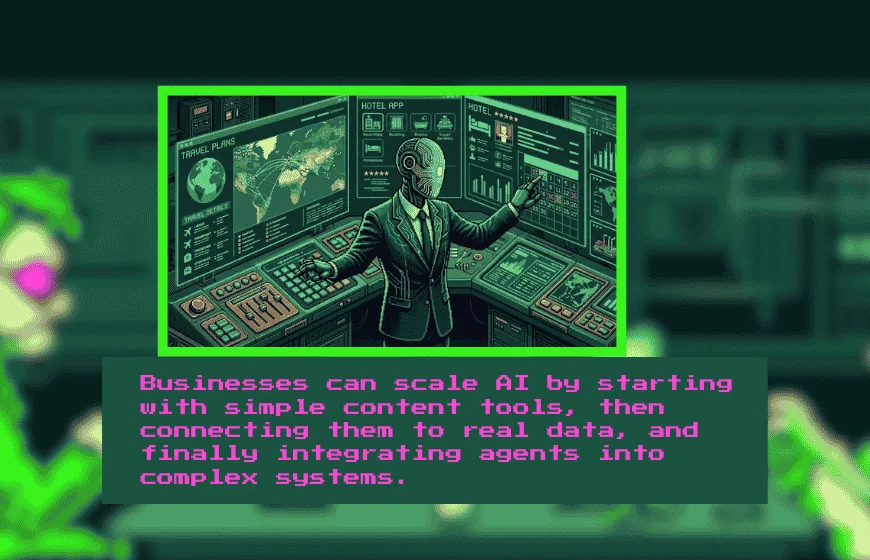
A practical approach is to scale gradually:
Start with generative AI for content tasks. Add tools that connect AI to real data. Introduce AI agents for coordination. Expand into full agentic systems over time.
This step-by-step approach reduces risk and builds internal expertise.
What the Future Looks Like
Both technologies are expected to grow, but in different ways.
Generative AI will continue to expand in creative and communication roles. It will likely improve in accuracy as models evolve.
Agentic AI will grow in automation and decision-making systems. However, not all projects will succeed.
A report cited by Reuters highlights that many agentic AI initiatives may fail due to high costs and unclear value.
Regulation will also shape adoption. Governments are introducing rules around data privacy and transparency. These may slow deployment but will improve trust.
In the long term, systems that combine generative and agentic capabilities may deliver the strongest results.
The comparison between agentic AI and generative AI is not about choosing one over the other. It reflects a shift in how AI systems are evolving.
Generative AI supports content creation. Agentic AI enables decision-making and execution.
Used together, they offer a more complete solution. The key is to start with clear goals and build systems in stages.
FAQs
What is the main difference between agentic AI and generative AI?
Generative AI focuses on creating content (text, images, code) based on user prompts, while agentic AI focuses on outcomes by planning, making decisions, and executing tasks autonomously to reach a goal.
Can generative AI become agentic AI?
Yes; by integrating planning capabilities, memory, and the ability to use external tools or APIs, a generative system can evolve into an agentic system that acts rather than just responds.
Where is agentic AI used in business?
It is primarily used in operational workflows such as supply chain management, complex customer service resolution, and automated financial monitoring where end-to-end execution is required.
Does agentic AI replace predictive AI?
No; predictive AI provides data-driven insights and forecasts, while agentic AI uses those insights as a basis to take specific actions or solve problems.
Which is easier to implement for a small business?
Generative AI is significantly easier to deploy because it is often available via simple cloud-based APIs, whereas agentic AI requires deep integration with internal legacy systems and databases.
What is a major limitation of generative AI?
Generative AI is reactive and lacks true reasoning, which can lead to "hallucinations" or inaccurate outputs that require human validation to ensure reliability.
How should a company start with these technologies?
A practical approach is to start with generative AI for content-based tasks and gradually introduce agentic features as you build the necessary technical integrations.