AI Agents for Content Creation: Why Marketing Teams Are Quietly Changing How They Work
Content teams used to run on caffeine and tight deadlines. Now? Not so much.
Somewhere between endless blog drafts and SEO checklists, AI agents for content creation started doing more than just “help.” They began taking over parts of the workflow. Not everything, of course. But enough to change how teams think about writing, planning, and publishing.
It’s not just about speed anymore. It’s about how the work gets done.
So, What Exactly Are AI Content Agents Doing?
At first glance, they look like upgraded writing tools. But spend a bit of time with them, and you’ll notice something else. They don’t just write. They move.
In many cases, these agents can research a topic, sketch out an outline, draft the article, and tweak it for search engines—all without someone hovering over every step. That shift matters.
According to IBM’s explanation of agentic AI, these systems are built to pursue goals with limited supervision, often by coordinating multiple smaller processes behind the scenes. Sounds technical, but in practice, it just means they can handle more of the heavy lifting.
And honestly, that’s where teams feel the difference. Less repetitive work. Fewer bottlenecks. More breathing room.
The Quiet Backbone: AI Content Generation Tools
Before agents became the headline, the real groundwork was already there. Writing assistants, image generators, editing tools—these have been around for a while.
These systems generate content based on patterns learned from large datasets. That’s the engine behind everything.
What’s changed is how those tools are now connected.
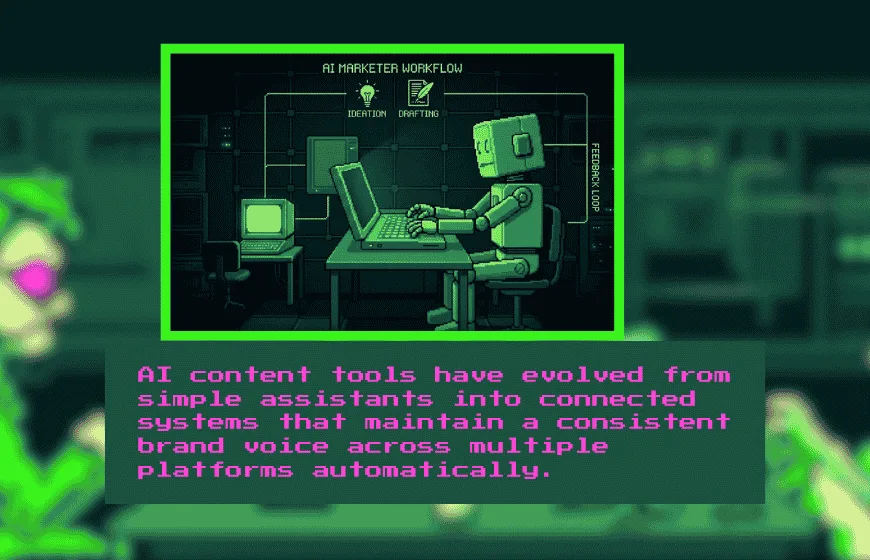
Instead of working one task at a time, teams are stacking tools together. An agent pulls keyword data, drafts a post, and aligns it with brand tone—all in one go. Not perfectly, sure. But consistently enough to be useful.
Consistency matters more than people admit.
Especially when you’re publishing across blogs, email, and social media at the same time. Keeping the voice steady across all that? That used to be a headache.
Why Teams Are Actually Using This Stuff
Let’s be real...no one adopts new tech just because it sounds impressive.
It usually comes down to time and pressure.
AI agents help teams move faster, yes, but they also free people up to focus on the parts that feel… human. Strategy. Storytelling. The messy creative bits that don’t fit into neat templates.
There’s also scale. A small team can now produce content that used to require a full department. That’s a big deal for startups trying to compete with larger brands.
And then there’s the data side of things. Agents don’t just create—they observe. They track what works, what doesn’t, and quietly suggest adjustments. Over time, that feedback loop sharpens the whole strategy. It adds up.
Where This Shows Up in the Real World
You’ll see it most clearly in industries that rely heavily on content.
E-commerce brands, for example, are using AI agents to produce product guides and SEO-driven blog posts at a much faster rate. One company reportedly tripled its blog output after adopting these systems. That’s not a small jump.
Media companies are experimenting too. Short-form reports—financial updates, sports summaries—are often drafted by AI before a human editor steps in. It’s efficient, if a bit strange at first.
Marketing agencies? They’re probably the biggest adopters. Managing multiple clients means juggling tone, deadlines, and volume. AI agents help keep things moving without everything falling apart.
Still, it’s not magic. Things break. Outputs need editing. That part hasn’t gone away.
The Not-So-Obvious Challenge: Integration
Here’s where things get tricky.
AI agents don’t operate in isolation. They need access to systems—content management platforms, analytics dashboards, keyword tools. Without those connections, they’re basically stuck.
Platforms like WordPress and HubSpot make this easier through APIs, but even then, setup takes time. And patience. Sometimes more than expected.
A typical rollout looks something like this:
Start with clear content goals. Pick tools that actually fit your workflow. Connect them to your CMS and analytics platforms. Train your team to review outputs properly. Adjust as you go.
It sounds simple on paper. In reality, there’s always a bit of trial and error.
The Ethical Side (Yes, It Matters)
This part often gets brushed aside, but it shouldn’t.
AI-generated content can blur lines—especially around originality. Sometimes it pulls too close to existing material. Sometimes it just gets things wrong.
That’s why human review still matters. A lot.
There’s also the question of transparency. Should audiences know when content is AI-assisted? Many would argue yes. It builds trust. Or at least avoids awkward surprises later.
It’s not black and white. But ignoring it isn’t an option either.
Looking Ahead (Without the Hype)
There’s a lot of talk about where this is all going.
Some of it feels exaggerated, if we’re being honest.
Still, certain trends are hard to ignore. Personalization is one. AI agents are getting better at tailoring content based on user behavior. That could reshape how campaigns are built and delivered.
But there’s also caution in the mix.
A report highlighted by Reuters suggests many agentic AI projects may fail due to high costs and unclear returns. That’s a reminder: not every shiny tool delivers real value.
Sometimes, the simplest setup works best.
AI agents for content creation aren’t replacing marketers. Not really.
They’re changing how the work gets done. Quietly. Gradually. And in some cases, quite effectively.
Handled well, they take care of the repetitive grind. That leaves people to focus on what actually matters—ideas, direction, and the kind of writing that still needs a human touch.
That balance? Still evolving.
FAQs
How do AI agents differ from standard AI writing tools?
Standard AI writing tools require a human to provide prompts for every single output. AI agents are "agentic," meaning they can pursue a goal (like "publish a blog post") by coordinating multiple tasks—researching, drafting, and SEO optimization—with minimal supervision.
Can AI agents really increase content output for businesses?
Yes. For example, some e-commerce brands have reported tripling their blog output after integrating AI agents. These systems allow small teams to produce the volume of content that previously required an entire department.
What are the main benefits of using AI agents in marketing?
The primary benefits include increased production speed, the ability to scale content across multiple platforms (blog, email, social) consistently, and the automation of repetitive "grind" tasks like SEO checks and data tracking.
Do AI agents replace the need for human editors?
No. While agents handle the heavy lifting, human review remains essential for ensuring accuracy, maintaining original brand voice, and managing the ethical implications of AI-generated material.
What is the biggest challenge when implementing AI content agents?
The most significant hurdle is integration. To be effective, agents need access to various systems like Content Management Systems (WordPress/HubSpot), analytics dashboards, and keyword research tools via APIs.
Should companies be transparent about using AI-assisted content?
Yes. Transparency helps build trust with the audience and avoids potential backlash. Many experts recommend disclosing AI assistance to maintain ethical standards and clear communication with readers.
Why do some AI agent projects fail?
According to recent industry reports, projects often fail due to high implementation costs and a lack of clear return on investment (ROI). Success usually comes from starting small and focusing on specific workflow bottlenecks rather than over-hyped "magic" solutions.