The Voight-Kampff Test in Real Life: Can It Spot AI?

Key Takeaways
- Think of the Voight-Kampff as a polygraph for empathy: it reads bodies, not answers.
- Pupils do track emotional arousal, but room lighting can drown the signal.
- Polygraph science is shaky, so a real Voight-Kampff machine would inherit that weakness.
- Chatbots can pass as human in conversation, so text alone no longer settles it.
- Use the homemade questions below to probe for lived detail, never to label anyone.
The Voight-Kampff test is fiction's favorite way to ask a rude question: are you actually a person? A real-life version exists only in pieces (pupil sensors, polygraph-style readings, empathy assessments, the Turing test for chatbots), and no piece works as neatly as the movie made it look. Below you'll know what each one does, where it falls apart, and how to run a homemade version at your own kitchen table.
A Lie Detector That Asks About Feelings
In Philip K. Dick's novel and the film Blade Runner, the Voight-Kampff machine is polygraph-like: it tracks blush response, respiration, heart rate, and eye movement while the subject answers questions about empathy. In the film, Deckard tells Tyrell it usually takes 20 to 30 cross-referenced questions to spot a replicant.
The trick is the order of operations. The questions are bait, the body reacts before the mouth can edit, and the readout is the real answer. Every real-life attempt below tries to copy that one move.
Has Anyone Actually Built One?
Designers at Lancaster University researched an earpiece and pupil-dilation sensor for their own version, with the earpiece reading skin and heart-rate responses. The project was a design-fiction exercise meant to get people thinking about the ethics of computers that monitor or even manipulate our emotions.
So the closest thing to a real Voight-Kampff is a prop built to start an argument. If someone sells you a gadget that "detects empathy," I'd ask what it was validated against before I'd ask the price.
Your Pupils Are Snitching (Mostly)
A 2008 Psychophysiology experiment found that the pupil's response to emotional pictures reflects arousal and sympathetic activity.
Pupillometry researchers report that pupils can dilate within about 200 milliseconds of noradrenaline release, but ambient light can swing pupil size by up to 50%, which makes pupils tricky to read as an emotion gauge.
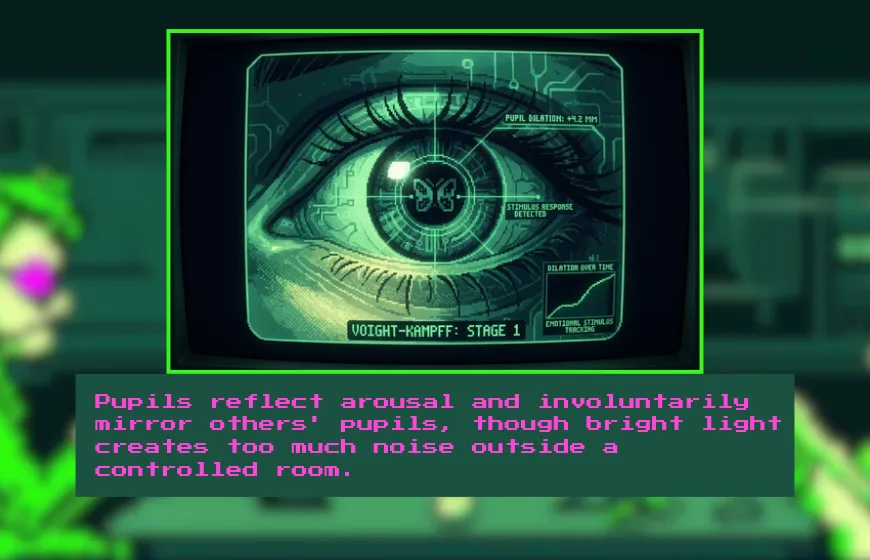
When people watch someone else's pupils change, their own pupils change too. This pupillary contagion is involuntary, reliable between humans, and shaped by empathy and familiarity.
A 2021 Scientific Reports experiment found that pupil dilation differs between authentic and acted laughs and cries: acted laughs produced larger dilation than real ones, while real cries produced larger dilation than acted ones.
Here's the practical read: a pupil measurement only means something in a dim, evenly lit room where nothing else is stirring you up. In a bright coffee shop it's mostly noise. I find the contagion result the most Dick-like of the lot, since an involuntary mirror reaction is hard to fake on cue.
Why "Lie Detector" Should Make You Nervous
The American Psychological Association says most psychologists and other scientists see little basis for the validity of polygraph tests. A National Research Council review found that almost a century of research gives little basis for expecting extremely high polygraph accuracy, partly because the signals involve several processes, some of which people can consciously control.
Now picture the Blade Runner version. An anxious human in a high-stakes interview has a racing heart that reads as "not empathic." A calm, rehearsed subject sails through. A machine that reads arousal can't tell "I feel for that animal" from "I'm terrified of this interview."
Two Kinds of Empathy, and the Test Only Covers One
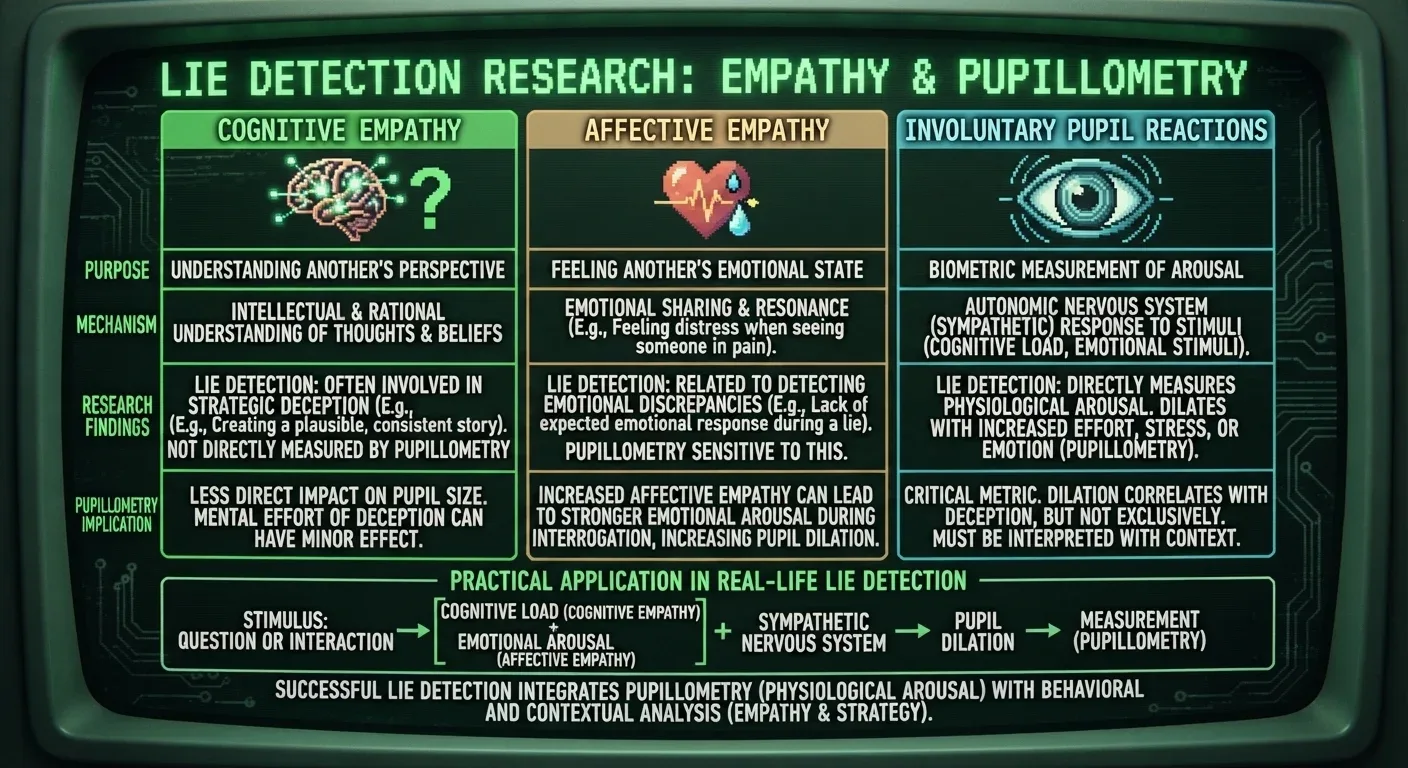
Researchers separate cognitive empathy (inferring what another person thinks or feels) from affective empathy (feeling an appropriate emotion in response). The two come apart in autism and psychopathy: cognitive empathy is impaired in autism while affective empathy likely stays intact, and psychopathy involves reduced affective empathy. People with autism commonly don't realize they've upset someone, yet feel remorse once told.
The best-known performance test of cognitive empathy, the Reading the Mind in the Eyes test, uses 36 eye-region photos, each with four possible emotions or mental states to choose from.
That split matters for our fictional machine. The Voight-Kampff goes after the feeling half, the part that flinches. Most real-life testing measures the reading half, and I'd expect software trained on labeled faces to do fine on something like the Eyes test. It also means a blank face in the middle of your questions proves nothing. Someone can feel plenty and show little.
Can a Chatbot Pass It?
A study published in PNAS found that, given the right persona instructions, advanced language models were judged human as often as real people in Turing-test conversations. The models won by sounding human: matching tone, directness, and humor, and making human-style mistakes. Without detailed persona instructions, they couldn't pull it off.
In an earlier GPT-4 version of the experiment, interrogators judged mostly on linguistic style and socioemotional traits, at 35% and 27% respectively.
That's the uncomfortable part for any Voight-Kampff-style quiz. Empathy-flavored questions are just conversation, and conversation is what these models now do well. The movie's edge was the body, and a chatbot has no pupil to dilate. What's left is whether the reply feels lived-in.
A Homemade Voight-Kampff for Your Next Dinner Party
Don't use this on a stranger or to decide someone is "fake." A blog post can't judge anyone's inner life, and people who are shy, tired, or autistic can answer flat while feeling plenty. If you're asking because someone you love seems unable to feel for others, a licensed clinician is the right route. As a conversation game, though, these four prompts show the difference between lived detail and a polished script:
- "Your friend texts: 'I got the job. I also feel weirdly empty.' What do you send back?"
- "Describe a smell that wrecked a good memory for you."
- "Someone cracks a joke at a funeral. Nobody laughs, but you almost do. Walk me through the next ten seconds."
- "What's the last small kindness someone gave you that you didn't deserve?"
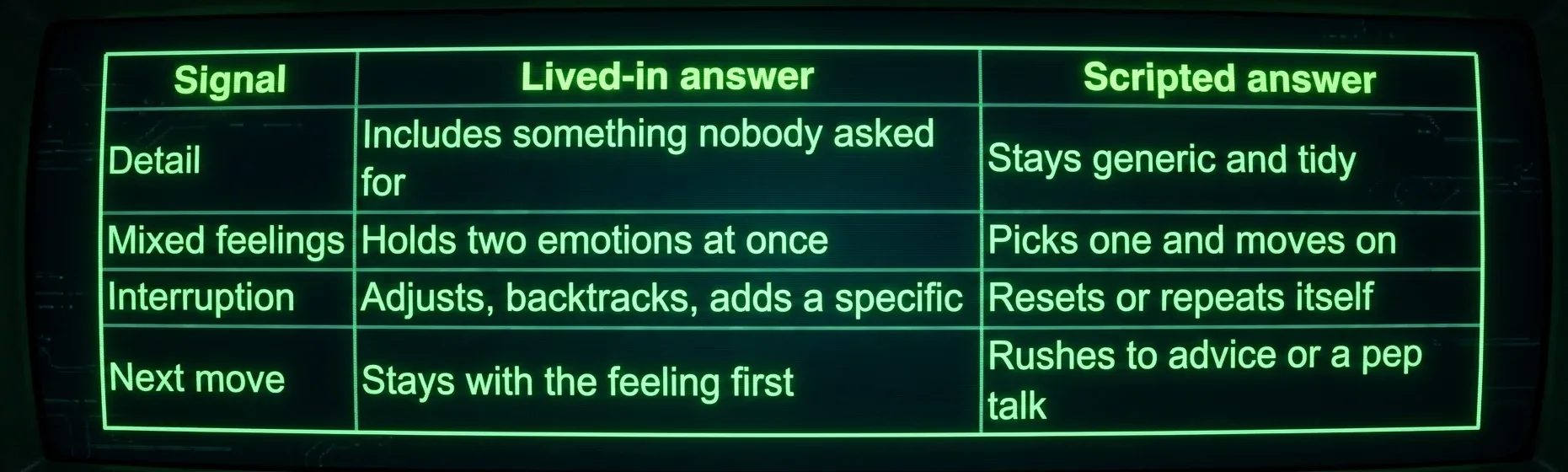
Scripted: "Congratulations! That's a huge achievement. Remember to celebrate yourself and practice self-care."
Lived-in: "Okay, both of those can be true. Is the empty part about the job, or about who you wanted to tell first?"
Then interrupt, because scripts hate that.
You: "Describe a smell that wrecked a good memory."
Them: "Burnt toast. My grandmother's kitchen, the last summer there."
You: "Wait, which kitchen?"
A lived answer produces a detail you couldn't have guessed ("the yellow one, the stove always clicked three times"). A scripted one restates itself more generally.
Where This Leaves You
The Voight-Kampff lasts because it's a good story about a real worry: how do you know who's on the other end? The real-life answer is slower and less cinematic. Give it time, ask for specifics, and let patterns carry more weight than any single reaction.
FAQs
Is the Voight-Kampff test the same as the Turing test?
No. The Turing test measures substitutability: whether a system can stand in for a real person without the other party noticing. The Voight-Kampff adds a body to the mix, watching physical reactions to emotional prompts instead of judging conversation alone.
Could brain imaging replace the pupil sensor?
A neuroscientist who studies consciousness and emotion told Nautilus that some people would reach for brain imaging in a modern version. His bigger question was whether any measure would catch replicants at all, which depends on what you believe robots can do.
Why do replicants live only four years?
In the franchise's lore, the Nexus 6 four-year lifespan is a safety mechanism meant to stop replicants from developing empathic cognition and becoming immune to the Voight-Kampff machine. In other words, the story's designers treat empathy as the thing that would let a replicant slip through.
Why is the name spelled two different ways?
Dick's novel spells it Voigt-Kampff, while the film and later material use Voight-Kampff. Same machine either way; the spelling just tells you which version of the story someone is quoting.
Does a bigger pupil reaction mean someone is more empathic?
No. Dilation tracks arousal, and arousal can come from fear, excitement, or a shift in room lighting. A big reaction says something stirred, not what or why, so it can't rank anyone's empathy.
Sources
- Lancaster University, "Is this the kind of world we actually want?," Lancaster University News, 2016, https://www.lancaster.ac.uk/news/articles/2016/is-this-the-kind-of-world-we-actually-want/index.php (also read: Phys.org, "Researchers build 'Blade Runner' Voight-Kampff machine," 2016, https://phys.org/news/2016-05-blade-runner-voight-kampff-machine.pdf; paper "Research Fiction: How to Build a Voight Kampff Machine," https://core.ac.uk/download/42415879.pdf)
- American Psychological Association, "Do 'lie detectors' work? What psychological science says about polygraphs," 2025, https://www.apa.org/topics/cognitive-neuroscience/polygraph
- National Research Council, "The Polygraph and Lie Detection," Ch. 8, National Academies Press, 2003, https://www.nationalacademies.org/read/10420/chapter/10
- "The pupil as a measure of emotional arousal and autonomic activation," Psychophysiology 45(4):602–607, 2008, https://pmc.ncbi.nlm.nih.gov/articles/3612940/
- Pupillometry luminosity paper, arXiv:2504.13886v2, https://arxiv.org/pdf/2504.13886v2
- "Pupil dilation reflects the authenticity of received nonverbal vocalizations," Scientific Reports, 2021, https://www.nature.com/articles/s41598-021-83070-x.pdf
- Pupillary contagion study, PubMed Central, https://pmc.ncbi.nlm.nih.gov/articles/PMC7812621/
- "The 'Reading the Mind in the Eyes' Test: Complete Absence of Typical Sex Difference in ~400 Men and Women with Autism," PLOS One, 2015, https://pmc.ncbi.nlm.nih.gov/articles/pmid/26313946
- Reading the Mind in the Eyes test and cognitive empathy study (1,168 students), PubMed Central, https://pmc.ncbi.nlm.nih.gov/articles/PMC8047060
- UC San Diego, "AI can seem more human than real humans in a classic Turing test, study finds," EurekAlert, https://www.eurekalert.org/news-releases/1128875
- Cameron R. Jones and Benjamin K. Bergen, "Does GPT-4 pass the Turing test?," arXiv, https://arxiv.org/html/2310.20216v2
- Cameron R. Jones and Benjamin K. Bergen, "Large Language Models Pass the Turing Test," arXiv, 2025, https://arxiv.org/html/2503.23674v1
- Victor Gomes, "The Science Behind 'Blade Runner's Voight-Kampff Test," Nautilus, 2017, https://nautil.us/the-science-behind-blade-runners-voight_kampff-test-236837/
- "Blade Runner (franchise)," Wikipedia, https://en.wikipedia.org/wiki/Blade_Runner_(franchise)
- "Voight-Kampff test," Blade Runner Wiki (Fandom), https://bladerunner.fandom.com/wiki/Voight-Kampff_test?oldid=4471 and https://bladerunner.fandom.com/wiki/File:Deckard_Testing_Rachael.png