Why Is the Turing Test Important? Understanding the Idea That Changed Artificial Intelligence
Ask someone to name one famous idea in artificial intelligence, and there’s a good chance they’ll say the Turing test.
That’s interesting because the Turing Test isn’t an algorithm, a machine learning model, or even a technical benchmark in the modern sense.
It’s a thought experiment.
Yet more than 70 years after it was introduced, people still use it to talk about machine intelligence, human cognition, AI ethics, and whether computers can ever truly think.
So why is the Turing test important?
Not because it proves machines are intelligent.
Its importance comes from something bigger: it changed the question.
Instead of asking “Can machines think?”, it asked something measurable:
Can a machine behave intelligently enough that people cannot reliably distinguish it from a human?
That shift ended up influencing decades of AI research and continues to shape discussions today.
The Imitation Game
The Turing Test was introduced in 1950 by British mathematician and computer scientist Alan Turing in his paper Computing Machinery and Intelligence.
Rather than trying to define intelligence directly, Turing proposed what he called the Imitation Game.
The setup is simple.
A human evaluator communicates through text with two hidden participants:
- One human
- One machine
If the evaluator cannot consistently tell which one is the machine, then the machine is said to pass the test.
Notice what the test is measuring.
Not consciousness.
Not emotions.
Not understanding.
Only whether the machine’s behavior appears human.
That distinction becomes important later.
The Early Days of Computing
To understand the history of the Turing test, you have to go back to the early days of computing.
Computers at the time were enormous machines built mostly for calculations.
The idea that a machine could display intelligence sounded unrealistic to many people.
Turing noticed something.
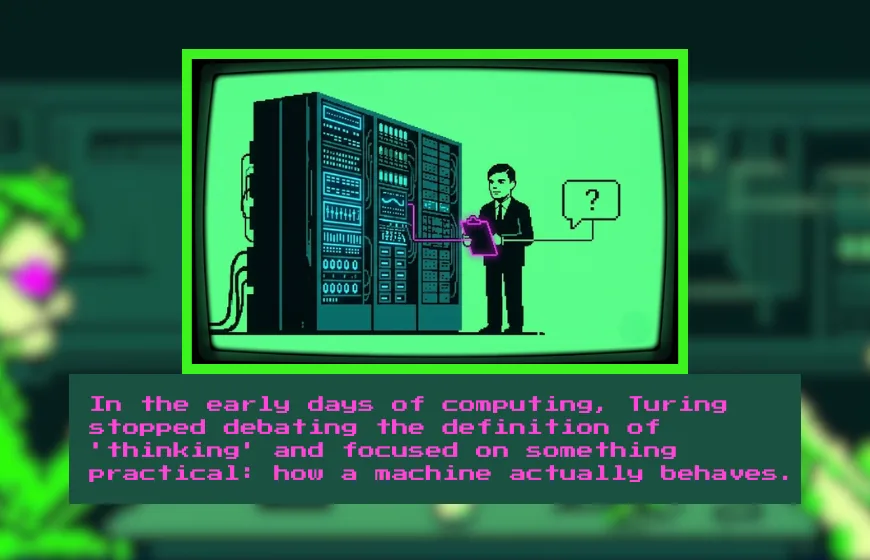
Arguments about whether machines could think often became impossible because people disagreed on what “thinking” meant.
So instead of debating definitions endlessly, he reframed the problem.
His approach was practical:
If a machine behaves like an intelligent system, maybe we should evaluate that behavior rather than argue about invisible mental states.
That idea became one of the foundations of early artificial intelligence research.
Why Is the Turing Test Important in AI?
The importance of the Turing test in AI comes down to three major contributions.
1. It Made Intelligence Testable
Before Turing, intelligence was mostly treated as a philosophical problem.
The Turing Test turned it into something observable.
Researchers suddenly had a practical question:
Can we build systems capable of human-like interaction?
That shift encouraged experimentation.
2. It Helped Define Early AI Goals
Much of early artificial intelligence research focused on creating machines that could:
- reason
- communicate
- answer questions
- imitate human responses
The Turing Test became a symbolic target.
Even if researchers didn’t literally run the test, the idea influenced development.
3. It Connected Technology and Philosophy
Few ideas in computer science became part of mainstream culture.
The Turing Test did.
People still reference it when discussing:
- machine intelligence
- consciousness
- ethics
- robotics
- human identity
That reach is part of its lasting significance.
Turing Test and Machine Intelligence: Are They the Same Thing?
This is where things become more complicated.
People often assume:
Pass Turing Test = machine is intelligent.
But that is not what the test claims.
The Turing test and machine intelligence are related, but they are not identical.
A system might appear intelligent while relying on:
- pattern recognition
- probability
- language prediction
- memorized responses
That doesn’t necessarily mean understanding exists.
This distinction matters more today because conversational AI has become dramatically more capable.
Modern systems can:
- explain concepts
- maintain dialogue
- answer questions
- imitate personality
Yet many researchers still debate whether that equals cognition.
Practical Applications of the Turing Test Today
The Turing Test itself is not usually used as an official evaluation framework anymore.
But its ideas appear everywhere.
Some modern applications of the Turing test include:
Chatbots
Developers measure whether conversations feel natural.
Virtual Assistants
Systems are designed to interact in ways users perceive as intuitive.
Customer Support Automation
Companies evaluate whether users can complete conversations smoothly.
Conversational AI
Language models increasingly focus on maintaining context and generating human-like dialogue.
Even though these systems are not literally competing in Turing Tests, the influence is obvious.
Systems That Approached the Turing Test
Over the years, several projects claimed progress toward passing.
One of the most discussed examples was conversational bots designed to imitate specific personalities or communication styles.
Many succeeded not because they demonstrated deep understanding but because they managed expectations.
For example:
- limiting conversation length
- pretending to be younger
- redirecting difficult questions
- using humor and ambiguity
These approaches revealed something unexpected.
Passing often depended as much on human psychology as technical capability.
That insight still influences AI design.
The Philosophical Implications of the Turing Test
The philosophical implications of the Turing test may be more important than the test itself.
It raises uncomfortable questions.
If a machine behaves intelligently:
Does that mean intelligence exists?
If people emotionally connect with AI:
Does the distinction matter?
If consciousness cannot be measured directly:
What counts as proof?
These questions extend beyond computer science.
They touch philosophy, psychology, and ethics.
One major challenge is that humans themselves judge intelligence mostly through behavior.
You assume other people think because of what they say and do.
The Turing Test asks whether machines should receive the same treatment.
Criticisms of the Turing Test
No discussion is complete without examining the criticisms of the Turing test.
It Measures Imitation, Not Understanding
A machine may generate convincing responses without understanding meaning.
It Focuses Too Much on Language
Human intelligence includes:
- perception
- physical interaction
- memory
- planning
Conversation alone is incomplete.
It Encourages Human-Like Behavior Instead of Capability
Systems may optimize for sounding human rather than solving problems.
It Cannot Measure Consciousness
Passing the test tells us nothing about internal experience.
These limitations led researchers to explore broader approaches.
Alternatives to the Turing Test
Several alternatives attempt to measure intelligence differently.
The Total Turing Test
Adds physical perception and interaction.
The Lovelace Test
Evaluates creativity and originality.
The Coffee Test
Asks whether a robot could successfully enter a home and make coffee.
Each test tries to move beyond conversation and capture more dimensions of intelligence.
The Future of the Turing Test
Will the Turing Test disappear?
Probably not.
Its role is changing.
Modern machine learning systems increasingly challenge the assumptions behind it.
As AI becomes more capable, conversations shift from:
“Can AI imitate humans?”
to:
“What does intelligence actually mean?”
Future AI evaluation will likely combine:
- reasoning
- memory
- language
- perception
- adaptation
- real-world performance
But the Turing Test will likely remain relevant because it introduced the discussion in the first place.
So, Why Is The Turing Test Important?
Not because it solved intelligence.
Not because it proved machines can think.
Its significance comes from changing how people approach the problem.
The Turing Test gave researchers permission to treat intelligence as something that could be explored instead of endlessly defined.
Even today, debates around AI ethics, conversational systems, and machine intelligence still return to questions Turing raised decades ago.
And maybe that’s the real achievement.
Not building machines that think.
But forcing humans to think more carefully about what thinking actually is.
FAQ
What is the primary purpose of the Turing Test?
The test was designed to measure whether a machine can exhibit intelligent behavior indistinguishable from that of a human through text-based conversation.
Does passing the Turing Test mean a machine is conscious?
No. Passing the test only indicates that a machine can successfully imitate human conversation; it does not prove the machine possesses feelings, consciousness, or true understanding.
Why did Alan Turing create the Imitation Game?
Turing created it to move away from philosophical arguments about the definition of "thinking" and toward a practical, observable way to evaluate intelligent behavior.
Is the Turing Test still used to evaluate modern AI?
It is not used as an official technical benchmark today, but its core concepts continue to influence the design and evaluation of chatbots and virtual assistants.
What are the main criticisms of the Turing Test?
Critics argue it measures imitation rather than understanding, relies too heavily on language, and ignores other aspects of intelligence like physical perception and problem-solving.
What is the Total Turing Test?
The Total Turing Test is an expanded version that requires machines to demonstrate physical interaction and perception, not just text-based communication.