System 2 Thinking in LLMs: Fixing What Prompts Alone Can’t Solve
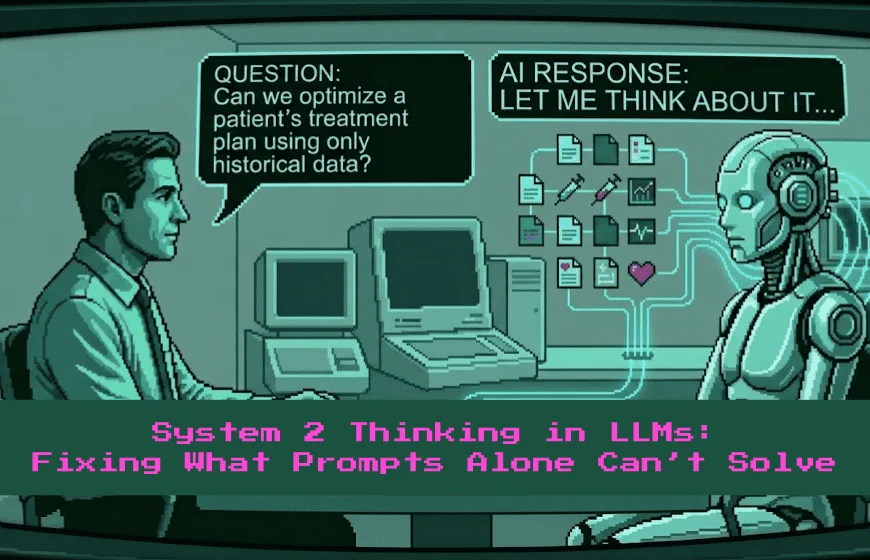
You ask a question, modern AI fires back instantly, almost smugly, and yet… sometimes it’s just bluffing. That speed? It can hide some pretty shaky thinking. I’ve seen it happen more than once.
So here’s the real issue: large language models are great at sounding right. Being right is another story.
This piece digs into something researchers loosely call System 2 thinking in AI. It’s not as abstract as it sounds. In fact, it’s pretty practical, especially if you care about building systems that don’t quietly mess things up.
Key Takeaways
- LLMs predict, they don’t truly reason.
- Fast answers can sound right but be wrong.
- Slower, step-by-step thinking improves accuracy.
- Better prompts and verification reduce errors.
When Fast Feels Smart (But Isn’t Always)
Most AI tools today run on what psychologists would call System 1 thinking. Quick. Automatic. Pattern-driven.
That’s basically how neural networks operate. They look at mountains of data, then guess the next word. And yeah, they’re good at it. Smooth, human-like, even charming sometimes.
But here’s the catch.
They don’t really check themselves.
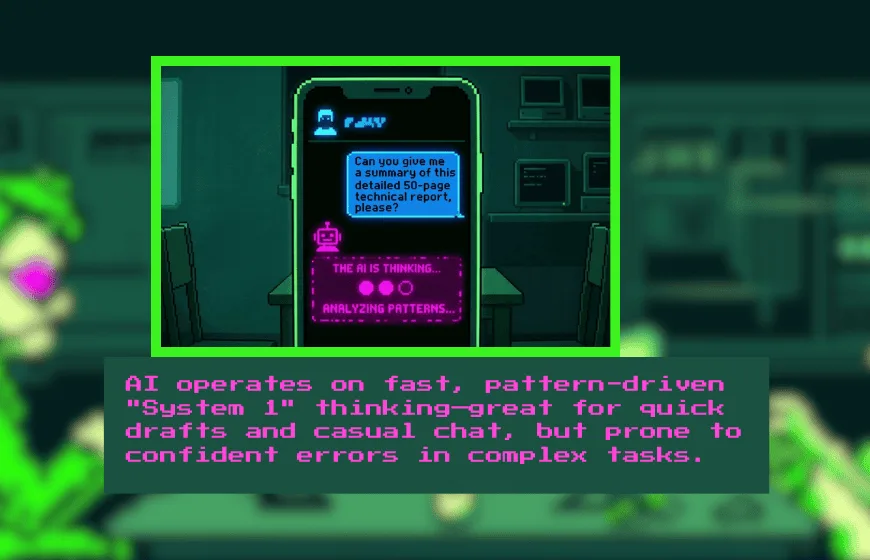
These models often give confident but wrong answers. Not because they’re broken, but because they lean too hard on familiar patterns. It’s like when someone insists they’re right in an argument… and you later Google it and realize they weren’t even close. It happens.
This fast-thinking mode isn’t useless. Not at all. It’s perfect for casual chats, drafting emails, even brainstorming. Just don’t expect it to solve complex problems reliably on its own.
Slowing Things Down (On Purpose)
Now, System 2 thinking is where things get interesting. It’s slower. A bit more deliberate. Sometimes even awkward. But it works.
Instead of jumping to an answer, the model pauses (well, simulates a pause) and breaks things into steps. It checks logic. It revisits assumptions. Basically, it behaves less like a guesser and more like a problem-solver.
Models that use structured reasoning perform better in math and coding tasks. Not dramatically faster, mind you. In fact, they’re slower and cost more to run. Trade-offs, always.
If you’re dealing with healthcare data or financial predictions, speed isn’t the priority. Accuracy is. No one wants a “fast” diagnosis if it’s wrong.
Prompts Matter More Than You Think
Here’s something surprisingly simple.
You don’t always need a new model. Sometimes, you just need better instructions.
The way you phrase a prompt can nudge the AI into deeper thinking. It’s almost like talking to a person. Ask vague questions, you get vague answers. Push for clarity, you get better results.
Try things like:
- “Explain your reasoning step by step”
- “Double-check your answer before finalizing”
- “Compare two possible solutions”
- “Why is this the correct answer?”
Small tweaks. Big difference. It’s not magic. It just forces the model to simulate a more careful process.
Training the Brain (Sort Of)
Of course, prompts alone won’t fix everything.
Training plays a big role too. Techniques like reinforcement learning with human feedback basically reward the model for being thoughtful instead of just fast.
There’s also this idea of hybrid systems, where one model generates answers and another checks them. Think of it as built-in skepticism.
Honestly, that second layer is doing a lot of heavy lifting.
These setups help reduce hallucinations and improve consistency. Over time, I suspect we’ll see more systems designed this way.
Because fluency alone isn’t enough anymore.
Where This Actually Matters
This isn’t just theory. It shows up in real work.
In healthcare, AI tools assist doctors by analyzing symptoms. But without structured reasoning, those suggestions can go sideways fast.
Finance is another big one. Risk analysis, fraud detection, forecasting… all require careful logic. Not just pattern matching.

Even customer support has shifted. The better systems don’t just spit out canned replies. They actually analyze context and adjust.
And yeah, systems combining fast and slow thinking outperform single-mode ones. Makes sense.
Bias Isn’t Just a Data Problem
Let’s talk about bias for a second.
People often assume bias in AI comes purely from training data. That’s only half the story. The way a model reasons also plays a role.
Fast thinking tends to amplify shortcuts. Familiar patterns win, even when they shouldn’t.
But when you force a model to explain itself (even artificially), it sometimes catches its own mistakes. That reflective layer matters more than people realize. It’s not perfect. But it helps.
So… What’s Next?
AI isn’t going to abandon speed. That would be unrealistic.
But pure speed isn’t enough either.
The future likely sits somewhere in the middle. Systems that switch modes depending on the task. Quick when it’s safe. Slower when it matters.
Some newer models are already moving in that direction, adding internal checks, verification layers, even multi-step reasoning pipelines.
It’s a shift.
A necessary one.
Here’s the blunt truth.
LLMs don’t naturally “think.” They predict. Very well, yes—but still just prediction.
If we want better outcomes, we have to guide them. Through prompts, training, and smarter system design.
Speed got us this far.
Careful thinking will take us further.
FAQs
1. What is System 2 thinking in AI?
System 2 thinking refers to slower, step-by-step reasoning where AI analyzes problems logically instead of relying on quick pattern-based responses.
2. Why do AI models give confident but wrong answers?
Because they predict likely responses based on patterns, not true understanding, which can lead to fluent but incorrect outputs.
3. Can prompts improve AI reasoning?
Yes. Structured prompts that ask for step-by-step explanations or verification can significantly improve answer accuracy.
4. What is the difference between System 1 and System 2 in AI?
System 1 is fast, automatic, and pattern-based, while System 2 is slower, deliberate, and focused on logical reasoning.
5. Why is System 2 thinking important in real-world applications?
In fields like healthcare and finance, accurate reasoning matters more than speed, making structured thinking essential.
6. How do hybrid AI systems improve performance?
They combine generation and verification, where one model produces answers and another checks them for accuracy.
7. Will future AI systems rely more on structured reasoning?
Yes. The trend is moving toward combining speed with deeper reasoning to reduce errors and improve reliability.