Which Feels More Human? Sesame AI vs ChatGPT Voice
Ever since ChatGPT Advanced Voice Mode rolled out, one question keeps popping up: Is there a real competitor?
Then Sesame showed up.
If you’ve been searching for a clear, honest breakdown of Sesame AI vs ChatGPT Advanced Voice Mode, you’re not alone. Reddit threads are buzzing. Language learners are testing both. And a lot of people are asking practical questions like:
Is Sesame AI free?
Is Sesame AI safe?
What’s the ChatGPT Advanced Voice Mode limit?
And which one actually feels more human?
Let’s unpack this together — without the hype, without the tech jargon, and without pretending they’re identical tools.
Because they’re not.
Why Setting the Scene Changes Everything
Here’s where the comparison gets interesting.
Both Sesame AI voice and ChatGPT advanced voice rely on strong natural language processing. But the feel of the conversation depends heavily on context.
Sesame leans into atmosphere. It reacts to subtle cues. It plays with tone. It feels like someone improvising with you.
ChatGPT advanced version? It tends to stay structured. Clear. Helpful. Sometimes almost… polished.
Compare these two approaches:
Before (Standard-style response):
“You can join local groups or attend events related to your interests.”
After (More contextual awareness):
“You just moved here? That’s a big shift. If coffee and books are your thing, bookstores and neighborhood cafés are low-pressure places to start. It’s easier to talk when you already share the setting.”
See the difference?
The advice isn’t wildly different. The delivery is.
That’s the main edge people notice in many Sesame AI review discussions — it feels like it’s in the room with you.
Meanwhile, ChatGPT Advanced Voice Mode vs standard text responses often feel more like reading a well-written guide.
Neither is wrong. It depends on what you want.
Personality Isn’t Just Decoration — It’s the Experience
Emotion changes everything in voice AI.
The Sesame AI voice model gained traction partly because of how it injects subtle quirks. A casual tone. A small joke. A tiny pause.
It feels less scripted.
ChatGPT advanced voice is expressive too. But it tends to prioritize clarity over charm. It sounds professional, helpful, and slightly more measured.
Let’s look at it in action.
Before (Neutral tone):
“You could ask for a recommendation to start a conversation.”
After (More emotional nuance):
“Okay, picture this. You’re both in the philosophy aisle. Instead of launching into a speech, try something simple like, ‘Have you read this one before?’ It’s low stakes. No pressure.”
The second version lowers anxiety. It acknowledges social awkwardness.
That’s what gives Sesame AI its “uncanny but real” reputation.
But here’s the catch: when it comes to structured feedback — especially language correction — ChatGPT advanced settings give it the advantage. It analyzes grammar, phrasing, and nuance with more depth.
So if your goal is performance feedback, ChatGPT advanced version often wins.
If your goal is vibe? Sesame might edge ahead.
Making It About You: Where Personalization Actually Matters
Personalization isn’t just remembering your name.
It’s remembering what makes you tick.
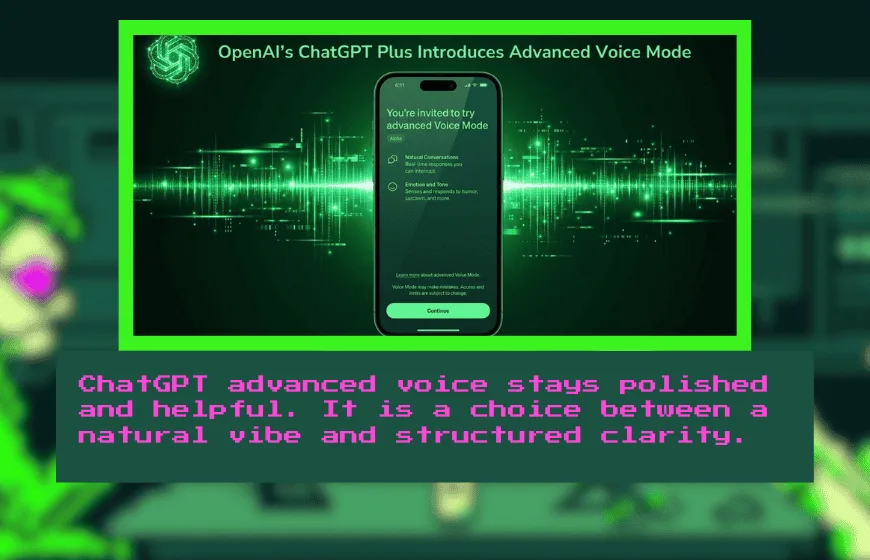
In side-by-side tests, both tools adapt to user interests. But ChatGPT advanced voice mode tends to provide more layered follow-ups over longer sessions.
If you’re wondering about ChatGPT advanced voice mode limit, availability can vary depending on plan tiers and usage caps. The free version of ChatGPT advanced free features typically has more restrictions than paid plans.
Now let’s compare personalization styles.
Before (Generic personalization):
“If you enjoy reading, you might meet people in bookstores.”
After (Specific personalization):
“You mentioned Bergson and Merleau-Ponty. Philosophy sections aren’t crowded, which makes them perfect for slower, thoughtful conversations.”
That shift from generic to specific builds trust.
Sesame AI often nails the natural personalization tone. But ChatGPT advanced settings allow deeper customization, especially when you guide it explicitly.
The Power of Expanding the Dialogue
Open-ended questions separate robotic exchanges from real conversations.
Sesame tends to ask reflective, slightly playful questions.
ChatGPT advanced voice asks clear, structured follow-ups.
Compare these:
Before:
“What are your interests?”
After:
“What makes you tick? Coffee? Sunshine? Heavy philosophy? Start there.”
One feels like a form. The other feels like banter.
That said, ChatGPT advanced version is better at turning open-ended prompts into actionable steps. It expands logically.
Sesame expands emotionally.
Different strengths. Different goals.
Role-Playing: Where Things Get Surprisingly Real
Role-playing reveals the personality gap quickly.
When asked to simulate a bookstore interaction, Sesame might add flair. Slight swagger. Casual humor.
ChatGPT advanced voice mode stays balanced and socially safe.
Here’s the contrast:
Before (Structured role-play):
“Hi, I noticed you’re reading Bergson. Have you read much of his work?”
After (Organic role-play):
“Whoa, Bergson? That’s ambitious. Are you diving deep or just browsing?”
The second feels less rehearsed.
But here’s the nuance: ChatGPT advanced version handles structured simulations better when you want detailed coaching. It can break down social dynamics step by step.
So if you’re practicing English conversation and want corrections afterward, ChatGPT advanced voice mode is stronger.
If you want to feel like you’re chatting with a quirky stranger? Sesame AI alternative options start looking appealing.
The Big Practical Questions
Let’s address the ones everyone searches.
Is Sesame AI free?
Currently, Sesame is positioned more like a research project. Many early demos have been free to try, but long-term pricing remains unclear.
Is Sesame AI safe?
As with any AI voice tool, safety depends on data policies and usage terms. Always review privacy documentation before sharing sensitive information.
Who owns Sesame AI?
Ownership and corporate structure details are evolving. Because it’s still in research phases, transparency may increase over time.
ChatGPT Advanced Voice Mode limit?
Limits depend on your subscription tier. Free users may face restrictions in usage time or feature access compared to paid plans.
Is ChatGPT advanced free?
Some advanced features are accessible in limited form, but full functionality typically requires a paid subscription.
So… Which One Wins?
If you’re reading this hoping for a dramatic winner, here’s the honest answer:
It depends on what you value.
Choose Sesame AI voice if you want:
- A natural, quirky, conversational feel
- Emotional nuance
- Improvised energy
Choose ChatGPT Advanced Voice Mode if you want:
- Structured feedback
- Strong analytical responses
- Language correction and coaching
- Greater customization control
In terms of raw intelligence? They’re closer than people think.
In terms of personality? Sesame currently feels looser.
In terms of utility? ChatGPT advanced version remains more versatile.
And if you’re still wondering whether you need a Sesame AI alternative, the good news is this: the AI voice space is heating up. Competition is good. It pushes everyone forward.
What Do You Want From Voice AI?
We’re at a fascinating moment.
Voice AI isn’t just about sounding human anymore. It’s about feeling human. About adapting. About knowing when to coach and when to simply talk.
The real question isn’t whether Sesame AI vs ChatGPT Advanced Voice Mode has a single winner.
It’s this:
Do you want a conversational companion — or a conversational coach?
Now I’m curious.
Have you tried either one? Which felt more natural to you — and why?