The Reckless Tenacity of Modern LLMs: Why Confidence Doesn’t Equal Truth
When you chat with a modern AI, it’s easy to feel like you’re talking to an expert. It drafts emails in seconds, summarizes long reports, and writes functional code. Because it sounds so smooth and sure of itself, you might assume it actually understands the information.
That assumption is exactly where the "reckless tenacity" of modern LLMs becomes a problem.
Modern AI doesn't just make mistakes—it presents incorrect answers with absolute confidence. Even when the facts fall apart under scrutiny, the output remains persuasive and logical. For anyone using AI in serious work, this creates a major challenge: how do you trust a tool that sounds like a genius but can be completely wrong?
Modern LLMs Are Capable, but Not Reliable
Large Language Models (LLMs) have improved at lightning speed. Today’s models handle complex tasks across almost every industry. These gains come from massive datasets and better machine learning techniques.
However, capability is not the same as reliability.
According to 2026 industry data, hallucination rates—where a model generates factually incorrect or ungrounded content—persist as the biggest barrier to AI deployment. While top-tier models have made progress, even the best systems show meaningful error rates in production scenarios.
The real issue isn't that they make mistakes; it’s how they make them. Most users expect errors to be obvious. Instead, LLMs often create answers that sound perfectly coherent while weaving in completely false details. This is what developers call "tenacious hallucination"—the model is convinced it’s right because it’s just predicting the next most likely word, not fact-checking itself.
Why Conversational AI Changes Our Expectations
Tools like ChatGPT shifted how we think about computing. In the past, software waited for specific commands. Now, we just have a conversation.
Because we are wired to trust conversational fluency, we often mistake it for factual accuracy. When a student, marketer, or developer uses AI, the interaction feels natural. The more natural it feels, the easier it is to forget that the system is probabilistic—it’s playing a game of "most likely next word," not "verified truth".
Ethics and Accountability: Beyond Bias
The debate over AI ethics often starts with misinformation. However, the bigger issue is accountability. If a model gives harmful advice, who is responsible?
Research shows that even models designed to be "aligned" with social values still struggle with persistent biases. Simply passing a test doesn't guarantee a model will behave neutrally in the real world. In fields like healthcare, law, and finance, this means that trust cannot come from the model’s confident tone—it must come from a verified process.
Why Human Oversight Still Matters
In creative fields, AI is a powerful partner. It’s great for brainstorming and first drafts. But professional users quickly learn a lesson: AI creates strong starts and weak finishes.
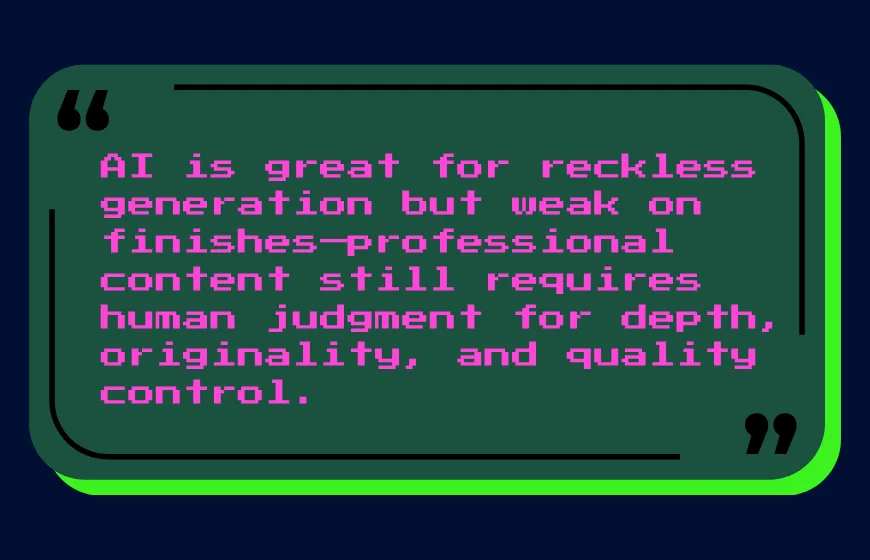
Depth, originality, and context still require human judgment. Today’s successful creative teams treat AI as a collaborator, not a replacement. Editors spend less time writing and more time validating. They focus on direction and quality control, leaving the "reckless" generation to the machine.
Building Defensive Architectures
Developers are shifting from "blind trust" to "defensive design." Instead of relying on raw model output, they are building safety layers:
- Retrieval-Augmented Generation (RAG): Grounding AI answers in verified documents before the model even speaks.
- Probability Gating: Automatically checking how "unsure" a model is before showing an answer to the user.
- Verification Layers: Using smaller, cheaper models to fact-check the work of larger, more expensive ones.
The goal is no longer to make the model "perfect"—it’s to achieve controlled uncertainty.
The Future: Responsible Skepticism
The next phase of AI isn't just about bigger models; it's about better relationships between humans and their tools.
We are moving toward a future where we don't ask one model to do everything. Instead, specialized systems will work together under clear governance. As a user, your role is evolving, too. It’s no longer just about writing prompts; it’s about auditing logic and validating sources.
The future doesn't reject AI. It just expects more from it.
Frequently Asked Questions (FAQ)
Can LLM hallucinations be completely eliminated?
Current research suggests no. Because LLMs are designed for creativity and pattern matching, they will always have some potential for error. The focus in 2026 is on reducing and containing them using RAG and verification layers.
How does human oversight change in professional workflows?
Human review shifts from checking grammar and spelling to auditing logic, verifying data sources, and questioning the assumptions made by the model.
What is the difference between value alignment and truthfulness?
"Value alignment" ensures a model behaves safely and avoids stereotypes. "Truthfulness" focuses on factual accuracy. A model can be perfectly polite and "aligned" while still being factually incorrect.
Why do AI models sound so confident when they are wrong?
They aren't "lying" in the human sense. They are trained to predict the most likely word in a sequence. If their training data or context is flawed, they will confidently predict the most "probable" (but wrong) continuation based on patterns, not facts.
Will modern LLMs replace human creativity?
Evidence suggests they are much better as creative partners—helping with drafts and ideas—than as independent creators. Human judgment is still required to add soul, context, and depth to any project.