Claude AI Finds 22 Firefox Flaws in Two Weeks: What This Means for Cybersecurity
Software bugs hide in plain sight. Even trusted tools like Mozilla Firefox contain hidden flaws. The real problem is speed. Human researchers cannot review millions of lines of code quickly enough.
That is where Claude AI enters the story.
Recently, Anthropic’s Claude AI found 22 Firefox flaws in just two weeks. According to reporting from The Wall Street Journal, the model discovered its first Firefox security flaw in roughly 20 minutes. Mozilla engineers called the bug serious and asked for a follow-up discussion.
This event shows how AI-powered bug hunting may change cybeairsecurity.
Quick Insights
- Claude AI found 22 Firefox flaws in two weeks.
- Fourteen vulnerabilities were classified as high-severity.
- Mozilla patched the issues in Firefox 148.
- AI-powered bug hunting differs from traditional fuzzing methods.
- Vulnerability discovery carries dual-use risks.
- Human oversight remains critical in AI-driven cybersecurity.
How Claude AI Found Firefox Security Flaws
Anthropic’s Frontier Red Team worked directly with Mozilla. Together, they tested Claude Opus 4.6 against Firefox’s codebase.
Unlike traditional security tools, Claude does not throw random data at programs. Instead, it reads source code like a human analyst. It examines commit histories, traces risky function calls, and looks for partially fixed bugs.
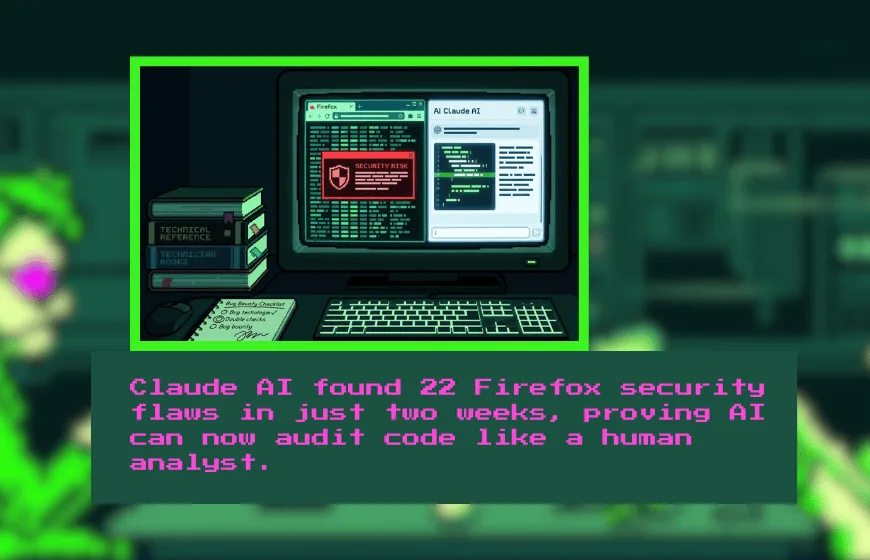
During the two-week collaboration, Claude AI found 22 security vulnerabilities. Fourteen of those were classified as high-severity. Mozilla included fixes for these issues in Firefox 148, which shipped on February 24 with over 50 security patches.
This process highlights a key shift. AI now supports defenders in finding flaws before attackers exploit them.
What Makes AI-Powered Bug Hunting Different
Traditional bug hunters often rely on fuzzing tools. Fuzzers send random inputs into software to trigger crashes. While useful, they cannot reason about code logic deeply.
Claude AI works differently. It analyzes patterns and relationships in code. For example, it can spot a function that handles memory incorrectly or identify logic errors introduced during updates.
Earlier in February, Anthropic reported that Claude Opus 4.6 discovered over 500 previously unknown high-severity vulnerabilities across open-source libraries. These included projects like Ghostscript and OpenSC.
Logan Graham, head of Anthropic’s Frontier Red Team, explained the urgency clearly. He told Axios, “There’s a competition between defenders and attackers, and we aim to equip defenders with tools as swiftly as possible.”
That competition defines modern cybersecurity.
Why This Matters for Everyday Firefox Users
Most users never see security flaws directly. However, vulnerabilities can expose personal data or enable remote attacks.
When Claude AI found 22 Firefox flaws, Mozilla patched them before widespread exploitation. As a result, hundreds of millions of users received safer browser updates.
For example, imagine using Firefox to access online banking. A high-severity flaw in memory handling could allow malicious code execution. Fixing such bugs early prevents serious damage.
Therefore, AI-assisted security scanning benefits everyday users, even if they never notice.
The Rise of Claude Code Security
Following these discoveries, Anthropic launched Claude Code Security. This tool scans codebases for vulnerabilities and suggests patches for review.
Initially, the tool targets enterprise customers and open-source maintainers. However, the broader goal remains clear: strengthen software supply chains.
Open-source libraries support countless applications. If vulnerabilities hide there, they can spread widely.
AI tools like Claude help reduce that risk by reviewing large codebases quickly and consistently.
The Dual-Use Challenge of AI Vulnerability Discovery
However, the story does not end with celebration.
AI vulnerability discovery carries dual-use risks. The same model that finds flaws for defenders could also help attackers.
Anthropic acknowledged this concern in its research blog. The company warned that traditional 90-day disclosure windows may not hold up against the speed of large language model discoveries.
In simple terms, AI can find bugs faster than current reporting systems can manage.
Therefore, companies must balance innovation with control. Anthropic introduced real-time misuse detection systems to monitor how people use Claude. Still, the company admits this may create friction for legitimate researchers.
A Shifting Cybersecurity Landscape
Claude AI’s work with Firefox signals a broader change. Artificial intelligence now participates actively in software auditing.
Governments and tech companies also watch closely. Recently, Anthropic faced scrutiny over potential military applications of its AI systems. The Pentagon even labeled the company a supply chain risk.
These developments show how cybersecurity, AI research, and national policy now intersect.
Yet one fact remains clear. AI models like Claude increasingly support defensive cybersecurity work.
Common Misconceptions About AI in Security
Some people assume AI replaces human security experts. That is not accurate.
Claude AI identifies potential flaws, but human engineers verify and patch them. Mozilla developers still reviewed findings before releasing updates.
Another misconception involves perfection. AI tools can miss vulnerabilities or produce false positives. Therefore, human oversight remains essential.
AI acts as a powerful assistant, not a standalone authority.
What Comes Next for AI in Cybersecurity
AI-powered bug hunting will likely expand. As software grows more complex, automated reasoning tools become valuable.
However, developers must design guardrails carefully. Misuse prevention, disclosure policies, and transparency will shape the future of AI security tools.
The discovery of 22 Firefox flaws in two weeks marks a milestone. Yet it also raises new questions about speed, responsibility, and global coordination.
Faster Defense in a Digital World
Cyber threats evolve quickly. Meanwhile, software complexity increases every year.
Claude AI’s ability to find Firefox security flaws demonstrates how artificial intelligence can strengthen digital defenses. At the same time, it highlights the need for ethical oversight.
As AI tools grow more capable, the key question becomes simple: Can defenders stay ahead without empowering attackers?
Artificial intelligence now plays an active role in defending software. Understanding that shift helps us grasp the future of cybersecurity.
FAQs
How did Claude AI find Firefox flaws?
Claude analyzed Firefox source code using pattern recognition and logical reasoning, identifying vulnerabilities such as memory handling issues and incomplete patches.
What is Claude Opus 4.6?
Claude Opus 4.6 is an advanced large language model developed by Anthropic that can analyze complex codebases and assist in cybersecurity tasks.
Were the Firefox vulnerabilities fixed?
Yes. Mozilla patched the identified issues in Firefox 148, which included more than 50 security updates.
How is AI bug hunting different from fuzzing?
Traditional fuzzing sends random inputs to trigger crashes, while AI models like Claude reason about code structure and logic to detect deeper vulnerabilities.
Does AI replace human security researchers?
No. AI assists by identifying potential issues, but human engineers verify findings and implement fixes.
Is AI vulnerability discovery risky?
Yes. The same tools that help defenders find bugs could potentially be misused, creating dual-use concerns in cybersecurity.