OpenAI’s New LLM Exposes the Secrets of How AI Really Works

Artificial intelligence has become powerful enough to write, code, summarize, and reason across thousands of topics. Yet one major problem remains: people still struggle to explain exactly why these systems arrive at certain answers. That gap has shaped years of debate around AI safety, trust, and reliability.
OpenAI’s new LLM research points toward a different future. Instead of treating advanced AI as a sealed black box, researchers are experimenting with ways to expose internal decision paths and make model behavior easier to understand. This work combines sparse neural architectures, interpretability tools, and new monitoring methods to improve AI transparency without abandoning performance.
This post explains what changed, why it matters, and why many researchers believe this could reshape the future of Large language models (LLMs).
The Long Road to AI Model Understanding
Modern AI did not begin with giant language models. Early neural networks used simple layered structures and solved narrow tasks. As computing power increased, researchers built deeper systems capable of recognizing images, generating text, and learning patterns from enormous datasets.
The arrival of transformer models changed everything. These architectures allowed models to process relationships across huge amounts of information at once. That breakthrough created today’s OpenAI LLM systems and other frontier models.
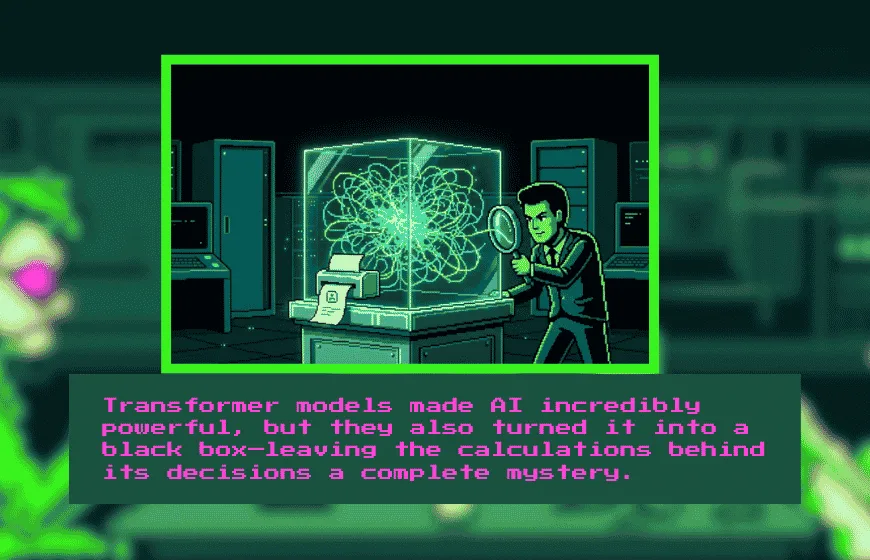
Yet better performance introduced a new problem. Engineers could measure outputs but often could not explain internal reasoning. Researchers started calling these systems “black boxes” because millions or billions of internal calculations became difficult to trace.
This challenge pushed interest toward AI model understanding and model interpretability. Instead of asking only what a model produces, researchers started asking what happens inside the network while decisions form.
OpenAI Is Trying Two Different Paths Toward AI Transparency
Most public discussion misses an important distinction.
One approach studies existing dense models after training. Another approach builds interpretable structure directly into the model itself.
OpenAI now explores both directions.
The first path uses interpretability tools on existing models. One major example uses sparse autoencoders to analyze internal activations and separate overlapping concepts hidden inside dense networks. OpenAI reported scaling a 16-million latent sparse autoencoder trained across 40 billion GPT-4 activation tokens to isolate more human-readable features from internal representations.
The second path may prove more important.
OpenAI’s sparse circuit research explores a weight-sparse transformer architecture where many neural connections are intentionally removed. Instead of every neuron talking to thousands of others, each component connects to a much smaller set of destinations. The goal is not simply to inspect intelligence afterward. The goal is to design systems that remain understandable from the beginning.
Think of it this way.
Sparse autoencoders act like powerful glasses that help researchers see through a foggy window.
Weight-sparse models try to replace the foggy window with clear glass.
That distinction matters because AI transparency becomes much easier when structure exists before training rather than after deployment.
Why Dense Neural Networks Become Hard to Explain
Traditional neural networks rely heavily on a phenomenon called superposition.
Superposition happens when one neuron represents many concepts at the same time. Instead of storing one idea in one place, models compress information across overlapping directions inside internal space.
This compression improves efficiency but makes explanations difficult.
Imagine opening a music mixer where every slider controls ten songs at once. Lowering one channel unexpectedly changes several others. Dense models behave similarly. A single internal adjustment may affect many unrelated outputs.
Mechanistic interpretability tries to solve that problem.
Researchers measure internal pathways using interpretability metrics and search for monosemantic feature directions, which are internal features linked to more isolated meanings. Sparse representations reduce overlap and create cleaner explanations of model behavior.
This work connects directly to deep learning advancements because the objective is not reducing capability. Researchers want systems that stay powerful while becoming easier to inspect.
Early findings suggest there may be a trade-off curve between performance and interpretability, yet increasing scale appears to push that boundary outward rather than keeping it fixed.
The Technical Shift That Makes OpenAI’s New LLM Research Different
The most interesting technical idea is that OpenAI no longer treats interpretability as an optional debugging layer.
Instead, interpretability becomes part of training.
Sparse autoencoders use controlled activation patterns that activate only selected latent dimensions. Researchers found that Top-K activation methods improved reconstruction quality and produced stronger sparsity-reconstruction Pareto frontiers compared with older approaches. Independent evaluation showed cleaner recovery of internal features and more stable analysis.
At the same time, sparse transformer research studies explicit neural circuits.
A circuit maps which internal units influence later decisions. When enough connections become sparse and traceable, researchers can follow decision paths step by step.
That capability opens a new level of model interpretability.
Instead of saying “the model probably relied on pattern X,” researchers can ask which internal route produced the result.
That shift moves AI model understanding closer to science than observation.
Real-World Applications Go Far Beyond Research Labs
Better interpretability changes more than academic papers.
Healthcare systems may benefit because clinicians need explanations before trusting AI recommendations. Understanding decision paths could improve confidence in diagnostic support tools.
Finance could gain stronger auditability. Regulators increasingly expect evidence for automated decisions involving lending, fraud detection, and risk scoring.
Education may benefit through systems that explain learning steps rather than generating answers alone.
Another promising direction involves monitoring reasoning behavior.
OpenAI introduced monitorability evaluations to study how internal reasoning signals reveal deception, reward hacking, and unexpected behavior. Researchers created 13 evaluation categories across 24 environments to measure how observable reasoning remains during inference. Results suggested longer reasoning traces often improved monitorability compared with observing outputs alone.
These methods connect structural interpretability with behavioral oversight.
One examines the brain.
The other watches behavior.
AI Ethics Become More Important as Models Become More Transparent
Greater visibility does not automatically solve every problem.
AI ethics becomes more complicated when researchers gain deeper access into model behavior.
Transparency can expose hidden biases and reveal dangerous shortcuts. At the same time, more visibility creates new risks if companies overstate what interpretability actually proves.
Critics describe this as the goldfish versus whale problem.
Understanding a small interpretable model does not guarantee understanding a frontier-scale system with far more internal interactions.
Other researchers warn that chain-of-thought monitoring alone may not always reflect genuine internal reasoning. Recent studies continue to examine where visible reasoning differs from actual decision processes.
That debate matters because trust should come from evidence, not from explanations that only appear convincing.
The Future of Large Language Models May Be Less Mysterious
The biggest takeaway is not that AI has become fully explainable.
It has not.
OpenAI’s new LLM exposes the secrets of how AI really works in a narrower but more meaningful sense. Researchers now have stronger tools to inspect model behavior and early evidence that future architectures may be designed for interpretability from the beginning.
The next generation of Large language models (LLMs) may not force engineers to choose between capability and understanding.
If that happens, AI transparency will stop being a safety feature added later and become a foundation of how intelligent systems are built.
FAQs
What is the difference between a dense neural network and a sparse model?
Dense neural networks spread information across many overlapping connections. Sparse models restrict connections so concepts become easier to isolate and trace.
Does increasing AI transparency make models less intelligent?
Current research shows some trade-offs, but scaling larger systems appears to improve the balance between capability and interpretability instead of making transparency impossible.
How does understanding neural circuits prevent AI hallucinations?
Researchers can identify internal pathways linked to faulty outputs and target those areas directly instead of relying only on prompt adjustments.
What role does model interpretability play in AI ethics?
Model interpretability helps researchers detect bias, improve accountability, and understand unexpected behavior before deployment.
Why are sparse neural networks considered a major deep learning advancement?
Sparse structures may allow powerful systems to remain understandable, creating a path toward stronger performance and better oversight at the same time.