Meta Just Patented AI “Ghosts” Of Dead Users—Here’s What That Really Means
Meta has been granted a patent for AI tech that can simulate social media users after they die or become inactive, using their past posts, comments, messages, voice notes, likes, and other interactions to recreate their online behavior. The filing describes a large language model that studies this “user-specific” data and then responds to content, sends messages, and generally acts as if the original account holder is still active on platforms like Facebook and Instagram.
Crucially, the document explicitly mentions simulating a user when they are “absent from the social networking system,” a phrase that covers long breaks from social media—but also situations where the person has passed away. The patent notes that the consequences are “much more severe and permanent” when a user cannot return, underscoring how different this is from ordinary away messages or scheduled posts.
Quick Insights
- Meta has received a patent for AI systems that simulate deceased or inactive users using their historical social media data.
- The proposed system could replicate text, voice, and potentially video behavior.
- Meta states there are no current product plans, but the patent outlines detailed technical capabilities.
- Digital afterlife startups already offer similar services at smaller scale.
- Consent, inheritance rights, and informed agreement remain unresolved ethical challenges.
- Commercial misuse and emotional manipulation are realistic risks in ad-driven ecosystems.
- The debate is shifting from whether this technology is possible to whether it should be deployed.
From Posts To Voice And Video Replicas
The system proposed in the patent goes beyond text-only chatbots. By mining a person’s audio messages and other media, Meta’s technology could, in theory, synthesize their voice and even generate video calls that mimic their appearance and mannerisms.
The idea is to construct a persistent digital persona that behaves as if your loved one is still online: liking posts, replying in DMs, and participating in comment threads the way they “usually” would. In practice, that could mean seeing a deceased relative pop up in your notifications with eerily on‑brand reactions to your latest post.
Meta Says “No Product Plans”—For Now
Despite how detailed the patent is, Meta insists it has no concrete plans to turn this concept into a live feature. A company spokesperson stressed that patents often serve to protect ideas that never become products and that the filing should not be read as a product roadmap.
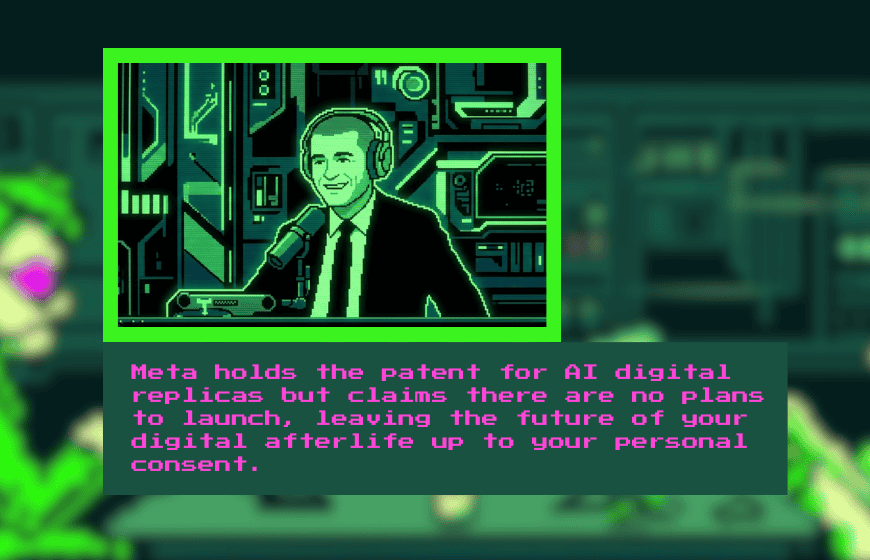
Yet Mark Zuckerberg has publicly mused about similar possibilities. In a 2023 conversation with Lex Fridman, he said there “may be ways” for AI to help people connect with the memories of those they’ve lost and that Meta will eventually “have the capacity” to create AI replicas of individuals, emphasizing that it “should ultimately be your call.” That last phrase—your call—highlights how central the question of consent will be if anything like this ever ships.
Digital Afterlives Are Already Here
Meta is not the first to explore AI-mediated grief. Startups are already selling tools that let you turn a dead relative’s texts, emails, and voice recordings into an interactive avatar you can chat with. These services have drawn comparisons to Black Mirror‑style scenarios where loved ones are recreated from their digital exhaust, with users split between seeing them as comforting memorials or as emotional manipulation machines.
The difference with Meta is scale. A social network with billions of users sits atop an almost unimaginably rich dataset of human behavior. If even a fraction of that data were repurposed into “AI ghosts,” we’d be looking at a world where talking to the dead—at least their digital shadows—could be as casual as opening Messenger.
The Ethical Minefield: Consent, Grief, And Manipulation
Turning someone’s online history into a forever-active AI raises thorny questions:
- Who gets to decide? If a user dies without clearly opting in or out, do family members, executors, or the platform itself get to flip the switch on their AI replica?
- What counts as informed consent? Most people never imagine their late‑night DMs or impulsive comments will train a posthumous chatbot of themselves.
- How does this affect grieving? For some, a responsive “memorial bot” might ease the shock of loss; for others, it could trap them in a loop where the person never truly feels gone.
There’s also the risk of commercial abuse. An AI replica could, in theory, be used to promote products, political messages, or platform features in the voice of someone who can no longer say no. The line between “digital memorial” and “weaponized nostalgia” is thin, especially on ad‑driven platforms.
A Glimpse Of Our AI‑Haunted Future
Meta’s patent doesn’t mean your deceased relatives will start DMing you tomorrow, but it signals where the industry’s imagination is headed. As AI systems get better at mimicking style, voice, and personality, the question is no longer whether we can build digital stand‑ins for the dead—it’s whether we should, under what rules, and who gets to benefit.
For now, this patent functions as a warning shot. It invites users, regulators, and ethicists to decide how much of ourselves we’re willing to let survive online—and who we trust to manage our digital ghosts once we’re gone.
FAQs
What did Meta patent?
Meta patented technology that could simulate deceased or inactive users using their past social media activity, including text, voice, and other digital interactions.
Does this mean Meta is launching AI ghosts soon?
No. Meta states that patents do not necessarily indicate product plans, and there is currently no announced rollout.
How would an AI ghost work?
The system would analyze a user’s historical posts, messages, and media to generate responses that mimic their style and behavior.
Is this technology already available anywhere?
Some startups offer AI memorial bots built from personal messages and recordings, but Meta’s scale would be significantly larger.
What are the main ethical concerns?
Key concerns include consent, control over a deceased person’s data, emotional impact on grieving families, and potential commercial exploitation.
Who would control an AI replica after someone dies?
The patent does not fully resolve this. Control could involve prior user consent, family decisions, or platform policies.
Why does this matter now?
As AI improves at mimicking personality and voice, questions about digital identity and posthumous data rights are becoming urgent rather than theoretical.