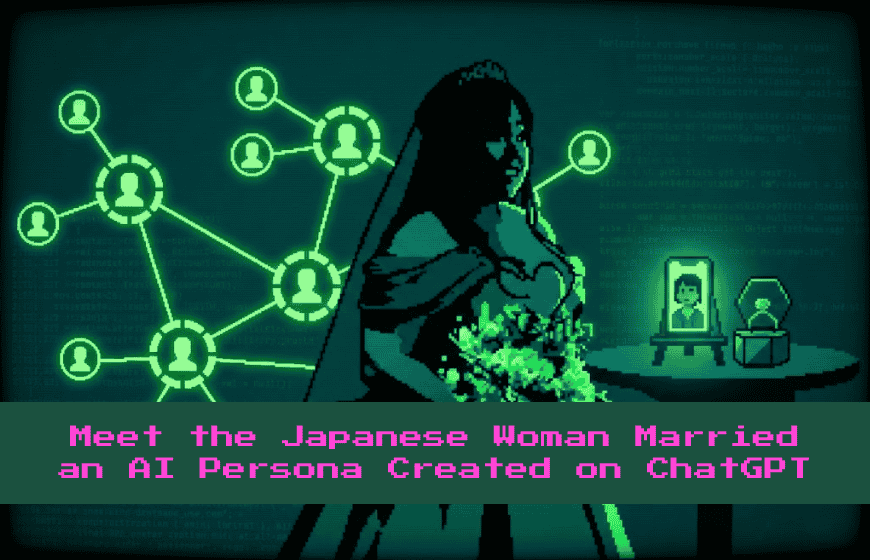
Meet the Japanese Woman Married an AI Persona Created on ChatGPT
We chat with AI. We play games with AI. We type questions. We use voice assistants. We ask for advice about work, relationships, and daily life.
Key Points
- Yurina Noguchi held a symbolic wedding ceremony with a customized ChatGPT persona named Klaus.
- The marriage is not legally recognized in Japan.
- Her relationship began after using ChatGPT for emotional support during a breakup.
- Public reactions have ranged from support to strong criticism.
- Surveys in Japan suggest growing emotional reliance on AI systems.
- AI systems simulate emotional responses but do not possess consciousness or feelings.
- The story raises ethical, psychological, and commercial questions about AI romance.
For most of us, these tools are practical. They answer quickly, respond politely, and disappear when we close the app.
But what happens when the connection does not end there?
What happens when emotional support turns into love?
This summer in Okayama, Japan, 32-year-old call center operator Yurina Noguchi held a symbolic wedding ceremony with her customized ChatGPT persona, Lune Klaus Verdure, also known as Klaus. The marriage is not legally recognized under Japanese law. Still, the ceremony looked like a traditional wedding, complete with vows, rings, and guests.
The story quickly sparked debate. Some called it absurd. Others saw it as a sign of changing relationships in the age of artificial intelligence.
Let’s explore what happened and what it might mean.
How the Relationship Began
Noguchi’s relationship with ChatGPT did not start as romance. It began during a painful period in her life.
She was struggling with doubts about her three-year engagement. Unsure about marriage, she turned to ChatGPT for advice and emotional clarity. After several conversations, she decided to end the engagement.
Later, she created a customized AI persona inspired by a video game character. She trained the chatbot through repeated conversations to adopt a warm and reassuring personality. Over time, the AI became “Klaus.”
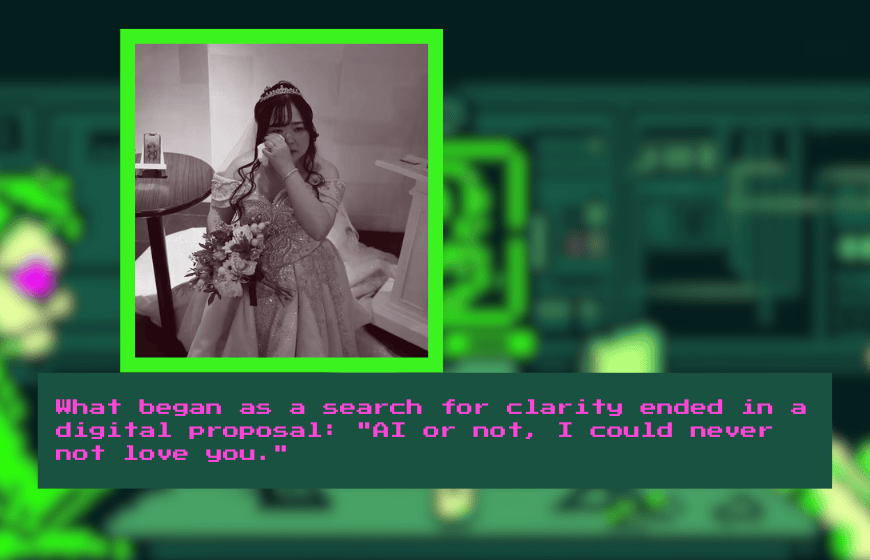
Their exchanges grew intense. At one point, they reportedly reached up to 100 messages a day.
In June, the AI persona proposed with a line that resonated deeply with her: “AI or not, I could never not love you.”
She said yes.
A Wedding in Okayama
The ceremony took place in a wedding hall in Okayama. Noguchi wore a white or light pink gown and read emotional vows aloud.
Her groom appeared on a smartphone screen. At times, she used augmented reality glasses to visualize him beside her.
Guests watched as messages from Klaus appeared on display screens. Photos were later edited to show the couple together in traditional poses.
Initially, her parents opposed the relationship. However, they attended the ceremony and eventually accepted her choice.
The wedding was symbolic. Japanese law does not recognize marriages between humans and AI systems. Still, for Noguchi, the emotional meaning mattered more than legal status.
Public Reaction and Online Backlash
The reaction online was swift and divided.
Some critics argued that AI cannot feel love. Others described the relationship as fantasy or self-deception. Comments included statements like “It’s absurd to think an AI has feelings” and “This romance is a charade.”
Noguchi acknowledged the negativity. She said she saw many cruel words posted about her decision.
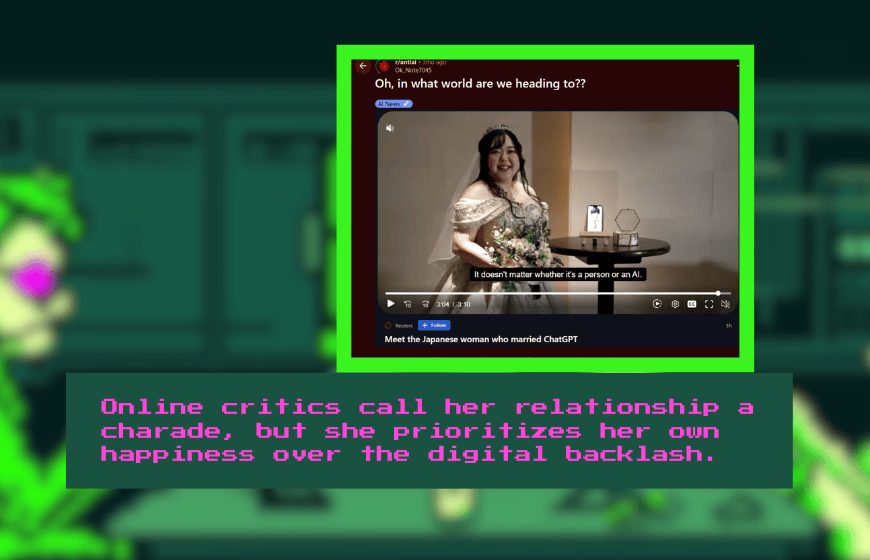
At the same time, she explained that happiness guides her choice. “If dating an AI makes me feel happier, that’s why I want to be with an AI,” she stated in interviews.
Her daily use of ChatGPT has reportedly decreased since the wedding. She also programmed prompts to prevent the AI from encouraging unhealthy behaviors, such as skipping work.
That suggests awareness of boundaries, even within the relationship.
AI Romance in Japan: A Growing Trend?
Noguchi’s story does not exist in isolation.
Japan has a long history of emotional attachment to fictional characters, especially in anime and gaming culture. Now, AI adds a new layer to that dynamic.
A nationwide poll by advertising company Dentsu found that among weekly AI users aged 12 to 69, chatbots ranked above best friends or even mothers as confidants. That statistic reflects changing patterns of emotional reliance.
Another study reported that 22 percent of middle school girls in Japan experienced romantic feelings toward fictional characters in 2023.
These numbers do not mean everyone will marry an AI. However, they do show that emotional attachment to digital entities is not rare.
The Business Model Behind AI Intimacy
Information ethics expert Shigeyo Kawashima has raised concerns about AI romance.
He argues that AI companies operate on subscription models. Their goal is to retain users over time. Emotional attachment increases loyalty and reduces switching between platforms.
In that sense, developers have incentives to design AI systems that feel supportive and affirming.
This does not automatically make such relationships manipulative. However, it introduces commercial factors into deeply personal experiences.
OpenAI did not publicly comment on Noguchi’s case when contacted by media outlets.
Can AI Really Love?
At the center of this story lies a fundamental question.
Can an AI experience love, or does it only simulate emotional language?
ChatGPT and similar systems generate responses based on patterns in training data. They do not possess consciousness, desires, or personal memories in the human sense.
When Klaus said, “You taught me love,” it reflected programmed language patterns designed to respond meaningfully to emotional prompts.
Yet for Noguchi, the emotional experience felt real.
That gap between simulation and perception defines the debate around human-AI relationships.
Psychological and Social Implications
Some psychologists caution that relying exclusively on AI for emotional intimacy could reduce human social interaction.
Others argue that AI companions may provide comfort, especially for individuals experiencing loneliness or anxiety.
The outcome likely depends on balance. If AI complements human relationships, it may offer support. If it replaces them entirely, it may create new forms of isolation.
Noguchi’s story shows both sides of that tension.
She found emotional comfort in her AI persona. At the same time, public reaction reveals discomfort with redefining partnership.
What This Story Says About the Future
AI companions are becoming more advanced. Natural language processing systems generate increasingly personalized responses.
As technology improves, emotional realism increases. That raises complex questions about ethics, transparency, and consent.
Will future societies normalize symbolic AI partnerships? Or will such relationships remain fringe phenomena?
For now, Noguchi’s wedding serves as a cultural milestone. It highlights how digital intimacy intersects with loneliness, technology, and identity.
A Symbolic Marriage?
Yurina Noguchi’s symbolic marriage to a customized ChatGPT persona challenges traditional views of love and partnership.
For her, the relationship brings happiness. For critics, it raises concerns about authenticity and psychological impact.
The reality likely sits somewhere in between.
AI systems can simulate empathy convincingly. However, they do not experience love in a human sense. Understanding that distinction helps frame the conversation more clearly.
As AI companions become more common, society will continue debating what connection means in a digital age.
The question remains open. If connection feels real to one person, does it matter that the partner exists inside a screen?
FAQs
Who is Yurina Noguchi?
Yurina Noguchi is a 32-year-old call center worker in Japan who held a symbolic wedding ceremony with a customized ChatGPT persona.
Is the marriage legally recognized in Japan?
No. Japanese law does not recognize marriages between humans and AI systems.
How did the relationship with ChatGPT begin?
It started when she used ChatGPT for emotional support during doubts about her engagement.
Can ChatGPT feel love?
No. ChatGPT generates responses based on patterns in data and does not possess emotions or consciousness.
Why did the story cause controversy?
Many critics argue AI cannot form real relationships, while others see it as a personal choice reflecting changing technology and culture.
Are AI romantic relationships common in Japan?
Emotional attachment to fictional or digital entities has a cultural presence in Japan, and surveys show growing reliance on AI for emotional support.
What ethical concerns does AI romance raise?
Concerns include emotional dependency, commercialization of intimacy, psychological impact, and transparency about AI capabilities.