The Chinese Room Argument, Explained Simply

Key Takeaways
- Searle's thought experiment says following rules for symbols isn't the same as understanding them.
- It targets "strong AI," the claim that the right program literally has a mind.
- Many replies concede the man understands nothing, then argue something else might.
- Searle never claimed machines can't think; he says brains are machines.
- Chatbots reopen the debate, but the thought experiment alone can't settle it.
The Chinese room argument is a thought experiment you can explain in a minute, and people have been fighting about it for more than forty years. The question underneath is blunt: if something answers you perfectly, does it understand you? Here's the setup, the best objections, and where today's chatbots fit.
Inside the Room: What Searle Asked You to Imagine
Searle's version asks you to imagine you're locked in a room with a large batch of Chinese writing, you know no Chinese at all, and you follow rules that match symbols to other symbols until your answers are indistinguishable from a native speaker's. That setup comes from Searle's 1980 Behavioral and Brain Sciences paper. He wrote it as a response to claims that AI programs, like those from Yale researcher Roger Schank, literally understand the sentences they handle.
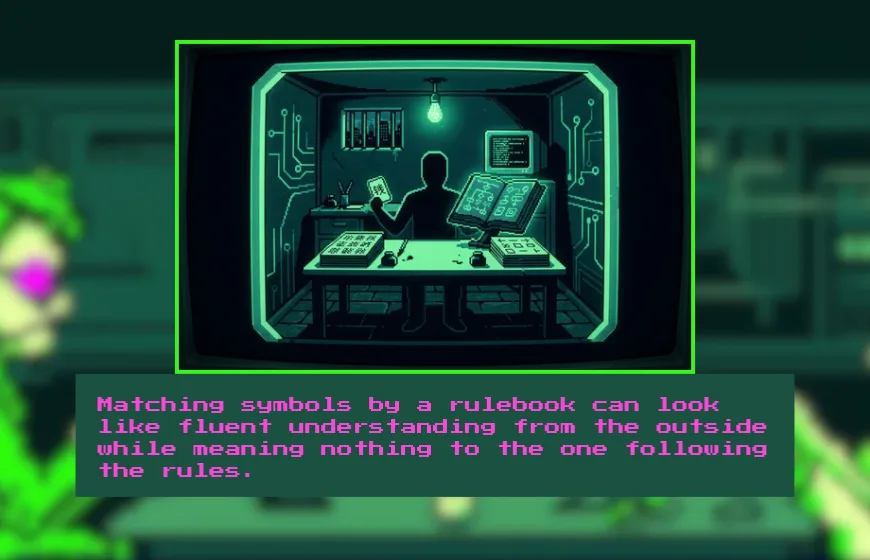
Here's the same idea at coffee-shop scale. Someone slides a card under the door: 你喝咖啡还是茶? Your rulebook says that when you see that squiggle, you hand back this one: 我喝茶。 You do, and outside, someone says, "Wow, they speak Chinese." Inside, you matched shapes. You couldn't tell me whether you just answered a question about drinks or about the weather.
Strong AI, Weak AI, and the Syntax Trap
Searle aims at "strong AI," the view that a suitably programmed computer really understands language and has mental states, not merely simulates them. "Weak AI," which says computers are useful for simulating mental abilities, isn't his target, and he says brains are machines that think.
Searle later laid the logic out in three premises: programs are purely formal, human minds have meaningful contents, and syntax alone doesn't produce meaning. So programs by themselves can't make minds.
Think of a dictionary that defines every word using other words. You could shuffle definitions forever and never taste a hamburger. That gap between shuffling and meaning is the whole argument. My pet peeve is hearing it summarized as "AI can never think." It's narrower: it says running a program, by itself, isn't enough.
The Replies, Sorted by How Much They Concede
Stanford's account sorts the objections into three lines by how much they grant Searle: some accept that the man understands nothing but say something else does, some accept that the program alone isn't enough but say a modified system could understand, and some reject even his narrow point. Here are the main ones.
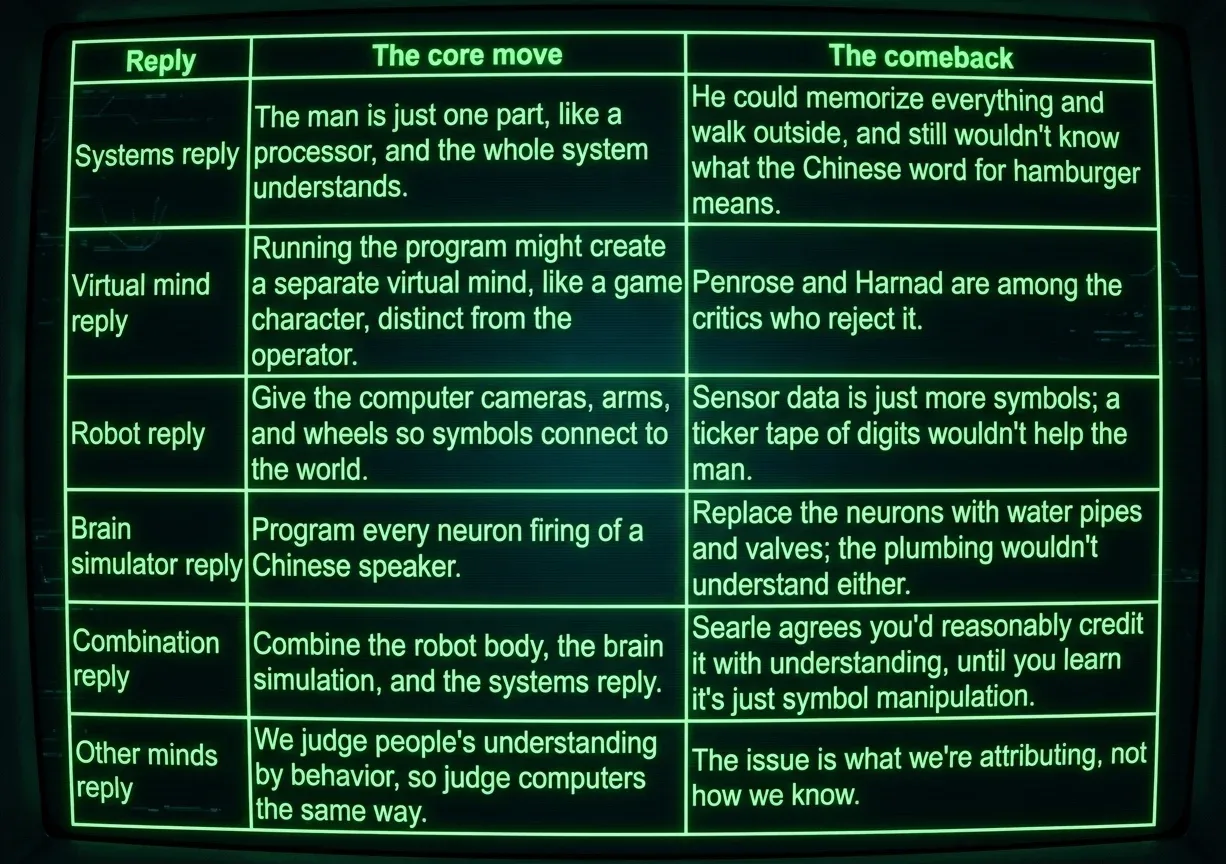
I like the robot reply best, because a hamburger is something you learn by seeing, making, and tasting it. Searle's answer, that more input is still just more syntax, is where the real fight happens.
Gut Check or Proof?
Daniel Dennett called the thought experiment an "intuition pump," and the Churchlands compared it to waving a magnet, seeing no visible light, and concluding light isn't electromagnetic. Their point is that our intuitions fail on systems this complex. Steven Pinker adds that Searle slows mental computation to a pace where we no longer call it understanding.
The speed objection is the one I find most fun, since real conversation happens in milliseconds. But the point is to test your own intuition, so try this three-question audit:
- If a system gave perfect answers, what extra evidence would you need before saying it understands?
- Would you demand that same evidence from a person?
- Does your answer change once you learn how it works inside?
Plot twist: suppose you spend an hour with a support agent who fixes your billing mess perfectly, then the company says it was a bot. If "it understood my problem" now feels false, your answer to question three is yes, and you're closer to Searle than you thought. If it still feels true, you're closer to his critics.
When Chatbots Knock on the Door
Schank's programs were hand-built, so their output of a sentence or two about restaurants rarely surprised their programmers. Large language models, by contrast, can generate paragraph after paragraph that is news to their coders. That changes the flavor of the debate, though not necessarily its logic. Sabine Hossenfelder argues chatbots understand some of what they say, much as people understand quantum mechanics well enough to make predictions, while Nvidia's Jensen Huang sees no limits on their understanding.
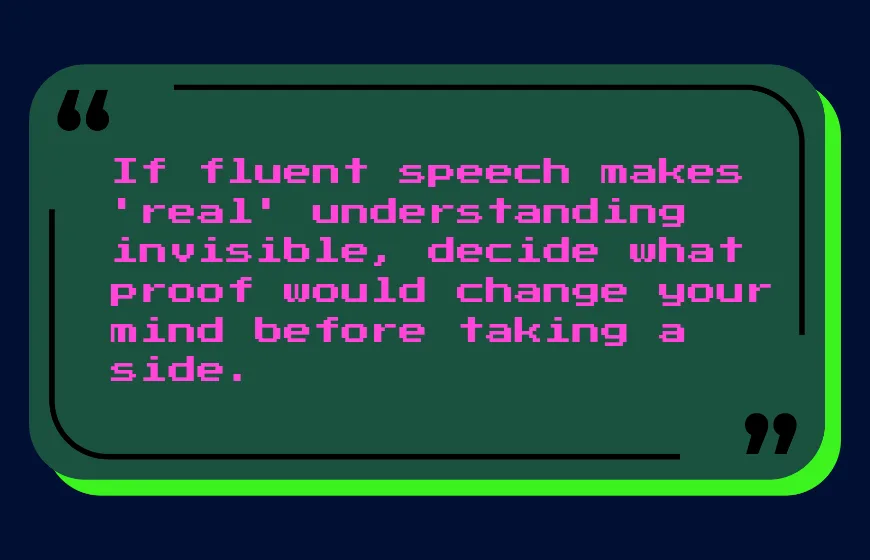
Philosopher David Cole points out a sharper wrinkle. If a system uses language as well as humans do in every context, yet is argued not to "really" understand, then real understanding becomes undetectable and irrelevant to everything we use language for. Whether you find that a problem for Searle or a problem for the concept of understanding is the live question.
What I'd do before picking a side: decide what observation would change your mind. If the answer is "nothing," you aren't weighing evidence anymore, and I'd be wary of anyone, on either side, who says the case is closed.
READ MORE: The First AI Chatbot in History: ELIZA at MIT (1966)
The Chinese room doesn't hand you a verdict about AI. It hands you a better question: what, exactly, is behind the slot in the wall?
FAQs
Did Searle invent this kind of thought experiment?
No. Leibniz imagined walking inside a thinking machine like a mill and finding only moving parts. In 1961 a Soviet story had students act as a computer, and in 1978 Ned Block imagined China's population simulating a brain. Searle's version became the famous one.
Is the Chinese room the same as the Turing test?
No, it's a challenge to it. Turing proposed that a computer passing for human in online chat should count as intelligent. Searle's point is that passing such a test doesn't show understanding, because the man in the room would pass too.
Does it still apply to brain-like neural networks?
Partly. The Churchlands and Andy Clark agreed with Searle about traditional symbol-shuffling programs, but argued that brain-style connectionist systems work differently and aren't covered. Searle thought his point applied to any computational model.
Does it prove computers can't be conscious?
Not directly. Searle later described his conclusion in terms of consciousness and intentionality, but Stanford's account says that shift isn't directly supported by the original 1980 argument. Someone could accept the room's lesson about understanding without accepting that.
How did scientists react when it was published?
It ran with commentaries from 27 cognitive science researchers, and Searle replied to them. By 1991, computer scientist Pat Hayes had joked that cognitive science is the research program of refuting it.
Sources
- John R. Searle (University of California, Berkeley), "Minds, Brains, and Programs," Behavioral and Brain Sciences, 1980, https://zoo.cs.yale.edu/classes/cs458/materials/minds-brains-and-programs.pdf (also read via https://cse.buffalo.edu/~rapaport/Papers/Papers.by.Others/Searle/searle80.html)
- David Cole (Stanford Encyclopedia of Philosophy), "The Chinese Room Argument," Stanford Encyclopedia of Philosophy, Fall 2025 edition, https://plato.stanford.edu/archives/fall2025/entries/chinese-room/
- Internet Encyclopedia of Philosophy, "Chinese Room Argument," Internet Encyclopedia of Philosophy, n.d., https://iep.utm.edu/chinese-room/ (also https://iep.utm.edu/chinese-room-argument/)