Are There Bots on Random Chat Sites? Who's Running Them and Why
Key Takeaways
- Bots on random chat sites come from spammers, scammers, and occasionally the sites themselves.
- Spot spam bots by canned replies, and test them with one odd question.
- Be suspicious of paywalls that appear right as someone "likes" you.
- Distrust any chat partner who pushes you to another app.
- Check a site's fake-profile rules and report tools before paying.
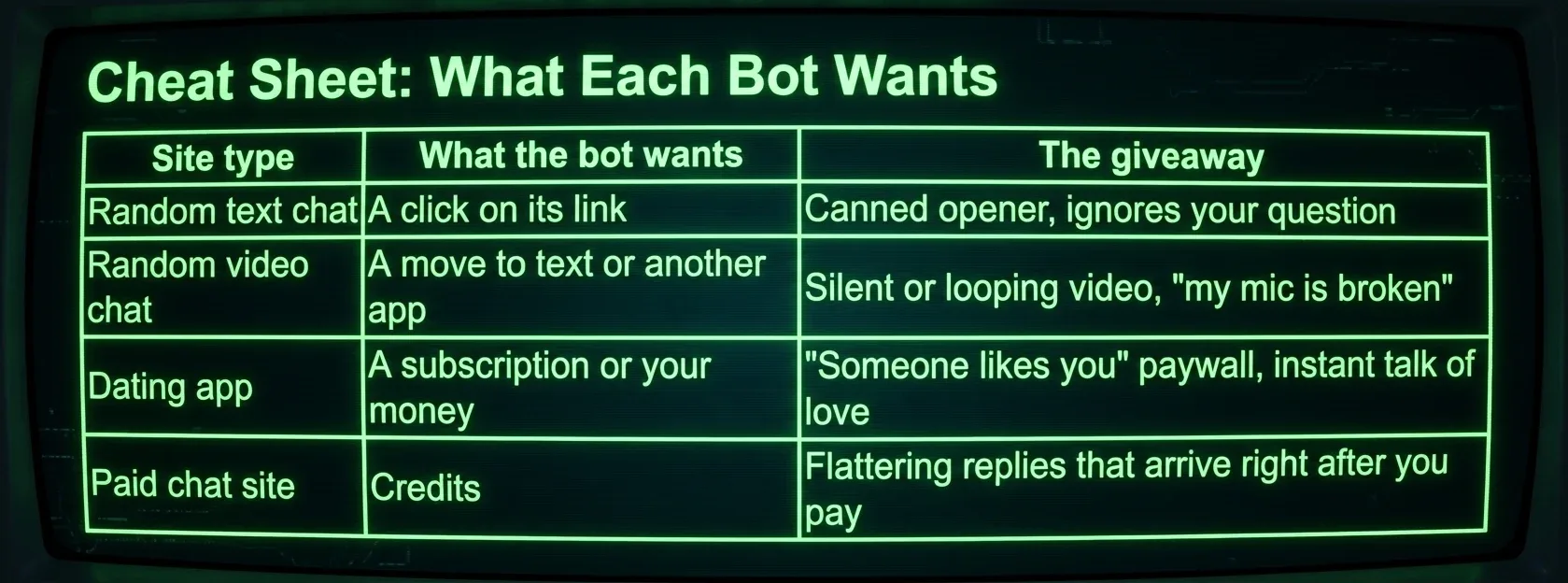
Are there bots on random chat sites? Yes. The more useful question is who's behind them. Some belong to spammers and some to scammers. On a few dating and paid-chat platforms, regulators have said the fake profiles were run by the site's own staff. So, how to tell which kind you're talking to, and what each one wants from you?
Spam Bots Win on Attention, Not Quality
Researchers who ran spam experiments on Chatroulette found that spam there gets more attention than email spam. They also found that most of the site's spam defenses could be bypassed, and they estimated upper and lower bounds on how many spam bots were active.
The reality is that random chat gives every bot something email never could: a person who has to read the first message right now. That's why every opener is a hook. A bot that gets skipped costs its owner nothing, so don't expect it to learn. Skipping fast is your best defense.
When the Site Itself Plays the Bot
The FTC found that Ashley Madison staff posed as real female users. Staff built "engager profiles" from the details of dormant accounts and chatted as if they were real members. Many non-paying users upgraded so they could message people they believed were real.
A separate case involved Match Group. The FTC claimed that millions of "you caught his eye" messages came from accounts already flagged as likely fraudulent. Match Group settled the FTC's claims over scam love-interest ads for $14 million in 2025 and said it admitted no liability.
Here is where it gets interesting. In both cases the fake "someone" wasn't there to flirt. Its job was to get you to pay.
That doesn't mean every site does this. It means the paywall moment is where you check. A good rule of thumb: if the only thing between you and a message from someone who "likes you" is a payment screen, pause. Before you pay, ask yourself:
- Can I browse real profiles without paying?
- Is there any visible activity from people who aren't prompting me to pay?
- Does the "match" disappear once I try to message them?
Puppets and Funnels on Random Video Chat
Malwarebytes documented scam bots on a random video chat service that play recorded clips of real people. A recording can't talk back, so scammers use the silence as an excuse to push the chat into text. Malwarebytes also points to asking for something unusual on camera as a way to tell a bot from a person.
The FTC describes the next step in the typical scam: the scammer wants to move the conversation off the platform and keeps you chatting, but never meets up.
You can run that test yourself:
You (typed): "Hold up three fingers, then touch your left ear."
Them: "hi baby my mic is broken, chat with me here 👉 [link]"
A real person might laugh or refuse, but they'll react to what you said. A recording keeps smiling.
The Three-Question Audit
When a chat feels off, run through this:
- Who benefits if I keep talking? If the answer is "whoever sells something," slow down.
- What is it asking me to spend? Money, a click, a photo, or an app install all count.
- Can it handle a curveball? Ask something odd and specific, like "What's the worst smell you've ever tolerated?"
Two bad answers means you leave. Don't try to win an argument with a script.
How to Vet a Site Before You Trust It
I start by searching the site's name plus "fake profiles" and "FTC." It takes thirty seconds and tells you more than any "best of" list. I'd also read the rules: a site that never mentions fake profiles or bots deserves more suspicion than one that explains what it does about them.
Then check four things:
- You can read and reply before paying.
- Cancelling is easy and clearly explained.
- Reporting a user takes one tap.
- Age rules are stated plainly.
I'm also wary of "free forever" sites that make you pay just to read replies. The best free random chat sites tend to share traits, not names: sign-in, visible moderation, and a report button that works.
Bots on random chat sites aren't a mystery once you know who owns them. Spammers want your attention, scammers want you off the site, and some platforms have wanted your credit card. Ask one odd question, notice who benefits, and leave the chat when the answer is "not you."
FAQs
Do all random chat sites use bots?
No. Spam bots show up on open, easy-to-join sites, and some fake profiles have been exposed on dating and paid-chat platforms. But it isn't universal. Judge the specific site by its rules, its complaints, and what happens when you try to message someone.
If I paid and think I was chatting with fake profiles, what now?
The FTC advises contacting the company or your bank right away if you paid a scammer. Ask for a refund, keep screenshots, and report the site to your country's consumer protection agency.
Are AI chatbots replacing old-school bots?
Many are probably smarter now, which makes bad grammar a weaker tell. Watch behavior instead: ignoring your odd question, rushing to links, pushing you off-site, or asking for money or photos.
Why do bots reply instantly?
Software doesn't type, pause, or get distracted. Instant, identical response times, especially to long messages, are one of the cheapest clues. Humans stall, correct typos, and drift off-topic. If the speed feels inhuman, test it with a curveball.
Can a human operator be "fake" too?
Yes. In the Ashley Madison case, staff, not software, chatted as fake users. If compliments arrive suspiciously fast, the "person" pushes you to pay or move apps, and your odd questions get ignored, treat it the same as a bot.
Sources
- Federal Trade Commission, "Operators of AshleyMadison.com Settle FTC, State Charges Resulting from 2015 Data Breach" (title inferred from URL), FTC, 2016, https://www.ftc.gov/node/74124 (also https://ftc.gov/news-events/press-releases/2016/12/operators-ashleymadisoncom-settle-ftc-state-charges-resulting)
- Courthouse News, "Match Group to pay FTC $14 million to end claims of scam advertisements, cumbersome cancellation process," Courthouse News, 2025, https://www.courthousenews.com/match-group-to-pay-ftc-14-million-to-end-claims-of-scam-advertisements-cumbersome-cancellation-process/
- Authors not seen, "An Empirical Study of Spam and Prevention Mechanisms in Online Video Chat Services," arXiv, year not seen (arXiv ID suggests 2012), https://arxiv.org/pdf/1204.2774
- Malwarebytes, "Shady scam bots trick Omegle users into nonconsensual video sex recordings," Malwarebytes blog, 2021, https://www.malwarebytes.com/blog/awareness/2021/04/shady-scam-bots-trick-omegle-users-into-nonconsensual-video-sex-recordings/
- Federal Trade Commission, "Looking for love? Watch out for scammers" (title inferred from URL), FTC Consumer Alerts, 2025, https://www.consumer.ftc.gov/consumer-alerts/2025/02/looking-love-watch-out-scammers
- Federal Trade Commission, "What to Know About Romance Scams" (title inferred from URL), FTC Consumer Advice, https://consumer.ftc.gov/articles/what-know-about-romance-scams?os=svergi