AI and Jobs: What Will Change, What Won’t, and How to Prepare
Artificial intelligence is already reshaping the workplace, but not in the way most headlines suggest. The dominant narrative often focuses on job loss, automation, and even fears of artificial general intelligence (AGI) replacing entire professions. In reality, the impact of AI on jobs is more nuanced, slower, and more uneven.
The key shift is not mass unemployment. It’s task-level transformation, a gradual redesign of how work gets done.
This article breaks down what AI can actually do today, how AI agents and automation are changing workflows, what the future might look like with AGI and superintelligence, and what individuals and organizations should do now.
Key Takeaways
- Task-Level Change: AI transforms how we do specific tasks before it ever replaces an entire job title.
- White-Collar Exposure: High-skill, knowledge-based roles are currently more vulnerable to AI than physical or empathetic trades.
- Productivity Paradox: AI significantly boosts individual output, but this can lead to fewer entry-level hiring needs.
- Agentic Shift: The move from simple AI tools to "AI agents" is accelerating the automation of complex workflows.
- Judgment Premium: As technical tasks become automated, human judgment and critical thinking become the most valuable assets.
- Gradual Adoption: Physical constraints like energy, cost, and reliability prevent AI from disrupting the market overnight.
- Adaptation is Mandatory: Survival in the AI era depends on "AI literacy"—understanding how to use the technology to augment your own skills.
Understanding the Spectrum: AI, AI Agents, AGI, and Superintelligence
Before discussing jobs, it’s critical to separate different levels of AI capability.
- Current AI (narrow AI): Tools like ChatGPT or Copilot that perform specific tasks (writing, coding, analysis)
- AI agents: Systems that can execute multi-step workflows with limited autonomy
- Artificial General Intelligence (AGI): Hypothetical systems that match human-level reasoning across domains
- Superintelligence: AI that surpasses human intelligence entirely
Most real-world impact today comes from the first two categories—not AGI.
This distinction matters because many job-loss predictions assume capabilities that do not yet exist. Current AI is powerful, but it remains constrained by data quality, compute costs, and reliability limitations.
The Market Reality: AI Is Changing Tasks Faster Than Jobs
One of the most consistent findings across research is this:
AI transforms tasks before it replaces jobs.
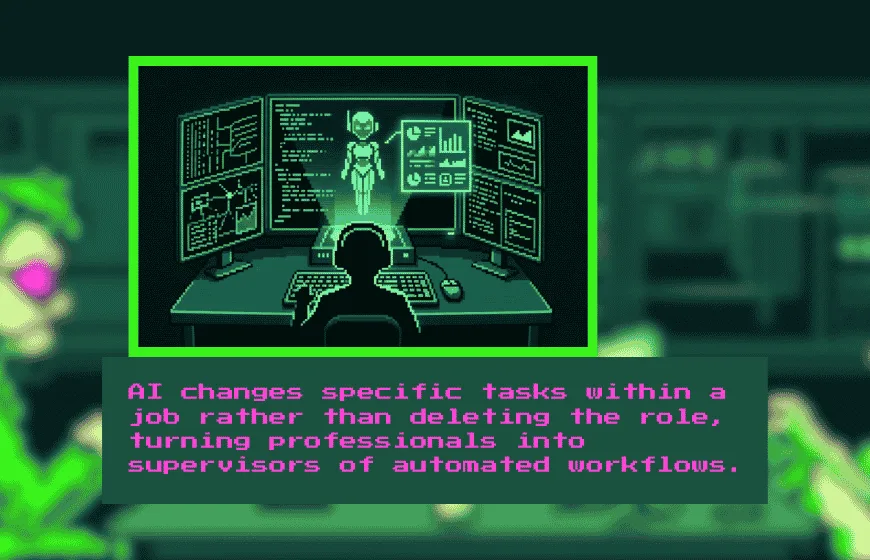
According to the OECD, occupations at the highest risk of automation account for about 28% of jobs, but this does not mean those jobs disappear—it means parts of them are automatable.
Similarly, McKinsey Global Institute finds that AI is reshaping entire workflows, not just individual roles, creating new forms of collaboration between humans and machines.
This distinction is crucial:
- A lawyer may use AI for research
- A marketer may automate content drafts
- A developer may rely on AI for code generation
But the job itself does not disappear—it evolves.
Which Jobs Are Most Exposed? It’s Not What You Think
Historically, automation affected manual labor. AI is different.
Recent research shows that white-collar and knowledge-based jobs are increasingly exposed. Academic studies find that about one-third of employment is highly exposed to AI, particularly in high-skill roles.
This includes:
- Software development
- Finance and analysis
- Legal and administrative work
- Customer service
At the same time, jobs involving physical interaction, empathy, or unpredictable environments—such as healthcare, skilled trades, and caregiving—remain less exposed.
This flips the traditional assumption:
AI is not just replacing low-skill work—it is reshaping high-skill work first.
The Productivity Effect: AI as a Force Multiplier
One of the clearest findings from research is that AI significantly boosts productivity.
A large academic review found productivity gains of 20% to 60% in controlled environments.
In practice, this means:
- Junior workers can perform at higher levels
- Routine tasks are completed faster
- Output per worker increases
The OECD also reports that 4 in 5 workers say AI improves their performance, suggesting that AI is often experienced as a tool, not a threat.
However, productivity gains create a paradox:
- Companies can do more with fewer people
- Entry-level roles may shrink
- Hiring patterns shift
This is why AI’s impact may be felt first in early-career jobs, not established roles.
Job Displacement vs Job Creation
One of the biggest debates is whether AI will eliminate more jobs than it creates.
The data suggests a mixed outcome:
- AI could displace tens of millions of jobs globally
- But it could also create 20–50 million new jobs by 2030
- Broader technology trends may generate 170 million new roles
At the same time, studies estimate:
- Up to 30% of work hours could be automated by 2030
- Around 60% of jobs will have significant task changes
The conclusion is not straightforward:
AI will both destroy and create jobs—but unevenly.
The key variable is adaptation speed—how quickly workers and organizations adjust.
The AI Timeline Problem: Short-Term vs Long-Term Impact
A major source of confusion is the timeline.
Some projections suggest that 50–60% of jobs could be transformed by 2040.
Others emphasize that:
- There is no evidence of large-scale job loss yet
- Most impacts are still emerging
This creates a gap between perception and reality:
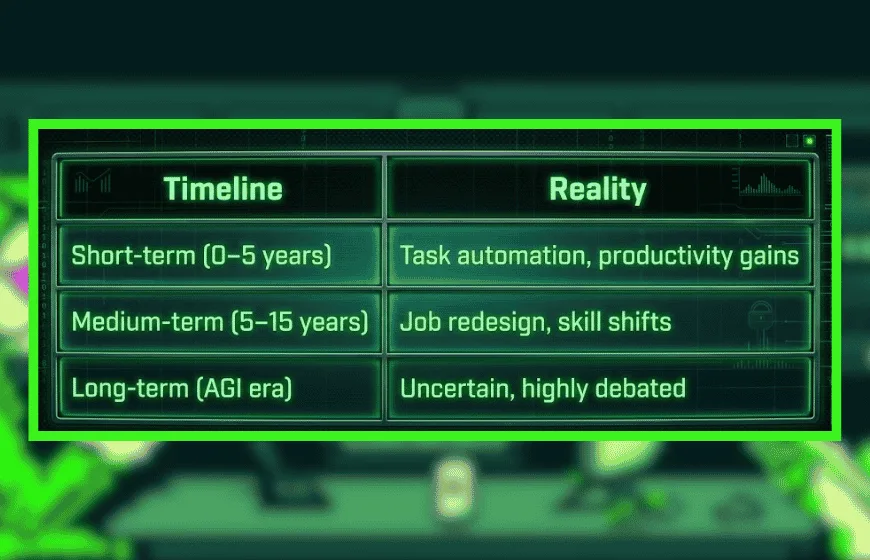
The biggest mistake is assuming that AGI-level disruption is imminent. Current AI systems, while powerful, are still limited in reasoning, reliability, and autonomy.
Why AI Won’t Replace Jobs Overnight
AI adoption is not just about capability—it’s about constraints.
Key limitations include:
- Compute costs: Training and running models is expensive
- Energy demand: Large-scale AI systems require significant power
- Data availability: High-quality training data is limited
- Reliability: AI still makes errors, especially in complex tasks
These constraints slow deployment, especially in high-risk industries like healthcare, law, and finance.
This is why:
AI adoption is gradual—not exponential in real-world workflows.
The Rise of AI Agents and Workflow Automation
One of the most important developments is the rise of AI agents.
Unlike traditional tools, AI agents can:
- Execute multi-step tasks
- Interact with software systems
- Operate with partial autonomy
This shifts the focus from individual tasks to workflow automation.
For example:
- Customer support agents handling entire conversations
- AI systems managing parts of supply chains
- Automated research and reporting pipelines
This reinforces the central theme:
Jobs are being redesigned, not simply replaced.
Governance, Risk, and Accountability
As AI becomes more autonomous, governance becomes critical.
Key issues include:
- Who is responsible for AI decisions?
- How do we audit AI systems?
- What happens when AI makes mistakes?
Regulatory frameworks are still evolving, but organizations must address:
- Transparency
- Accountability
- Bias and fairness
- Legal liability
This is especially important as AI moves from tools to decision-making systems.
The Skills That Will Matter Most
As AI reshapes work, certain skills become more valuable—not less.
Research consistently shows rising demand for:
- Judgment and decision-making
- Communication and collaboration
- Domain expertise
- Critical thinking
In contrast, purely routine or predictable tasks are most vulnerable.
This leads to a key insight:
Human judgment becomes the scarce skill.
How to Prepare for AI
For individuals and organizations, the question is not whether AI will have an impact—but how to respond.
1. Build AI literacy
Understand how AI works, its limitations, and how to use it effectively.
2. Focus on augmentation
Use AI to enhance your work, not replace it.
3. Develop complementary skills
Invest in areas where humans outperform AI:
- Strategy
- Creativity
- Leadership
4. Redesign workflows
Organizations should rethink processes—not just automate existing ones.
5. Invest in reskilling
Workers may need to transition roles as tasks evolve.
The Bigger Picture: AI and the Future of Work
AI is part of a broader shift in how work is structured.
Rather than replacing humans, it is creating a new model:
Human + AI collaboration
This model emphasizes:
- Efficiency
- Flexibility
- Continuous learning
But it also raises challenges:
- Inequality
- Skill gaps
- Workforce polarization
Addressing these issues will require coordination between:
- Businesses
- Governments
- Educational institutions
So Is AI Overhyped?
This growing debate about whether AI’s impact is overstated.
Some experts argue:
- Job-loss predictions are exaggerated
- Adoption is slower than expected
- Productivity gains may not translate into fewer jobs
Even widely cited claims like 40% of jobs will be lost are often misinterpreted or taken out of context.
The reality lies in between:
AI is transformative—but not instantly disruptive.
A Shift in Work, Not the End of Work
AI will not eliminate work—but it will change it fundamentally.
Key takeaways:
- AI reshapes tasks before jobs
- Productivity gains are real—but uneven
- White-collar work is increasingly affected
- The biggest risk is skill disruption, not unemployment
The future of work will not be defined by AI replacing humans—but by how effectively humans and AI work together.
FAQs
1. Will AI replace my job entirely?
For most people, no. AI tends to automate specific tasks rather than entire jobs. While some roles may shrink, most will be redesigned to focus on areas where human judgment is still required.
2. Which industries are most "exposed" to AI disruption?
Contrary to historical trends, white-collar and high-skill roles are currently the most exposed. This includes software development, finance, legal services, and administrative work.
3. What is the difference between AI tools and AI agents?
AI tools (like ChatGPT) require constant human prompting for specific tasks. AI agents can execute multi-step workflows with partial autonomy, shifting the focus from individual tasks to full-process automation.
4. Why is AI's impact on junior and entry-level roles so significant?
Because AI can handle routine, entry-level tasks with high efficiency, companies may hire fewer junior employees. This creates a "hiring paradox" where entry-level roles look more like mid-level roles.
5. How can I protect my career from AI automation?
Focus on "complementary skills" that AI struggles with: complex decision-making, high-level strategy, emotional intelligence, and domain-specific human judgment.
6. Is AGI (Artificial General Intelligence) going to replace humans soon?
While highly debated, current AI remains constrained by high compute costs, energy demands, and reliability issues. Most experts see AGI as a long-term possibility rather than an imminent reality.
7. Does AI create more jobs than it destroys?
Data suggests a mixed outcome. While tens of millions of roles may be displaced, new categories in AI oversight, integration, and entirely new tech industries could create up to 170 million new roles globally.