AI Agent vs. AI Assistant: What Actually Sets Them Apart
The discussion around AI agents and AI assistants is becoming more important in business today. Many companies want to automate tasks, but they are unsure which solution to choose. Some tools simply respond to commands, while others can act on their own. This difference affects cost, risk, and long-term value.
Business leaders in areas like customer service, HR, healthcare, and finance need a clear understanding before making decisions.
This guide explains how each system works, where they are most useful, and what to expect in real situations.
Key Takeaways
- Autonomy. Agents plan and act while assistants only react.
- Workflows. Complex multi-step processes require agents rather than simple assistants.
- Integration. Expect higher technical effort when connecting agents to internal databases.
- Investment. Spend more upfront on agents to secure higher long-term value.
- Adoption. Start with assistants to build user trust before expanding.
- Governance. Use NIST frameworks to manage risks as AI independence grows.
- Strategy. Match the tool to your workflow instead of following trends.
AI Agents Act Independently, While AI Assistants Respond
The main difference between an AI agent and an AI assistant is how they operate. AI assistants follow a simple pattern: they wait for a user request and then respond. They do not take action unless instructed.
AI agents, on the other hand, can act with more independence. They can plan tasks, choose tools, and complete multi-step processes. Assistants are reactive, while agents can plan and act toward a goal.
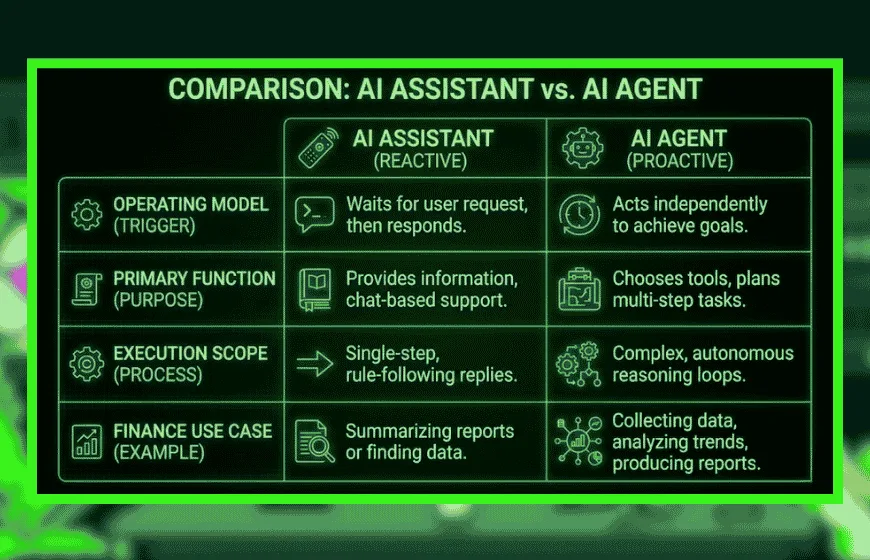
For example, in finance, an agent can collect data, analyze trends, and produce reports without detailed guidance. This difference makes agents better for complex operations, while assistants are suited for simpler support tasks.
Where AI Agents Work Best
AI agents are useful in situations that require planning and execution. They can handle tasks that involve several steps and different systems.
In customer service, an AI agent can manage an entire support case. It can read a complaint, check order details, process a refund, and update records. In healthcare, agents can handle scheduling, insurance checks, and follow-ups. In finance, they can monitor transactions and detect unusual activity.
These systems can operate continuously and at scale. However, they need careful setup. Without proper controls, errors may occur.
Where AI Assistants Add Value
AI assistants are designed to support users through conversation. They are most effective when human input is still required.
In customer service, assistants suggest replies to human agents. In HR, they help employees find policies or submit requests. In healthcare, they provide quick access to patient data or medical guidelines.
Their limitation is clear. They cannot manage complex workflows alone. They depend on users to guide each step. Still, they are easier to deploy and require less oversight.
Integration and Customization Matter
The value of AI depends on how well it connects with existing systems.
AI agents often require deep integration with CRMs, ERPs, and internal databases. This allows them to perform real actions. However, integration takes time and technical effort.
AI assistants are easier to connect. They usually integrate with chat platforms or knowledge bases. This makes them a practical starting point.
Customization is another factor. AI agents can be tailored to specific workflows and rules. AI assistants are more general in function.
Costs follow this pattern. AI agents require higher upfront investment but can deliver stronger returns. AI assistants cost less but offer smaller efficiency gains.
Many agentic AI projects may fail due to unclear value or high costs. This highlights the need for careful planning.
User Experience Affects Adoption
User experience plays a key role in how people accept AI tools.
AI assistants feel familiar. They work like chatbots, where users ask questions and receive answers. This makes adoption faster.
AI agents introduce a different model. They act more like digital workers. Users set goals instead of giving step-by-step instructions. This may require training.
Design matters. Clear feedback, progress tracking, and error handling improve trust. Without these, users may hesitate to rely on AI systems.
Risks and Regulations Increase with Autonomy
As AI systems become more independent, risks also increase.
The National Institute of Standards and Technology (NIST) provides guidance through its AI Risk Management Framework, which focuses on safety, transparency, and accountability.
The European Commission outlines similar expectations in its AI Act guidelines, including the need to inform users when they interact with AI systems.
Research from Massachusetts Institute of Technology (MIT) shows that many advanced AI agents still lack proper safety evaluation. This highlights the need for strong governance.
Businesses should set clear permissions, monitor system actions, and maintain audit logs. These steps reduce risk and build trust.
Key Differences at a Glance
The comparison becomes clearer when simplified:
- AI agents act independently; AI assistants respond to input
- AI agents handle complex workflows; AI assistants handle simple tasks
- AI agents require deeper integration; AI assistants are easier to connect
- AI agents cost more upfront; AI assistants are more affordable
- AI agents carry higher risk; AI assistants are easier to manage
The Future Will Combine Both
The future of AI is likely to combine both approaches.
Users will interact through conversation, while AI agents handle complex tasks in the background. This creates a more flexible system.
Adoption of agentic AI is growing, but still uneven. This suggests steady progress rather than rapid change.
Choosing between an AI agent and an AI assistant depends on your goals.
AI assistants are useful for communication and quick support. AI agents are better for automation and complex workflows. Each has strengths and trade-offs.
A practical approach is to start with assistants, then expand into agents as systems improve. This reduces risk and supports gradual adoption.
The key is simple: choose the tool that fits your workflow, not the trend.
FAQs
What is the main difference between an AI agent and an AI assistant?
The core difference is autonomy; AI assistants are reactive and wait for user commands, whereas AI agents are proactive and can plan and execute multi-step tasks independently to reach a goal.
Can an AI agent handle entire customer service cases?
Yes, an AI agent can read a complaint, verify order details, process a refund, and update the internal database without needing step-by-step human intervention.
Why are AI assistants easier to deploy than AI agents?
Assistants usually require less technical integration, often plugging directly into chat platforms or knowledge bases, whereas agents require deep connections to CRMs and internal systems.
What are the risks of using autonomous AI agents?
The primary risks include a lack of safety evaluation, potential errors without proper oversight, and the complexity of maintaining transparency as the system acts independently.
Is an AI assistant or an AI agent more cost-effective?
AI assistants have lower upfront costs and are more affordable to manage, but AI agents often deliver stronger long-term returns through significant efficiency gains in complex workflows.
How should a business decide which AI tool to use?
Businesses should choose based on the workflow: use assistants for communication and quick support, and use agents for end-to-end automation of complex, multi-step processes.