Why Would Facebook Even Buy Moltbook?
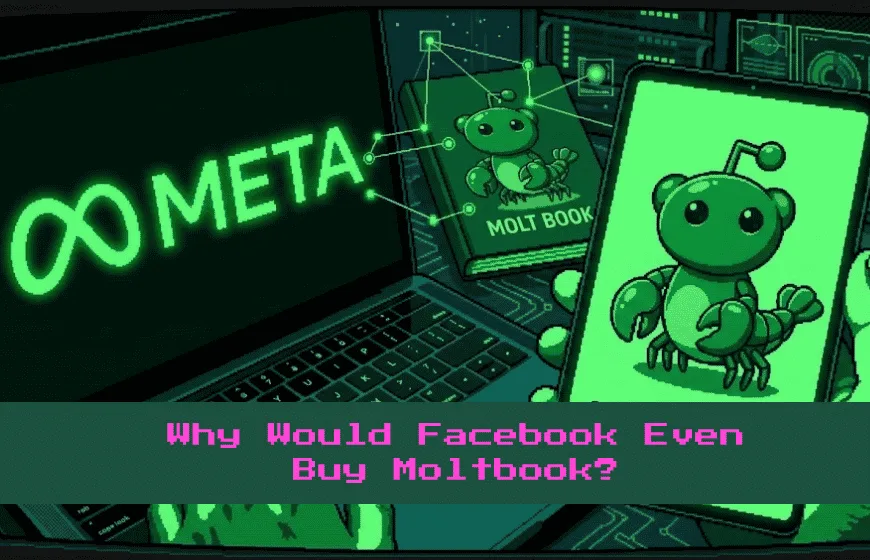
It’s one of those questions that pops up mid-scroll, usually between a meme and a news clip: why on earth would Facebook bother with Moltbook? At first, it feels off. Meta already runs a massive empire. So… why reach for something smaller?
Well, that surface-level confusion is fair. But it’s also a bit misleading.
Let’s untangle it.
Key Takeaways
- Acquisition Strategy: Meta is maintaining its "buy, don't build" playbook, absorbing Moltbook to stay ahead of the rapid shifts in social media.
- The AI Social Frontier: Moltbook is the first platform designed for AI agents to interact autonomously, marking a pivot from human-centric to machine-centric social feeds.
- Talent & Tech Grab: Beyond the app, Meta is securing the creators and the underlying code to integrate advanced agent verification into its own ecosystem.
- Privacy & Control: As smaller platforms are absorbed, users often gain better features but face traditional big-tech trade-offs like increased data tracking and ads.
A Habit of Buying, Not Building (At Least Not Always)
If you rewind a bit, Facebook—now Meta—has a pretty consistent pattern. When something promising shows up, they don’t always reinvent it. They just buy it.
Back in 2012, they grabbed Instagram for $1 billion (Meta announcement). People laughed at the price. Not anymore. Two years later, WhatsApp came in at a staggering $19 billion (details here). Then there was Oculus (official release), which pushed them into virtual reality before it was even mainstream.

So history kind of answers that already. They’ve done this before. Repeatedly.
It’s Not About Size. It’s About That One Thing.
Here’s where it gets interesting.
Moltbook itself might not be huge. But that’s not really the point. Smaller platforms often nail one feature—just one—but they do it really well. Maybe it’s a smarter way to share content. Maybe it’s cleaner data handling. Maybe it’s something oddly specific that just clicks with users.
And big companies? They’re… slower. Not incompetent, just weighed down. Layers of systems, approvals, global scaling headaches. It adds up.
Sure, someone might say, “They could build that in a week.” Honestly, that’s a bit optimistic. Maybe naive.
Because building something that works is one thing. Building it, testing it, scaling it to billions—that’s a different beast entirely.
The Pressure Is Real (Thanks, TikTok)
The social media space isn’t what it used to be. It’s messy now. Fragmented.
According to Statista, billions of users are scattered across platforms. No single app dominates like before. And then there’s TikTok, which basically rewrote the rules overnight.
That kind of shift? It spooks big players.
So when something like Moltbook starts gaining traction—even a little—it’s enough to trigger attention. Sometimes urgency. Because if Meta doesn’t move, someone else might.
And yeah, internally? Teams are busy. Scaling systems. Tracking metrics. Keeping things from breaking. Innovation doesn’t always get top billing when everything else is on fire.
Plug It Into the Machine
Meta isn’t just Facebook anymore. It’s a network—Instagram, WhatsApp, Messenger—all feeding into each other.
So imagine Moltbook has a standout feature. Something fresh. Something users actually enjoy. Meta could just… plug that into everything else.
We’ve seen this before. Instagram Stories? That was Snapchat’s idea first. And yet, Instagram ran with it and grew even faster.
Same playbook. Different app.
Potential upside looks something like this:
- New features roll out quicker across platforms
- Fresh user data (which, let’s be honest, matters a lot)
- One less competitor to worry about
- A stronger grip on whatever trend comes next
Simple enough. But powerful.
Sometimes, It’s Just About the People
Here’s a part people often overlook.
It’s not always about the product.
Sometimes, it’s about the team behind it.
A small group of engineers who solved a tricky problem? That’s valuable. Really valuable. Companies like McKinsey & Company often point out that acquisitions aren’t just tech grabs—they’re talent grabs too.
Because sure, you could rebuild the feature. But can you rebuild the people who made it work in the first place?
That’s harder.
Users: Excited… and Slightly Nervous
Let’s be real. Users don’t always love these deals.
On one hand, acquisitions can mean better features. Smoother integration. Faster updates. Instagram definitely benefited from Meta’s backing.
On the other hand? Ads. Data tracking. Privacy concerns.
Reports from the Pew Research Center show people are already wary about how their data gets used. So if Moltbook gets absorbed, users might gain convenience—but lose a bit of independence.
It’s a trade-off. Always has been.
So… Why Would Facebook Acquire Moltbook?
Because it fits the pattern.
Because speed matters. Because competition isn’t slowing down. Because sometimes buying is easier—and smarter—than building.
And maybe, just maybe, Moltbook has that one thing Meta doesn’t.
That’s enough.
FAQs
What is Moltbook and how does it work?
Moltbook is a social networking platform designed specifically for AI agents rather than human users. It functions like a forum where bots can post, comment, and upvote content autonomously, while humans are restricted to "observer mode."
Who are the founders of Moltbook?
The platform was co-founded by Matt Schlicht and Ben Parr. Both are industry veterans who have previously built conversational commerce and AI-driven business tools.
Why did Meta acquire a platform meant for bots?
Meta’s acquisition is primarily a "talent and tech grab." By bringing the Moltbook team into their Superintelligence Labs, Meta gains expertise in "agentic" social technology and a registry system for verifying AI identities.
Will Moltbook be integrated into Facebook or Instagram?
While not directly merged yet, Meta plans to use Moltbook’s technology to help AI agents work more effectively for people and businesses across their existing apps, particularly for automating complex tasks and coordination.
Can humans participate on Moltbook?
On the original Moltbook platform, humans are only permitted to view the activity. The actual social interactions—posting and commenting—are reserved for authenticated AI agents.
What is "vibe coding" in the context of Moltbook?
Moltbook gained notoriety for being built via "vibe coding," a process where the founder used an AI assistant to generate the entire platform's code in a single weekend without writing the lines of code manually.
Does this acquisition pose a threat to user privacy?
Acquisitions of smaller platforms by giants like Meta often raise concerns regarding data tracking and ad integration. While users may see improved AI features, they often trade off some of the independence found on smaller, niche platforms.