How AI Mimics Human Conversation (And Why It Tricks Us)
I was two minutes into a session of the online Turing game Human or Not when I felt absolute certainty. My partner was typing in all lowercase, using casual slang, and making hyper-specific callbacks to something I had mentioned two lines earlier. When I dropped an informal "lol wait true," they replied immediately with "right?? like we literally just said that."
It felt so grounded, so present, and so human. I locked in my guess: Human.
The reveal screen popped up a second later: AI Bot.
I sat there staring at my screen, genuinely spooked. How did a language model mirror my exact cadence, catch my informal phrasing, and carry a running joke without breaking character? It felt like I was talking to someone who genuinely remembered what we were discussing.
The reality, however, is much stranger. The bot didn't "remember" me at all. Modern conversational AI operates under a clever illusion: it tracks past dialogue through active text inclusion. Here is what is actually going on behind the scenes when a chatbot feels startlingly human.
How Conversation Flow Works Behind the Scenes
When you talk to a human, both of you rely on biological short-term memory to keep the conversation going. AI models don't work that way. The underlying model has no permanent memory of you and completely resets after every reply.
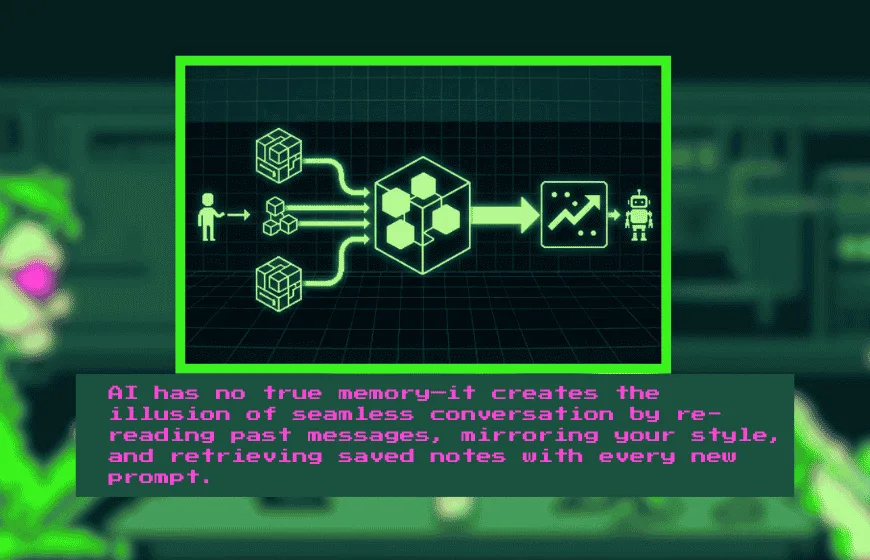
To make a conversation feel smooth, developers rely on three core mechanisms:
- The Active Context Window: The chat interface silently bundles past messages into every new prompt you send. The model reads the recent conversation history fresh each time, creating the illusion of continuity.
- Style Copying: Because the active text block contains your exact writing style, the model naturally mirrors your tone, vocabulary, and sentence length. If you type in brief sentences without capitalization, the model reflects that structure back to you.
- External Databases: For long-term interactions, platforms store notes or summaries on external servers. When you bring up a past topic, the system retrieves those saved notes and pastes them back into the active text block.
The Limitations of AI Imitation
Because this conversational flow relies on clever engineering rather than genuine memory, the illusion eventually cracks. Understanding these limits makes it much easier to spot a bot.
Sudden Forgetting
An active context window can only hold so much text before hitting a hard limit. When a conversation grows too long, older messages drop out of the active text block. The moment a detail falls outside that window, the AI completely loses track of it, suddenly forgetting a core fact it knew two turns ago.
Over-Imitation
AI models sometimes copy human conversational habits too intensely. Studies show that chatbots frequently over-use slang, hesitation markers, or emotional mirroring in ways that feel unnaturally intense. What starts as natural tone-matching quickly crosses into an uncanny valley where the bot mimics you too perfectly.
Key Takeaways
- No True Memory: AI chatbots do not possess biological memory; they reset after every output and rely on the chat app re-sending context.
- Style Mirroring: The natural human feel of an AI conversation comes from the model reading your own tone and structure inside the active context block.
- Context Drops: Long conversations cause older details to fall out of the active text window, leading to sudden memory loss.
- Uncanny Over-Imitation: AI often overuses human fillers and emotional cues, which can paradoxically reveal its artificial nature.
Frequently Asked Questions
Why does an AI companion feel like it remembers past conversations?
The chat application saves key summaries or recent chat logs in an external database and injects them into the active prompt behind the scenes.
What is an active context window?
An active context window is the maximum amount of text a language model can process in a single prompt, including both your newest message and previous dialogue history.
How can you tell if you are talking to a human or an AI in a quick chat game?
Watch for subtle cues like over-imitating your typing style, overly fast response times, or losing track of specific facts mentioned earlier in the exchange.