Humanoid Robots: Hype, Reality, and the Business Case for Physical AI
Humanoid robots are no longer confined to research labs or viral demo videos. Backed by billions in investment and rapid advances in physical AI, they are now entering warehouses, factories, and pilot deployments across industries. But beneath the headlines lies a more complex reality: adoption is slower, more expensive, and more constrained than the hype suggests.
This article takes a grounded, evidence-based look at humanoid robotics—what they can actually do today, where they are being deployed, and what must happen before they become commercially viable at scale.
What Are Humanoid Robots—and Why Do They Matter?
Humanoid robots are machines designed with a human-like body structure—two arms, two legs, and the ability to operate in environments built for people. The idea is simple: instead of redesigning factories, warehouses, or homes for robots, build robots that can adapt to human spaces.
This is where physical AI (also called embodied AI) becomes critical. Unlike software AI, which processes text or images, physical AI must interact with the real world—handling objects, navigating spaces, and maintaining balance.
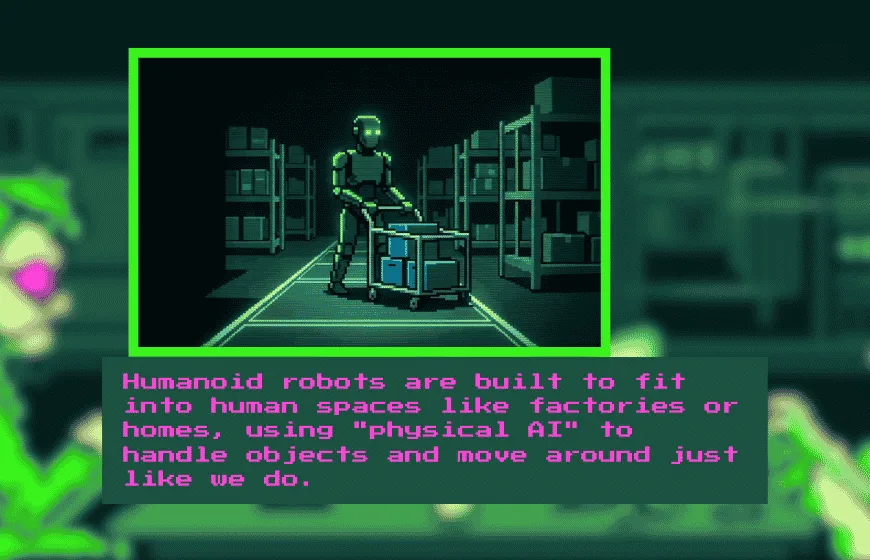
The appeal is clear. A single humanoid robot could theoretically perform multiple tasks across industries, from picking items in a warehouse to assisting in hospitals. But that flexibility comes at a cost—both technically and economically.
The Market Reality: Big Numbers, Long Timelines
The projected market for humanoid robots varies dramatically depending on the source.
- Goldman Sachs estimates a $38 billion market by 2035, with annual shipments reaching 1.4 million units.
- Morgan Stanley projects a far larger $5 trillion market by 2050, with over 1 billion robots deployed globally.
- Current market size remains small—roughly $2–3 billion today, highlighting how early the industry still is.
This gap between present reality and future projections is critical. It shows that humanoid robotics is not an immediate disruption but a long-cycle transformation, similar to the early days of industrial automation or cloud computing.
Morgan Stanley explicitly notes that adoption will remain slow until the mid-2030s, only accelerating once technology, cost, and infrastructure mature.
Where Humanoid Robots Are Actually Being Used Today
Despite the hype, real-world deployments are still limited—and highly controlled.
Current use cases include:
- Warehouse automation: Robots like Digit (Agility Robotics) are being tested for moving bins and handling repetitive logistics tasks
- Manufacturing: Early pilots in automotive plants for material handling
- Healthcare and elder care: Experimental support roles, not autonomous caregiving
- Teleoperation: Remote-controlled robots performing hazardous tasks
As of 2025, around 16,000 humanoid robots were deployed globally, with projections reaching 100,000 units by 2027.
This is important context: compared to millions of industrial robots already in use, humanoids are still a tiny fraction of the automation landscape.
Humanoid vs Industrial Robots: When the Human Shape Makes Sense
One of the most overlooked questions in the humanoid robotics debate is whether the human form is even necessary.
When humanoids make sense:
- Environments designed for humans (stairs, tools, narrow spaces)
- Multi-task roles requiring flexibility
- Situations where infrastructure cannot be easily modified
When they don’t:
- High-speed repetitive tasks
- Structured environments like assembly lines
- Tasks better handled by wheeled or fixed robots
This distinction is central to the industry debate. Many experts argue that task-specific robots are more efficient and profitable today.
As one industry perspective notes, the most productive robots are often those optimized for single, repeatable tasks—not general-purpose humanoids.
In other words: the first winners in automation may not look human at all.
The Real Bottleneck: Reliability, Not Intelligence
AI capabilities are advancing rapidly. Robots can now recognize objects, plan actions, and even learn from data. But intelligence alone does not solve the core problem of robotics.
The real bottleneck is physical reliability.
Challenges include:
- Dexterity: Handling fragile or irregular objects
- Balance and mobility: Navigating dynamic environments
- Battery life: Limited operational hours
- Error rates: Small failures can halt entire workflows
Even today, many humanoid robots still rely on teleoperation, where humans remotely guide actions.
This highlights a key insight:
A robot that works 95% of the time may still be unusable in a commercial setting.
For businesses, consistency matters more than capability. A slightly less intelligent robot that performs reliably can deliver far more value than an advanced system prone to failure.
The Economics: Total Cost of Ownership
The business case for humanoid robots depends on more than just purchase price.
Current estimates suggest humanoid robots cost roughly $100,000 per unit, though prices are expected to decline over time (industry estimates).
But the true cost includes:
- Maintenance and repairs
- Software updates and cloud infrastructure
- Human supervision or teleoperation
- Downtime and failure rates
- Battery replacement cycles
- Insurance and safety compliance
Goldman Sachs highlights that cost reduction—especially a 40% drop in materials—is essential for profitability.
Without significant cost improvements, humanoid robots struggle to compete with:
- Human labor (especially in emerging markets)
- Existing industrial robots
- Simpler automation systems
Safety, Regulation, and Workplace Integration
Deploying humanoid robots in real environments introduces regulatory and safety challenges.
Key considerations include:
- Human-robot interaction safety standards
- Liability in case of accidents
- Certification requirements for industrial use
- Workplace redesign for mixed human-robot environments
Unlike traditional industrial robots—which operate in isolated cages—humanoids are designed to work alongside humans. This increases both their potential and their risk.
Safety remains a major barrier to scaling deployments.
Cybersecurity and Privacy Risks
As humanoid robots become more connected, they introduce new risks:
- Cameras and sensors collecting sensitive data
- Cloud-based AI systems vulnerable to hacking
- Remote control (teleoperation) systems that could be compromised
These risks are particularly relevant in:
- Hospitals
- Homes
- Warehouses with proprietary data
Despite this, cybersecurity is rarely addressed in market forecasts—representing a major blind spot in the current narrative.
The “Robot Data Gap” Problem
One of the biggest technical challenges in humanoid robotics is the lack of real-world training data.
Unlike large language models, which can train on internet-scale datasets, robots must learn from physical interactions—which are slow, expensive, and difficult to scale.
This creates what many researchers call the robot data gap:
- Limited datasets for real-world manipulation
- High cost of collecting training data
- Difficulty transferring learning between environments
This gap slows progress in physical AI, even as software AI continues to advance rapidly.
ROI Benchmarks: What Needs to Happen Before Scale
A major missing piece in industry discussions is clear ROI thresholds.
For humanoid robots to scale beyond pilots, they must achieve:
- High uptime (near-continuous operation)
- Low error rates (<1–2% failure in critical tasks)
- Cost parity with human labor per hour
- Minimal supervision requirements
Until these benchmarks are met, most deployments will remain experimental.
This explains why, despite rapid progress, widespread adoption is still years away.
Labor Shortages: The Real Driver of Adoption
Interestingly, the strongest driver of humanoid robotics is not technology—it’s demographics.
- Aging populations
- Labor shortages in logistics and manufacturing
- Increasing demand for 24/7 operations
Humanoid robots are being positioned as a solution to jobs humans don’t want to do, rather than jobs humans cannot do.
This aligns with current deployments in:
- Warehouses
- Manufacturing plants
- Hazardous environments
The Bigger Picture: Humanoids vs the Robotics Ecosystem
Humanoid robots are only one part of a much larger automation trend.
The broader robotics market—including industrial robots and warehouse automation—is already well established and generating significant value.
Key insight:
Humanoid robots are the most visible part of automation—but not necessarily the most important.
In fact, much of the economic value will likely come from:
- Industrial robots
- Autonomous mobile robots (AMRs)
- AI-powered logistics systems
Humanoids may eventually play a role—but they are not the primary driver of automation today.
Is This a Bubble?
Not everyone is convinced that humanoid robots will live up to expectations.
Critics point to:
- Overly optimistic market projections
- Limited real-world performance
- High costs and slow deployment timelines
Even optimistic reports acknowledge that technical barriers—such as battery life, dexterity, and adaptability—remain unresolved.
This creates a tension between:
- Investor enthusiasm
- Operational reality
Understanding this gap is essential for anyone evaluating the space.
Practical, Not Inevitable
Humanoid robots represent a compelling vision of the future—but they are not yet a practical solution at scale.
Key takeaways:
- The market is growing—but still small
- Reliability and cost are the main barriers
- Most deployments are still pilots
- Simpler robots are solving real problems today
The most likely scenario is gradual adoption, starting with controlled industrial environments, before expanding into more complex use cases.
The Future May Not Look Human
The biggest misconception about humanoid robotics is that the human form is the end goal.
In reality, the future of automation will likely be a mix of:
- Specialized industrial robots
- AI-powered logistics systems
- Selective use of humanoid robots where flexibility is essential
Humanoid robots may become important—but they will need to prove their value in real-world economics, not just impressive demonstrations.
Until then, they remain a promising but unproven frontier in physical AI.
FAQs
1. Are humanoid robots currently being used in real-world jobs?
Yes, but usage is currently limited to controlled pilot programs. Roughly 16,000 units are deployed globally as of 2025, primarily in automotive manufacturing plants and logistics warehouses for tasks like material handling and moving bins.
2. How much does it cost to buy a humanoid robot in 2026?
Hardware estimates sit at approximately $100,000 per unit. however, the Total Cost of Ownership (TCO) is much higher when factoring in maintenance, software updates, cloud infrastructure, and the human supervision required for teleoperation.
3. Why is the "human shape" important for these robots?
The primary advantage is adaptability. Humanoid robots are designed to operate in environments already built for people—using stairs, narrow aisles, and existing tools—without requiring companies to redesign their entire infrastructure.
4. What is the "robot data gap" and why does it matter?
Unlike software AI that learns from the internet, robots need physical interaction data, which is slow and expensive to collect. This lack of real-world training data is a major bottleneck in making robots more autonomous and adaptable.
5. How do humanoid robots compare to traditional industrial robots?
Industrial robots are faster and more efficient at high-speed, repetitive tasks in caged environments. Humanoids are less efficient but more flexible, capable of performing multiple different tasks alongside human coworkers in dynamic spaces.
6. What are the main technical barriers to humanoid robot adoption?
The biggest hurdle is physical reliability, not just intelligence. Current challenges include limited battery life, difficulty with fine dexterity (handling fragile objects), and high error rates that can disrupt commercial workflows.
7. Is the humanoid robot market expected to grow?
Projections vary wildly; Goldman Sachs predicts a $38 billion market by 2035, while Morgan Stanley forecasts a $5 trillion market by 2050. Most experts agree that while the long-term potential is massive, widespread adoption won't accelerate until the mid-2030s.