Why the Human Brain Runs on 12 Watts While AI Burns Millions
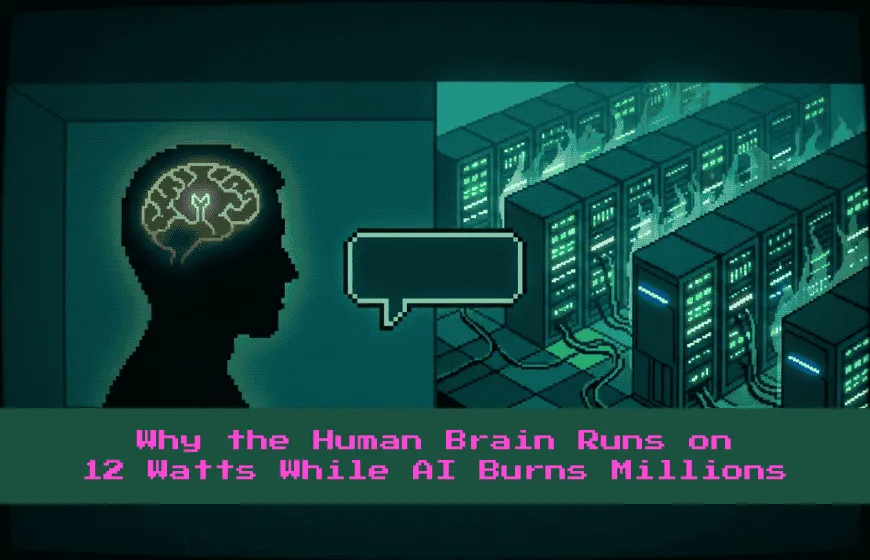
A Reddit post pointed out a strange fact: the human brain runs on about 12 watts of power. Some AI systems, when training, can reach billions of watts. The gap is enormous. But people still confuse AI for humans every day, especially in games like Human or Not. This contrast reveals something important. Power has nothing to do with how “human” something feels. Language does.
Quick Insights
- The human brain runs on about 12 watts, making it extraordinarily energy efficient.
- AI systems consume vastly more power, especially during training.
- People confuse AI with humans because we judge intelligence by language style, not energy use.
- Games like Human or Not reveal how easily tone and rhythm create the illusion of a “mind.”
- The real gap between humans and AI is not power, but awareness and subjective experience.
The Brain: A Quiet, Low-Power Machine Built for Thought
The brain works on the power of a small bulb. It handles memory, emotion, and problem-solving with almost no energy. It became this efficient through evolution. Each neuron fires only when needed. Each network learns to spend less energy over time. The result is a system that thinks, adapts, and feels with very little cost.
This efficiency is why we underestimate it. We do not sense the power running our thoughts. We only notice the outcomes: humor, empathy, attention, and instinct. These qualities form our idea of “mind.” They also shape how we judge others — and why we judge machines the same way.
AI Systems: Loud Machines That Mimic Calm Thought
AI does not think the way the brain does. It needs hardware that runs non-stop. It moves huge amounts of data through giant networks. It depends on racks of GPUs and cooling systems to stay operational. While these machines run, they burn real energy.
Despite this heavy machinery, the output often sounds simple and human: a quick joke, a warm reply, or a thoughtful sentence. The smoothness hides the scale behind it. A single response may represent millions of calculations. The “voice” seems human, but the process has no awareness behind it.
Why This Matters for Human or Not
In Human or Not, players try to guess whether they are talking to a person or an AI. Many feel certain they can tell. Yet the results often surprise them. A calm, warm reply convinces them it must be a person. A short or awkward answer makes them think it’s a bot. These reactions show something deeper than a guessing game. They reveal how we judge minds by style, not biology.
The brain uses 12 watts.
A bot may use millions.
But neither fact matters during a fast conversation.
People rely on tone, pacing, humor, and empathy. When these signals appear, the brain fills in the rest. It creates a sense of presence. It adds intention. It imagines emotion. The machine does none of this. It only predicts text. But prediction with the right rhythm feels like thought.
This is why the game works so well. It exposes how quickly humans assign “mind” to anything that speaks the right way.
Why We Still Confuse AI for People
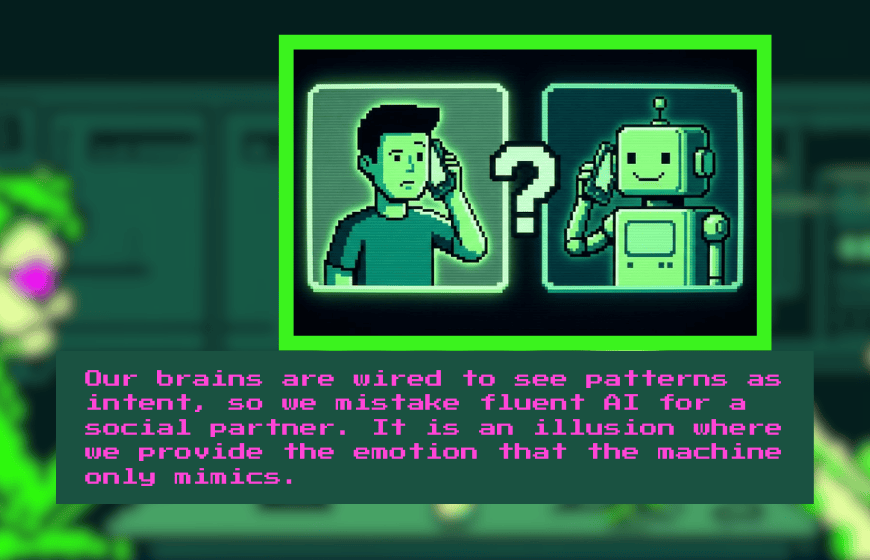
Language is powerful. When a model speaks fluently, we instinctively treat it as a social partner. We react to its warmth. We mirror its tone. We trust its confidence. These responses come from us, not the machine. The brain evolved to read social cues and respond to them. AI learned to generate the cues without feeling them. The mix creates an illusion of awareness.
This illusion grows stronger in short exchanges. A few convincing lines can outweigh all technical knowledge. Players may know how AI works, yet still guess wrong. They do so because the brain reacts faster than reasoning. It sees patterns and assumes intent.
What the Energy Gap Says About Our Future with AI
The difference between 12 watts and billions of watts raises questions about efficiency and sustainability. But it also highlights how little power has to do with our perception. A human mind runs on low energy and produces rich thought. A machine runs on massive energy and produces convincing imitation.
Future AI may become more efficient. Some researchers explore hardware that works more like the brain. Others focus on models that learn with less data. These changes may reduce cost but will not change the nature of the system. It will remain a tool, not a mind.
The human brain outperforms AI in energy efficiency by a huge margin. But AI still fools people in games like Human or Not. This shows that we judge intelligence through language, not watts. We trust the way something sounds more than the way it works. The challenge is not telling humans from bots. The challenge is understanding why the difference feels so small in conversation.
FAQs
How much power does the human brain use?
The human brain runs on roughly 12 watts of power, making it extremely energy efficient compared to large AI systems.
How much energy does AI consume?
During training, some AI systems can consume enormous amounts of electricity, sometimes reaching millions or even billions of watts across data centers.
Why do people still confuse AI with humans?
People judge intelligence based on tone, pacing, and language style. When AI mimics these cues well, it feels human in short conversations.
Does energy use determine intelligence?
No. Energy consumption does not directly determine how intelligent something feels. Perception depends more on communication style than power usage.
How does Human or Not reveal this confusion?
The game shows that players often rely on conversational cues rather than technical knowledge, leading them to misidentify bots as humans.
Is AI thinking like a human brain?
No. AI predicts text based on patterns in data. It does not possess awareness, emotion, or subjective experience like a human mind.
Will AI become as energy efficient as the human brain?
Researchers are working on more efficient hardware and models, but current AI systems remain far less energy efficient than the human brain.